Santa Maria di Piedigrotta: A Marian Church and Sanctuary in Naples


Site at a Glance
- Rating
- 4.7
- Popularity
- Low
- Country
- Italy
- Primary era
- Medieval
- External website
- Open
- Eras represented
- Medieval, Early Modern, Modern
- Civilizations
- Kingdom of Naples, Kingdom of the Two Sicilies
- Site type
- Religious
- Remains
- Church
On this page16 sections
History
Santa Maria di Piedigrotta is a Roman Catholic church and sanctuary in Naples, Italy, dedicated to the Nativity of the Virgin Mary. The present building was constructed in 1352 and 1353, on the site of a fifth-century church dedicated to the Annunciation, and it remains associated with the Archdiocese of Naples and the Canons Regular of the Lateran.
Early worship and foundation
A wooden image of the Virgin was already venerated at the earlier church. Records from 1316 refer to an annual Marian observance on 25 March, the feast of the Annunciation. In 1353, the Nativity of the Virgin became the sanctuary’s principal cult, celebrated on 8 September.
A foundation tradition relates that the Virgin appeared to three people and asked them to build a church. This religious tradition is separate from the historical evidence placing the construction of the present church in 1352 and 1353. The area also had older sacred associations. A nearby chapel dedicated to Santa Maria dell’Itria stood above an earlier shrine of Priapus, an ancient fertility deity mentioned in Petronius’ Satyricon. September rites involving dances and obscene songs around the god’s statue were later regarded as predecessors of the Piedigrotta festival. Archaeological discoveries also indicate that the area of the present church was used for the cult of Mithras, the central figure of a Roman-period mystery cult.
Lateran administration and royal connections
In 1453, King Alfonso of Aragon granted the church to the Canons Regular of the Lateran, a Catholic order of priests living according to a canonical rule and historically associated with the Lateran basilica in Rome. The principal entrance, originally situated near the high altar, was moved in 1506 to the facade facing the city. The church was restored in 1520, 1820, and 1853.
The sanctuary also became associated with major political and military events. In August 1571, Don John of Austria, commander of the fleet of the Holy League, prayed before the Madonna of Piedigrotta before the Battle of Lepanto, the naval victory in which the Holy League defeated the Ottoman fleet. He returned in October to give thanks after the battle.
Remodeling and modern religious life
The interior was remodeled between 1809 and 1824. In 1853, Ferdinand II of Bourbon commissioned the present facade, designed by Errico Alvino, while the restoration was financed by the Neapolitan aristocratic Capece-Galeota family. In 1912, Cardinal Prisco established the church as a parish. A restoration in the 1960s led to the Madonna’s tabard being placed in a display case.
The 8 September Piedigrotta festival is one of Naples’ oldest and most popular religious celebrations. It was observed with particular solemnity during Spanish rule, when the viceroys attended. A further celebration on 5 October combined the feast of the Rosary with the commemoration of Lepanto. During the nineteenth century, the festival included an important Neapolitan song competition that helped form and popularize the Neapolitan song tradition.
Claudio Gonzaga, son of Luigi Gonzaga of the Gonzaga di Palazzolo family, was buried in the church in 1586. After Italian unification, the cloister became part of a former Naval Military Hospital and is now administered by the Army. Santa Maria di Piedigrotta forms part of the historic center of Naples, which was inscribed as a UNESCO World Heritage site in 1997.
Remains
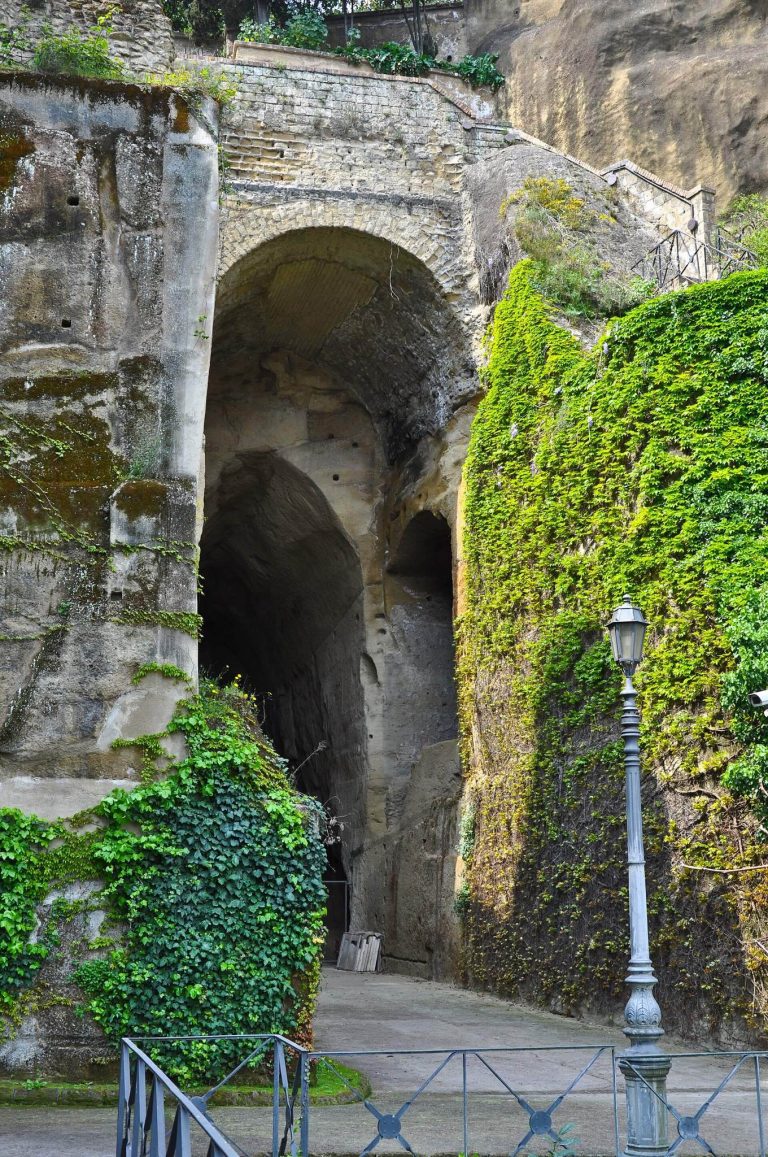
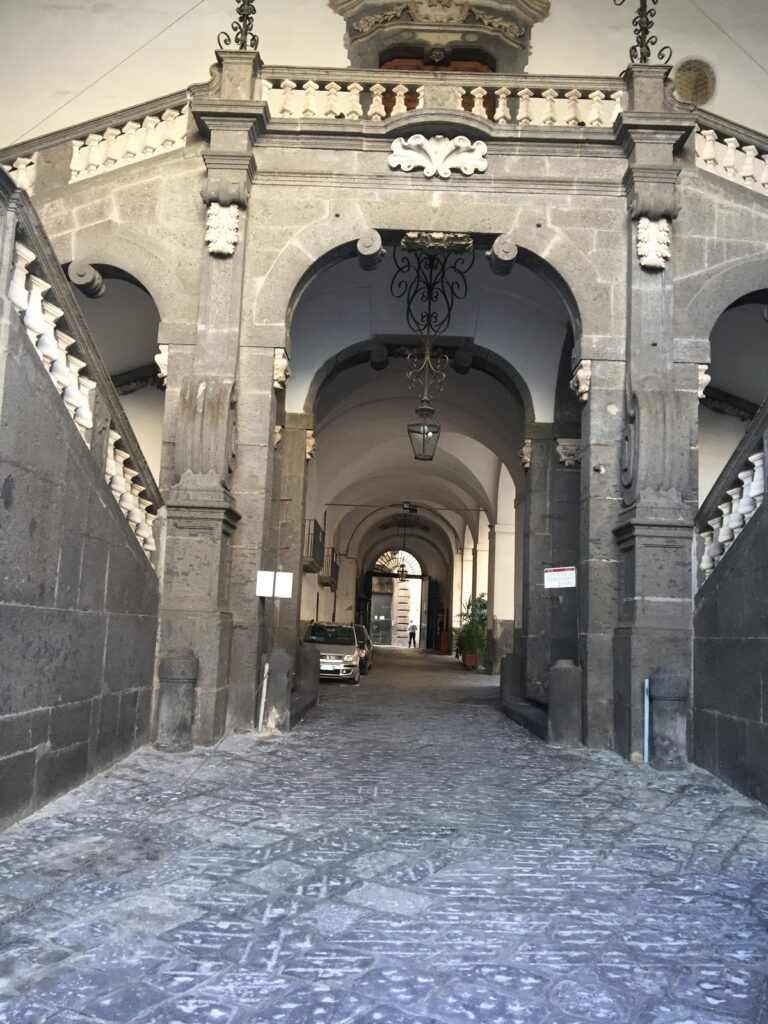
Santa Maria di Piedigrotta stands beside a rocky wall containing the Roman-period tunnel known as the Crypta Neapolitana. The name Piedigrotta means “at the foot of the grotto,” reflecting this physical setting. The surviving monastic complex includes the church, a communal monastic residence known as a cenobium, a pharmacy, rectory, bell tower, and cloister.
Facade and entrance
Facade sculpture
The present facade dates from 1853 and combines Renaissance and Gothic lines. Its tympanum, the central field within the pediment, contains a bas-relief of the Virgin. Alfonso of Aragon kneels on the left, Augustine of Hippo stands on the right, and Pope Nicholas V appears between them. Beneath the relief is the inscription “DEIPARAE VIRGINI NASCENTI SACRUM.”
Walnut portal
Bernardo Manco carved the walnut portal in 1853. Figures of the Four Evangelists, Peter, and Paul decorate it. The architrave above the doorway bears the emblems of the Lateran Canons, the Aragonese royal emblem, and the Capece-Galeota coat of arms. The portal also carries the inscription “UNA EX SEPTEM.” A fresco painted by Giacinto Gigante for the facade in 1853 has been lost.
Church interior
Nave and entrance works
The church has a Greek-cross plan, with four arms of roughly equal length extending from a central space, and a single nave. Eugenio Cisterna decorated the domes, while Gaetano Gigante frescoed the vault between 1818 and 1824. Gigante was a pupil of Giacinto Diano and the father of Giacinto Gigante.
An inscription to the right of the entrance commemorates Pope Pius IX’s visit on 15 September 1849. To the left, the baptistery is accompanied by Fabrizio Santafede’s Madonna di Piedigrotta con i santi Biagio, Ubaldo e Gennaro. Francesco Capobianco’s Visitation and Offering of Mary at the Temple flank Santafede’s painting.
High altar and choir
The high altar contains the painted wooden Madonna of Piedigrotta, attributed to the workshop of Tino di Camaino and dated 1339. A tabernacle, the liturgical receptacle used to reserve the Eucharist, was made by Pier Paolo Farinelli. The Madonna was adorned with two silver crowns in 1802.
Behind the high altar is a wooden choir dated 1525, containing twelve small statues of the Apostles. Beneath the central window is the Madonna’s tabard, a sleeveless outer garment associated here with the Marian image, now enclosed in a display case.
Transept and side chapels
The transept altar contains the painting Calvary, flanked by Risen Jesus and Mary Magdalene. The chapel dedicated to the Madonna of the Rosary of Pompeii contains a Crucifixion, Wenzel Cobergher’s Pietà with Anthony of Padua, and a Madonna of the Milk.
The Chapel of Saint Augustine contains Giuseppe Mancinelli’s The Death of Saint Augustine, flanked by Paolo Domenico Finoglia’s Marriage of the Virgin and Fabrizio Santafede’s The Risen Christ Appearing to the Virgin. The Chapel of Saint Lazarus contains works by Belisario Corenzio, including The Holy Trinity with the Madonna and Angels, the Evangelists, Healing of the Possessed Man, and Resurrection of the Boy of Nain.
Filangieri chapels
The Filangieri chapels are enclosed by an artistic wrought-iron gate bearing the family crest. Inside are monuments to Gaetano Filangieri and his son Carlo, made by Nicola Renda.
Rectory and cloister
Rectory and sacristy
The rectory contains an ex-voto, an object offered in fulfillment or acknowledgment of a vow, by Edoardo Dalbono after the healing of his wife. It also contains canvases attributed to Francesco Solimena, Mattia Preti, and Salvator Rosa. Other paintings and valuable furnishings are kept in the sacristy.
Cloister
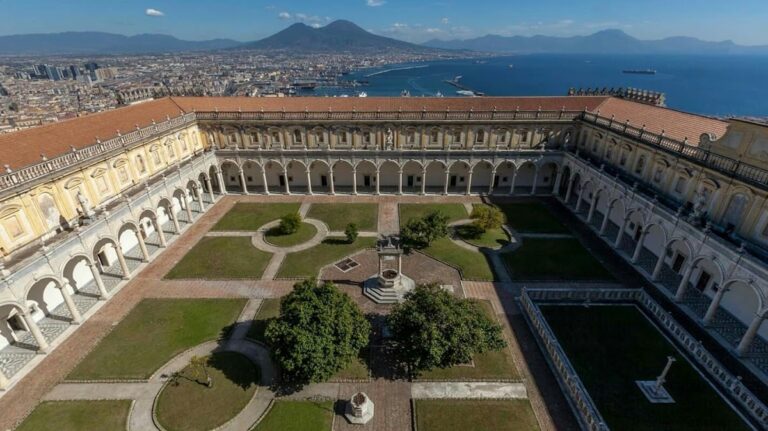
The ground floor of the cloister has a rectangular plan and is attributed to Tommaso Malvito. Onorato II Caetani commissioned it, and his family’s emblems decorate the marble capitals of the columns and the related corbels at the four corners. The cloister is a covered walkway surrounding an open courtyard and forms part of the complex’s surviving monastic architecture.