San Francesco Antonio Fasani: A Franciscan Church and Diocesan Sanctuary in Lucera


Site at a Glance
- Rating
- 4.9
- Popularity
- Low
- Country
- Italy
- Primary era
- Medieval
- External website
- Open
- Eras represented
- Medieval, Early Modern, Modern
- Civilizations
- Kingdom of Naples
- Site type
- Religious
- Remains
- Basilica
On this page21 sections
History
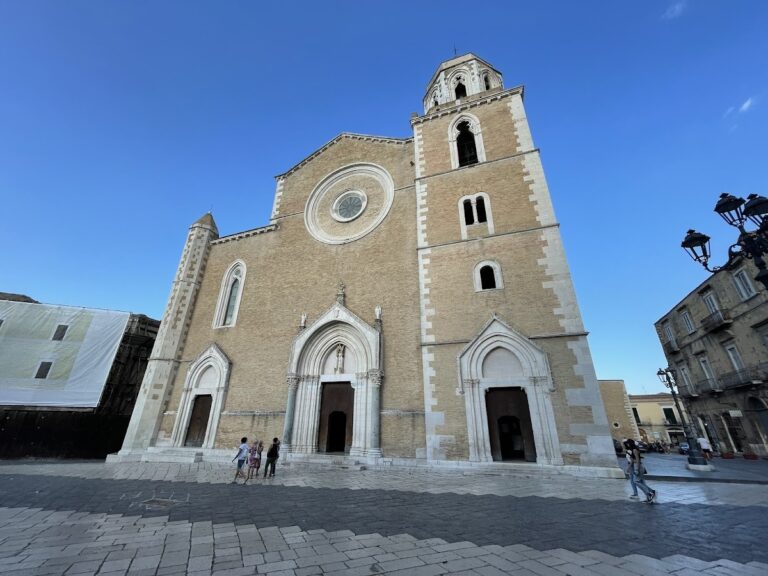
San Francesco Antonio Fasani is a Roman Catholic church in Lucera, Italy, built by the Christian community in the early fourteenth century in the Angevin Gothic style. Located on Piazza Tribunali in the historic centre, it was entrusted to the Order of Friars Minor and is associated with the Diocese of Lucera–Troia. Its history is closely connected with the Franciscan friar Francesco Antonio Fasani, whose body is preserved beneath the main altar.
Angevin Foundation
The church arose after Charles II of Anjou ended Lucera’s Saracen colony in 1300. Under his government, Christian institutions and monuments were restored or rebuilt in the city. The church dedicated to Saint Francis of Assisi was one of these foundations, and responsibility for it was given to the Friars Minor. The exact dates of its construction are uncertain, although the building belongs to the early fourteenth century.
Francesco Antonio Fasani
Francesco Antonio Fasani was born on 6 August 1681 and became closely associated with the church from the late seventeenth century into the early eighteenth century. A major preacher and a devotee of the Immaculate Virgin, the Catholic doctrine that Mary was preserved from original sin from the moment of her conception, he also supported poor and sick people in Lucera. Local people called him “Padre Maestro.”
Fasani established a soup kitchen and sought donations from the noble families Zunica, de Nicastri, Ramamondi, and Lombardi. He also commissioned the sculptor Giacomo Colombo to create wooden statues of the Immaculate Virgin and Saint Francis. Both works remain in the church.
Earthquake, Restoration, and Burial
An earthquake on 20 March 1731 seriously damaged the church and destroyed its altars. Fasani directed the restoration of the building, which was reconsecrated in 1739. He died on 29 November 1742 with a reputation for holiness and was buried in a tomb inside the church.
Following his beatification by Pope Pius XII on 15 April 1951, Fasani’s remains were exhumed, treated with wax, and transferred beneath the main altar. He was canonized in 1985, and Pope John Paul II visited Lucera the following year to venerate his body.
Convent and Modern Religious History
The convent built beside the apse was affected by the suppression of religious orders in 1809. It initially housed an archive and the notarial chamber before most of it was incorporated into Lucera’s judicial prison. On 16 November 2010, Fasani’s former cell returned to the convent after 144 years under prison administration. He had lived in that cell for 35 years and died there.
A major renovation between 1936 and 1943 restored the church, including the reconstruction of its rose window in 1943. Further work from 2002 to 2005 renewed the apse area and bell tower and restored the frescoes. In 1956, Father Bernardino Nonni founded the periodical Padre Maestro, which continues to be produced by friars of the Franciscan convent.
In 2001 the church became the Diocesan Sanctuary of Saint Francis Antonio Fasani, a designation for a church recognized by its diocese as a place of special devotion. In 2008 it was declared a UNESCO “Monument Witness to a Culture of Peace.” It received the title of minor basilica, an honorific Catholic designation for churches of particular religious or historical importance, on 11 May 2012; the title was formally proclaimed on 29 November that year in the presence of Cardinal Giuseppe Bertello.
The “Fasanian Jubilee Year” opened in Lucera on 29 November 2010 and closed on 29 November 2011, commemorating the twenty-fifth anniversary of Fasani’s canonization. During that year, a plenary indulgence could be received at the sanctuary. The church remains a place of devotion centred on Fasani’s altar and relics.
Remains
Gothic Exterior and Nave
Facade and Portals
The church has a gabled facade in the Angevin Gothic style, a regional form of Gothic architecture associated with Angevin rule in southern Italy. Its Gothic portal is linked with Angevin heraldry, while the lateral portal beside the gardens of Piazza Tribunali is surmounted by a lamb. The facade is crowned by a sixteen-rayed rose window, a large circular window with radiating divisions, reconstructed in 1943.
Nave and Dividing Portal
Inside, a single broad and very tall nave extends beneath a timber truss ceiling. Four pointed-arch windows light the space, and traces of fifteenth-century frescoes survive high on the walls. An 18-metre portal made of Tiburtine stone separates the nave from the apse, forming a substantial architectural boundary between the main body of the church and its terminal sanctuary area.
Altars and Interior Artworks
Sandstone Altars
Five eighteenth-century sandstone altars line the nave. On the left, viewed from the entrance, are the altar of Saint Francis of Assisi, dated 1713, the altar of Jesus Crucified, dated 1600, and the altar of Saint Anthony of Padua, dated 1943. On the right are the altar of Ecce Homo, dated 1600, and the altar of the Immaculate Conception, dated 1718.
The wooden statues of Saint Francis of Assisi and the Immaculate Conception were made by Giacomo Colombo. The Ecce Homo is attributed to Aniello Stellato, a sculptor associated with southern Italian religious art, while the other altars contain wooden statues of venerated saints. The pulpit incorporates the ancient sarcophagus of the noble knight Santa, dated 1555.
Counterfacade Paintings
The counterfacade, the interior wall opposite the main facade, contains two eighteenth-century paintings by Girolamo Cenatiempo of the Neapolitan school. One shows Saint Januarius with Saint Bonaventure and Saint Clare. The other represents Our Lady of Providence with Saint Elizabeth of Thuringia-Hungary and Saint Rose of Viterbo. Beneath the rose window is a painting of Fasani’s glorification, associated with his beatification.
Two additional paintings are positioned above the lateral portal and above the door to the Chapel of Our Lady of Sorrows. They depict miracles attributed to Fasani in connection with his canonization. A glass cabinet preserves his worn clothing and his cilice, a penitential garment or device. His original burial place is beside the Saint Francis altar.
Apse and Fasani’s Relics
Gothic Apse
The apse, the terminal area of the church that contains the principal altar, has a pentagonal plan and is lit by three Gothic windows. Beneath the right-hand window, a florid Gothic biforium, a window divided into two openings, frames an Annunciation dating from the late fourteenth century.
The apse frescoes include a double Crucifixion, an Annunciation, and two popes in the lower register. Other scenes show Saint Catherine of Alexandria, Saint Anthony Abbot, and Saint Margaret of Antioch. The upper register represents episodes from the life of Saint Francis of Assisi.
Reliquary Altar
At the centre of the apse, beneath an altar dated 1942, a bronze urn contains the relics of Francesco Antonio Fasani. His remains are arranged within a wax statue, making the relics visible beneath the altar and preserving the principal devotional focus of the sanctuary.
Chapel and Convent Rooms
Chapel of Our Lady of Sorrows
A small door in the left wall leads to the Chapel of Our Lady of Sorrows. Its apse contains statues of the Crucified Christ, the Dead Christ, and Our Lady of Sorrows. On the right wall is a large painting of the Exaltation of the Cross, dated to the late sixteenth or early seventeenth century, together with a niche containing a wooden statue of Fasani dated 1951. The left wall has a niche with a statue of the Sacred Heart of Jesus.
A doorway connects the chapel with the premises of the Archconfraternity of the Holy Cross, Our Lady of Sorrows, and the Holy Trinity. An archconfraternity is a confraternity authorized to affiliate or aggregate other confraternities.
Sacristy and Former Convent
A doorway beside the Saint Anthony of Padua altar leads to the sacristy, which contains additional paintings and connects with the adjacent convent of the Conventual Friars Minor. This branch of the Franciscan order is responsible for the neighbouring convent.
Most of the former convent is now incorporated into Lucera’s prison. The portion retained by the Franciscan community includes the refectory and the Fasani Hall, once part of the convent cloister portico. Several paintings, many of them depicting Fasani, are preserved there. On the first floor are the friars’ cells, including Fasani’s former cell, which returned to the convent in 2010.
Memorials in Lucera
Piazza Tribunali Monument
On 13 June 1983, a monument to Fasani was inaugurated in the centre of Piazza Tribunali beside the church. It consists of two bronze sculptures, one representing the Blessed Fasani and the other the Immaculate Virgin.
Birthplace Oratory
A bronze statue of Fasani made in 2000 stands in the square in front of his birthplace on Via Torretta. The house was donated to the diocesan curia by the Tandoja heirs and converted into a small oratory, which became a destination for devotees making pilgrimages in his honour.