St. Peter: A Collegiate and Parish Church in Bonn


Site at a Glance
- Rating
- 4.4
- Popularity
- Very Low
- Country
- Germany
- Primary era
- Medieval
- External website
- Open
- Eras represented
- Medieval, Early Modern, Modern
- Civilizations
- German, Holy Roman Empire
- Site type
- Religious
- Remains
- Church
On this page8 sections
History
St. Peter is a Roman Catholic parish church in Bonn, Germany, whose origins lie in a large three-aisled collegiate and pilgrimage church built between 1020 and 1050. A collegiate church served a college of clergy or religious women rather than a cathedral. At St. Peter, the church belonged to the originally Benedictine women’s monastery at Vilich and later, from 1488, to a free noble secular collegiate foundation, an institution whose members were not normally bound by monastic vows and came from the nobility.
The Vilich foundation
St. Peter served as the foundation’s collegiate church until the foundation was dissolved. Several nearby parish churches were incorporated into its institution, and their clergy were assigned particular duties at St. Peter. St. Paul, first mentioned in 1144, stood within the foundation’s immunity, an area belonging to an ecclesiastical institution and enjoying special legal and administrative privileges. Other incorporated churches included St. Gallus in Küdinghoven, St. Remigius in Königswinter, St. Cecilia in Oberkassel, St. Michael in Niederdollendorf, and St. Lawrence in Oberdollendorf. These churches shared related choir-tower arrangements, in which the lower part of a tower contains the choir bay.
The foundation’s church was enlarged in the early thirteenth century. Between 1208 and 1222, builders who had previously worked on Bonn Minster added the small Adelheidis Choir to the south side of the earlier building. Around 1270 to 1280, the women of the foundation commissioned a new Gothic choir modeled on the contemporary construction of Cologne Cathedral. The scale of this project placed the foundation under severe financial pressure. Intervention by the Archbishop of Cologne secured its continued existence.
War, rebuilding, and parish use
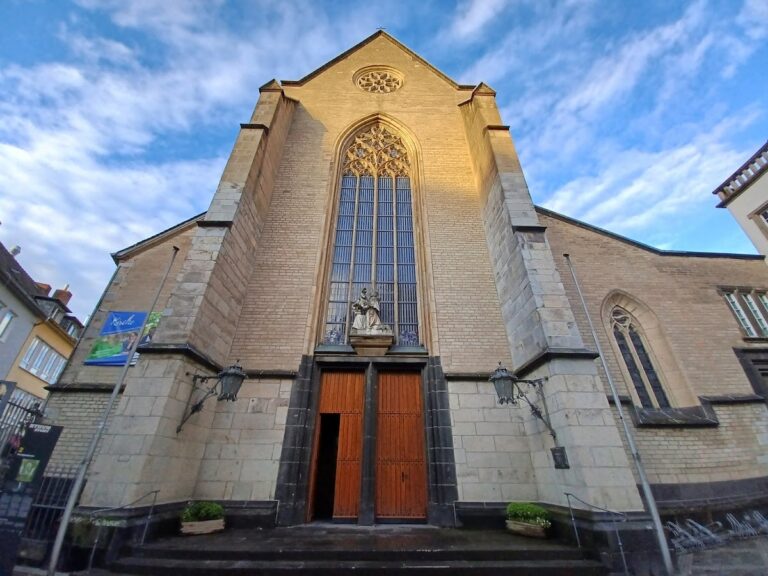
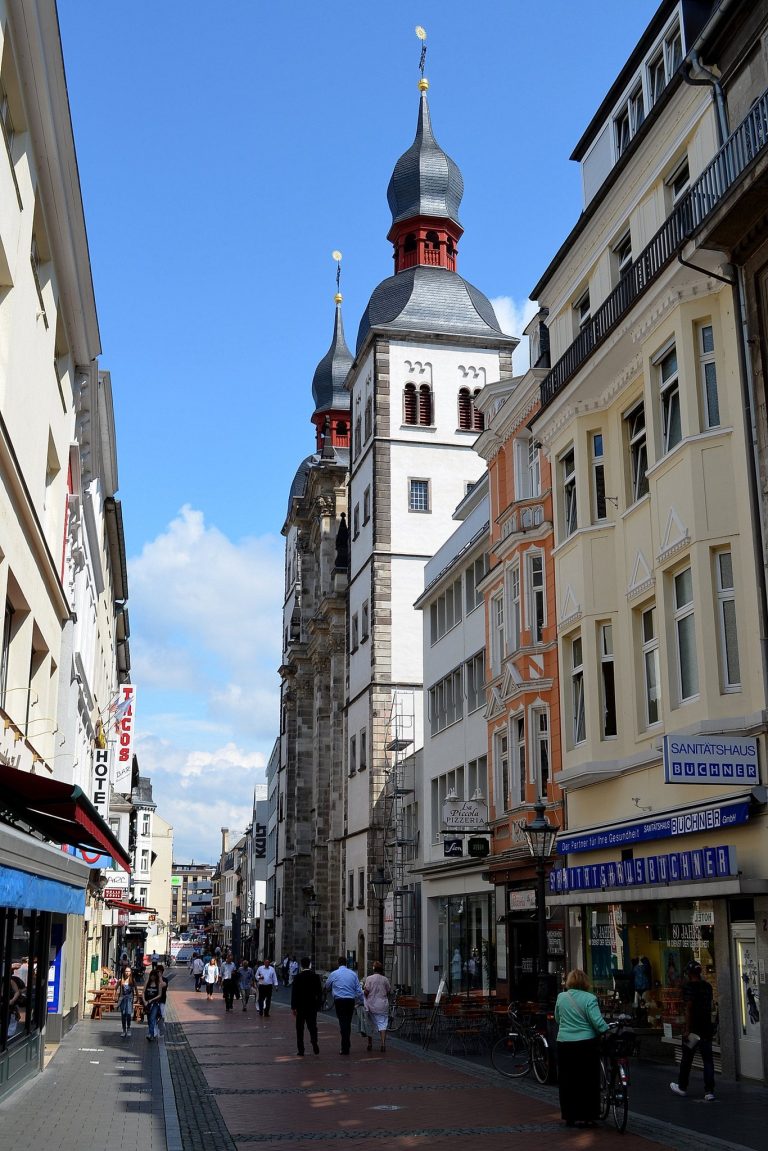
Wars in the sixteenth and seventeenth centuries damaged the church. Around 1650, the nave was partly demolished, and a new west wall was built for the shortened building. Shortly before 1700, a large west tower was raised in the area formerly occupied by the central nave. This tower established much of the church’s later external form.
St. Peter suffered heavy war damage on 18 October 1944, but its overall form from around 1700 was largely preserved. The neighboring church of St. Paul collapsed in a flood in 1765, and its baptismal font was later transferred to St. Peter. The Vilich foundation itself was dissolved on 27 February 1804, after which St. Peter became the place of worship of the parish community. The church is listed as an architectural monument in the City of Bonn’s heritage register under number A 1291.
Remains
Medieval church fabric
The surviving building preserves two bays of the former nave, with angular, austere piers that recall the earlier three-aisled church. Rows of piers and arches once continued westward to the boundary wall of the present church forecourt. Parts of the original long nave survive in the form of a garden wall. On the south side stands the small Adelheidis Choir, added between 1208 and 1222, while the later Gothic choir belongs to the enlargement undertaken around 1270 to 1280. The large west tower, built shortly before 1700 in the area of the former central nave, remains a landmark of Vilich and dominates the shortened church’s surviving arrangement.
Memorials, relics, and furnishings
Little of the original interior furnishing survives. The oldest surviving object is a Romanesque grave slab in the right side choir. Its carved design shows a six-leaved plant interpreted as the Tree of Life, a religious symbol associated with life, renewal, or salvation, with a cross forming the upper flower. The slab probably belonged to Abbess Elisabeth, who built the Adelheidis Choir.
The right side choir also contains the oldest Vilich reliquary of Adelheidis, a vessel made as a monstrance to display a consecrated Eucharistic host while preserving the saint’s association with the church. This late Gothic goldsmith’s work was restored during the Rococo period. Several portraits of Adelheidis appear in the interior, and a reliquary bust of her at the high altar was mentioned around 1650 by Johannes Bollandus, a seventeenth-century Jesuit scholar known for his work on the lives of saints.
A Baroque recumbent figure lies on a sarcophagus in the Adelheidis Choir. The red-stone sarcophagus beneath it is much older. It was rediscovered and raised in 1872, when it was combined with the recumbent figure. Together, the memorial and the older stone preserve a later funerary presentation connected with Adelheidis of Vilich, the medieval abbess venerated at the foundation as a saint.
The Romanesque-inspired baptismal font from St. Paul was moved to St. Peter after the neighboring parish and baptistery church collapsed in 1765. Its presence preserves a material connection between the two churches and the former institutional landscape of Vilich.
Stained glass and organ
Numerous stained-glass windows were created by Walther Benner between 1959 and 1966, contributing to the postwar interior of the church. The present organ was built by Rieger Orgelbau of Schwarzach in Vorarlberg from a disposition prepared by Josef Zimmermann, then organist at Cologne Cathedral. It has two manuals, a pedal, and 30 stops. Its stop action is electric, while its key action is mechanical, and the two reed stops of the main division are horizontal reeds. Weimbs of Hellenthal restored the instrument in 1997 and 1998, and Schulte of Kürten installed a modern combination setter system in 2008. Its playing aids include the standard couplers II/I, I/P, and II/P, together with a combination setter, tutti, and canceler.
The four bells
Four bells hang in the massive west tower. The large bell probably came from a predecessor building, although its location before the present tower was erected is unknown. It has been welded twice and has an unusually austere tone. Between pairs of round ribs, a one-line Gothic majuscule inscription, a medieval monumental letterform, honors Saint Margaret, gives the year 1412, and includes the Hail Mary. The inscription identifies Master Joiris as its caster.
The previous three-bell peal was destroyed during the Second World War. Its bells had been cast in 1643, 1792, and 1808. After the war, a replacement bell from Geislar and a loan bell from former East Prussia were installed. The loan bell has a very slender profile resembling the early medieval sugarloaf form, a narrow bell shape associated especially with eleventh- and twelfth-century design. Its overtone structure includes a prime lowered by a fourth and a minor sixth as an undertone, producing three lowest principal tones that form a six-four chord in A-flat minor. Its shape probably derives from an earlier bell copied by its caster, Michael Dornmann. The small Mary bell also came from Geislar, while a bell made specifically for St. Peter was cast in 1965.