Ermita de Nuestra Señora de los Hitos: A Historic Chapel in Alcántara, Spain

Site at a Glance
- Rating
- 4.8
- Popularity
- Very Low
- Country
- Spain
- Primary era
- Medieval
- Eras represented
- Medieval, Early Modern, Modern
- Civilizations
- Crown of Castile, Spanish
- Site type
- Religious
- Remains
- Chapel
On this page10 sections
History
Ermita de Nuestra Señora de los Hitos is a medieval-origin chapel in Alcántara, Spain, known to have existed by 1235. The present building is an eighteenth-century Baroque reconstruction, but the sanctuary’s religious importance reaches back to the thirteenth century. It is dedicated to the Virgin of Los Hitos, a Marian devotional title and image whose figure serves as patron of Alcántara, Mata de Alcántara, and Villa del Rey.
Medieval sanctuary
A local tradition holds that shepherds found the image of the Virgin in a nearby holm oak. This story explains the choice of the site for the medieval sanctuary and remains part of the chapel’s religious identity. During the thirteenth and fourteenth centuries, the chapel was an important place of worship.
The sanctuary is also associated with Martín Yáñez de la Barbuda, a late fourteenth-century master of the Order of Alcántara. This medieval military-religious order operated in the Iberian Peninsula. According to the tradition surrounding the chapel, its hermit persuaded Yáñez de la Barbuda that he could reconquer Granada. The master later died fighting Andalusi forces.
The replacement chapel and proposed convent
At the end of the fourteenth century, the earlier masonry chapel was replaced by a new structure built in ashlar masonry, using carefully cut stone blocks. The work was completed in 1402. The chapel’s location later attracted the friars of the Order of Alcántara, who sought a more secluded setting for a new convent in the late fifteenth century.
The foundation stone of the convent was laid in 1499. Its small size and uncomfortable conditions, however, made the establishment unsuitable for the community. From 1506, the friars abandoned it and settled instead at the Convent of San Benito.
Destruction and reconstruction
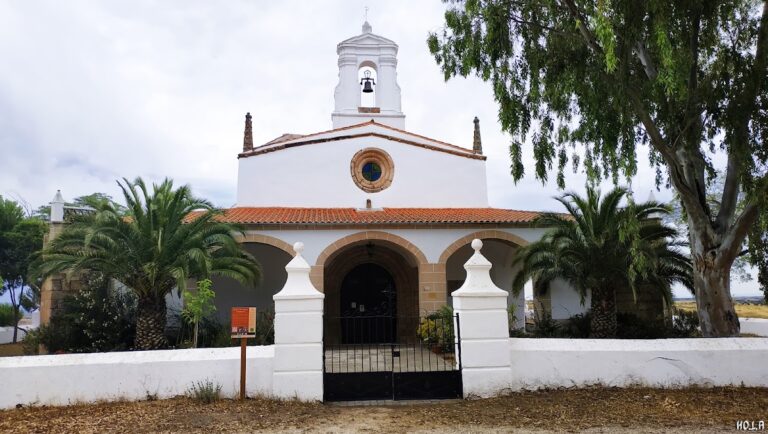
The medieval chapel was destroyed in the eighteenth century when a powder magazine installed inside it exploded during the wars against Portugal. The present chapel was reconstructed in 1768 and underwent restoration during the second half of the nineteenth century. Its form therefore belongs chiefly to the period after the medieval building had been lost.
The chapel depends on the parish of Santa María de Almocóvar in the Diocese of Coria-Cáceres and is administered by the Brotherhood of Our Lady of Los Hitos. Under the old-regime system, the town council exercised direct patronage and appointed a steward each year.
Traditions and archaeological interpretations
Ermita de Nuestra Señora de los Hitos is the setting for Alcántara’s pilgrimage festival. Held on the Saturday nearest 25 March, the Feast of the Annunciation, the Christian celebration of the announcement to Mary that she would bear Jesus, the event follows a nine-day novena in the town. The rural celebration lasts throughout the day around the chapel. Mass is celebrated at a temporary outdoor altar, and the proceedings begin with an auction in which residents bid for the honour of carrying the Virgin’s image.
Every five years, in years divisible by five, the celebration expands as the image is brought down to the town. This practice dates from the middle of the twentieth century and is established in the brotherhood’s statutes.
Because the present chapel replaced an earlier building, some theories propose that the site had a pre-Christian origin. The interpretation is partly linked to the meaning of “Hitos,” understood as referring to stones set upright in the ground. The area has consequently been associated with Roman milestones and, more tentatively, with a pre-Roman archaeological complex.
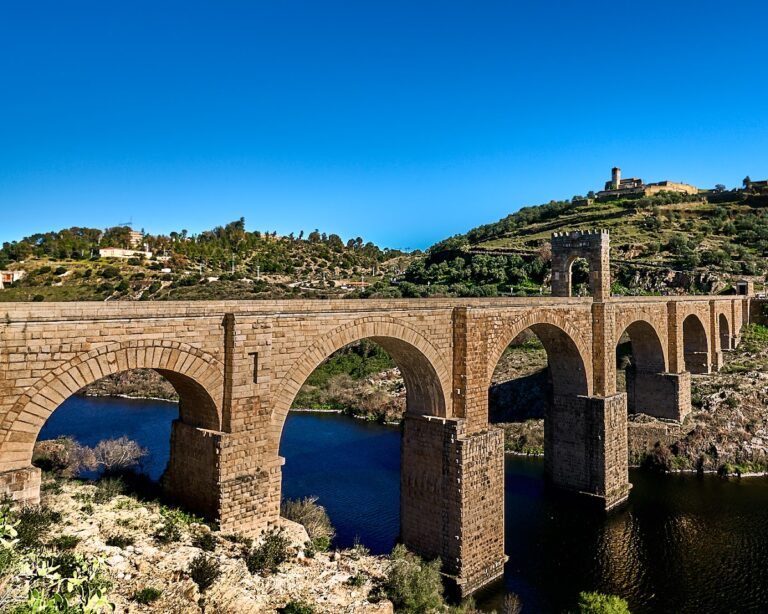
One Roman hypothesis places a road near the chapel that connected the Via de la Plata with the Bridge of Alcántara. Its exact route is difficult to establish because later routes used for transporting wool followed similar paths, but foundations belonging to a clearly Roman road have been found near the sanctuary.
A former local custom has also encouraged a possible prehistoric interpretation. Until the 1930s, residents built a large mound of stones around the chapel, which was later dismantled for road construction. A twentieth-century local legend said that the mound covered the place where the Virgin’s crown had fallen when the medieval chapel exploded, so that nobody would walk on it. The practice resembles the Galician tradition of amilladoiros, stone mounds formed when visitors to a sanctuary add stones during a pilgrimage. The mound probably originated in prehistoric rites associated with the area.
Modern recognition
The chapel was considered for designation as an Asset of Cultural Interest between 1982 and 1991. This proposed heritage status reflected the combination of its medieval religious history, eighteenth-century reconstruction, continuing devotional use, and archaeological associations.
Remains
The Baroque chapel
The present chapel is a simple Baroque building constructed mainly from slate rubble masonry, with granite ashlar blocks reinforcing the corners. Its plan takes the form of a Latin cross, with a long central axis crossed by shorter arms. A porch with semicircular arches and a gabled roof marks the principal entrance. Within the porch, a niche contains an alabaster image of the Virgin.
Inside, a single nave is divided into three bays and covered by a barrel vault, a continuous semicircular ceiling, with lunettes formed by smaller curved sections intersecting it. The crossing carries a dome supported by pendentives, curved triangular elements that allow a dome to rest above a square or polygonal space. A chamber for the devotional image is attached to the chapel, while the space below the choir has groin vaulting formed by the intersection of two vaults.
Images and furnishings
The principal altarpiece is a twentieth-century Neo-Gothic work, drawing on medieval Gothic forms. The Virgin of Los Hitos occupies its central niche, flanked by two plaster images. On the epistle side, the right-hand side when facing the altar from the nave, stands an eighteenth-century image of Saint Anthony. In 2005, an act of vandalism removed the Christ Child that the statue held in its arms.
Wayside cross
A wayside cross stands in the chapel’s surroundings on three circular steps. It consists of a plain cylindrical column with a clustered base and capital. The cross is believed to date from the reconstruction of the chapel around 1768. Its crowning cross imitates, in small scale and in stone, the metalwork decoration characteristic of Baroque processional crosses of that period. The monument is now seriously deteriorated.