San Michele, Oleggio: A Romanesque Church and Cemetery Church in Italy


Site at a Glance
- Rating
- 4.7
- Popularity
- Very Low
- Country
- Italy
- Primary era
- Medieval
- External website
- Open
- Eras represented
- Medieval, Early Modern
- Civilizations
- Holy Roman Empire, Italian, Lombard
- Site type
- Religious
- Remains
- Church
On this page16 sections
History
San Michele, Oleggio is a Roman Catholic church in Italy, probably built around the middle of the eleventh century in the Romanesque tradition over an earlier Lombard church. Dedicated to Saint Michael the Archangel, it is regarded as one of the principal examples of Romanesque art in the Novara area because of its architecture and fresco cycles.
An Earlier Church and the Eleventh-Century Basilica
A church dedicated to Saint Michael at Oleggio appears in a record from 973. Archaeological excavations carried out in 2001 revealed the remains of an earlier church beneath the present building. This predecessor was Lombard in origin, linking the site to an earlier medieval phase before the construction of the stone basilica.
The present church was probably erected around the middle of the eleventh century, likely replacing the earlier place of worship. It is generally assigned to the tenth or eleventh century, while its Romanesque frescoes belong mainly to the second half of the eleventh century. The Last Judgment on the counter-facade is dated to about 1060. The building’s painted decoration reflects a confident knowledge of Byzantine artistic traditions, although the patron who commissioned the cycles is unknown.
From Pleban Church to Parish Church
In 1133, a letter from Pope Innocent II to the bishop of Novara mentioned San Michele. By that time, the church had become a pleban church, meaning a baptismal and pastoral center serving a wider local district. In 1347, Bishop Guglielmo da Cremona identified it as the parish church of Oleggio.
Its parish role later passed to a new church built within the ancient fortified settlement. San Michele consequently declined in local importance and had lost its parish function by the sixteenth century. It was retained as a cemetery church, a role that it continues to hold. The building gradually deteriorated, but maintenance interventions allowed it to survive.
Frescoes, Conservation, and the Cult of Saint Michael
The interior paintings were first discovered in 1897. Restoration and conservation during the following century brought additional painted areas to light and helped preserve the church’s complex sequence of decoration. The cycles include scenes connected with the medieval cult of Saint Michael and draw on the Liber de apparitione sancti Michaelis in Monte Gargano, an early medieval Latin account of the archangel’s apparition at Monte Gargano in southern Italy.
Among the scenes are the story of a shepherd who shot an arrow at a bull, only for the arrow to return miraculously and strike him. Another image shows armed people from Sipontum, an ancient city in southern Italy, led by Saint Michael against the Neapolitans. These subjects connect the decoration with Saint Michael’s role as a protector and heavenly warrior in Christian tradition.
Remains
San Michele is a small basilical church, meaning a longitudinal building divided into a central nave and two lateral aisles. It retains an archaic Romanesque character, with masonry made from alternating river pebbles and brick. This combination creates a distinctive polychrome surface across the building. The surviving structure, crypt, and painted decoration preserve several layers of medieval and later religious use.
Exterior and Plan
The stepped, gabled facade expresses the division of the interior into three naves. Lesenes, narrow vertical strips of masonry, divide the facade into panels and meet hanging brick arches. Its arrangement is asymmetrical. The side naves are different in size, and the entrance lies away from the longitudinal axis, probably because the builders adapted the structure to the masonry of the earlier church.
The facade was later altered by a window in the area of the southern nave. It opened toward an ossuary built in 1710 and demolished at the beginning of the twentieth century. The side walls carry brick lesenes and hanging arches, together with narrow windows whose openings flare strongly outward. The central apse and the two smaller apses continue the same restrained decorative treatment.
Interior and Subterranean Structure
Naves and Presbytery
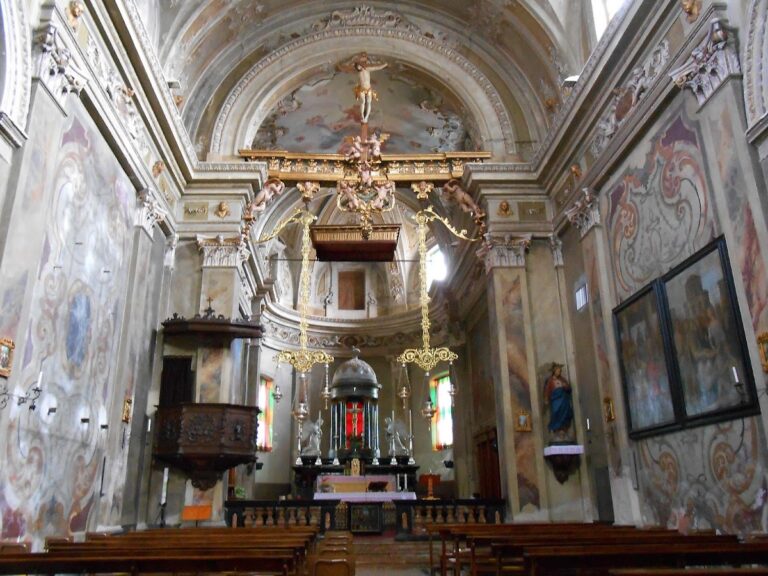
Inside, the central nave rises higher and extends more broadly than the two lateral naves. Rectangular piers without bases or capitals divide the spaces, and round arches link the piers along the length of the church. All three naves retain truss roofs. The presbytery, the area reserved for the altar and clergy, stands above the main floor and is reached by two paired stairways, each containing nine steps.
Crypt
A crypt, a chamber below the main floor often used for burial or the veneration of sacred remains, lies beneath the presbytery. Entrances open from the lateral naves. Rough columns divide the crypt into three small aisles. Some columns are square and others octagonal, and they have neither bases nor capitals. Above them, a low groin vault with pronounced ribs demonstrates considerable constructional skill for the period.
Romanesque Painted Decoration
Counter-Facade and Lateral Walls
The counter-facade contains a large Romanesque Last Judgment. Christ the Judge occupies the center, although his figure is now almost completely illegible. The upper register includes angels, saints, and the Virgin Mary, while the second register presents the Apostles. Beneath them are bust-length ecclesiastical dignitaries and monks.
Beside the entrance, three patriarchs hold the souls of the blessed beneath suspended crowns. The corresponding scene of the damned on the opposite side has been completely lost. Romanesque paintings also survive on the lateral walls near the counter-facade. The right wall shows an urban scene interpreted as either the discovery or the translation of a saint’s body. Fragments on the opposite wall include an image of Our Lady of Sorrows. Geometric designs and symbolic animals, including peacocks and deer, accompany the sacred scenes.
Central Apse
The central apse preserves a damaged but faintly legible Christ Pantocrator, an image of Christ as the all-powerful ruler, enclosed within a mandorla, the almond-shaped frame surrounding a sacred figure. Saint Michael the Archangel appears beside him, leading a company of angels. Traces of the richly dressed Virgin Mary remain, and her representation follows Byzantine artistic conventions.
Beneath ribbons and floral decoration, the apse contains scenes from the Liber de apparitione sancti Michaelis in Monte Gargano. Some of these paintings are intermixed with remnants of frescoes added in the late fifteenth century. The lower scenes include the shepherd and bull episode, the battle between armed people from Sipontum and the Neapolitans, a group of ten armed knights, and a mother with a child.
Right Apse
The right apse contains another Christ Pantocrator within a mandorla supported by angels. Deacons occupy the lower register, with six figures described in the surviving apse imagery. Together with the central apse paintings, this decoration forms part of the church’s extensive medieval program devoted to Christ, Saint Michael, and the sacred narratives associated with the site.
Later Paintings
High Altar and Central Pier
Above the archaic high altar is a Crucifixion dated 1587. The composition includes the Virgin Mary, Mary Magdalene, Saint John the Evangelist, and Saint Michael the Archangel. A Resurrection of Christ on one of the central-nave piers dates from the late fifteenth or early sixteenth century. It is attributed to the Novara workshop of the Cagnola family, specifically Francesco, the son of the workshop’s founder.
Painting of Saint Michael
The first pier on the right when entering the church bears a painting of Saint Michael the Archangel by Johannes Maria de Rumo. A painter of Polish origin, he adopted Oleggio as his home and was active around the middle of the sixteenth century. His work adds a later layer to the church’s long sequence of images devoted to its patron saint.