Church of San Francesco in Matelica: A Franciscan Church and Renaissance Art Treasury


Site at a Glance
- Rating
- 4.5
- Popularity
- Very Low
- Country
- Italy
- Primary era
- Early Modern
- Eras represented
- Medieval, Early Modern, Modern
- Civilizations
- Papal States
- Site type
- Religious
- Remains
- Monastery
On this page17 sections
History
The Church of San Francesco is a Roman Catholic Franciscan church in Matelica, Italy, founded by the Friars Minor during the thirteenth century. Its first building was constructed between 1240 and 1260 in the Romanesque style, a medieval architectural tradition characterized by substantial masonry, rounded arches, and compact forms. The friars had reached Matelica by this period, and the community included Blessed Gentile of Matelica. The adjoining convent and church formed a religious complex that remained connected with the Franciscan movement for centuries.
Franciscan Foundation and Renaissance Renewal
The church acquired much of its artistic importance through successive campaigns of decoration. Frate Giorgio di Giacomo, who served for many years as guardian of the church, promoted its Renaissance modernization and encouraged commissions from leading painters. Among the works associated with this period were Marco Palmezzano’s altarpiece and Carlo Crivelli’s Madonna della Rondine.
Crivelli painted the Madonna della Rondine in 1490. Also known as the Ottoni Altarpiece after the family that commissioned it, the work remained away from the church from 1862 and is now held by the National Gallery in London. Palmezzano’s large altarpiece, signed and dated 1501, was originally made for the high altar. These commissions formed part of a broader transformation in which older chapel furnishings were retained alongside new Renaissance works.
The Catholic Reformation and Later Alterations
A major decorative campaign took place during the 1560s and 1570s, when the church was reshaped in the spirit of the Catholic Reformation. This was the Catholic Church’s sixteenth-century program of institutional and devotional renewal in response to the Protestant Reformation. Its religious art generally favored clear narratives, emotional engagement, and subjects that communicated doctrine, including the saints and the souls in Purgatory.
The large altarpieces by Simone and Gianfrancesco De Magistris inaugurated the church’s series of reforming paintings. Their Adoration of the Magi dates from 1566, while their Martyrdom of Saint Stephen was completed in 1569. Other commissions followed, including works by Ercole Ramazzani and Durante Nobili. Cesarea Varani of Camerino commissioned Ramazzani’s Liberation of the Souls in Purgatory in memory of her deceased husband, Anton Maria Ottoni, a controversial and turbulent lord of Matelica who died in 1564.
The church was extensively reconstructed during the eighteenth century. This intervention altered the facade and gave it its sober brick elevation with monumental pilasters. The interior was also organized in a restrained late-Baroque manner associated with the first half of the eighteenth century. The convent was rebuilt in the seventeenth century, a change recalled by an inscription on one of its exterior walls, while the monastery had fallen out of use by the nineteenth century.
Earthquake Damage and Restoration
The church was damaged by the 1997 earthquake and remained closed in 2014. It suffered serious further damage in the 2016 earthquake. Preparation of the restoration worksite began on 11 May 2022. The building belongs to the Diocese of Fabriano-Matelica and remains dedicated to Saint Francis of Assisi, the thirteenth-century founder of the Franciscan movement.
Remains
Medieval Structure and Interior Arrangement
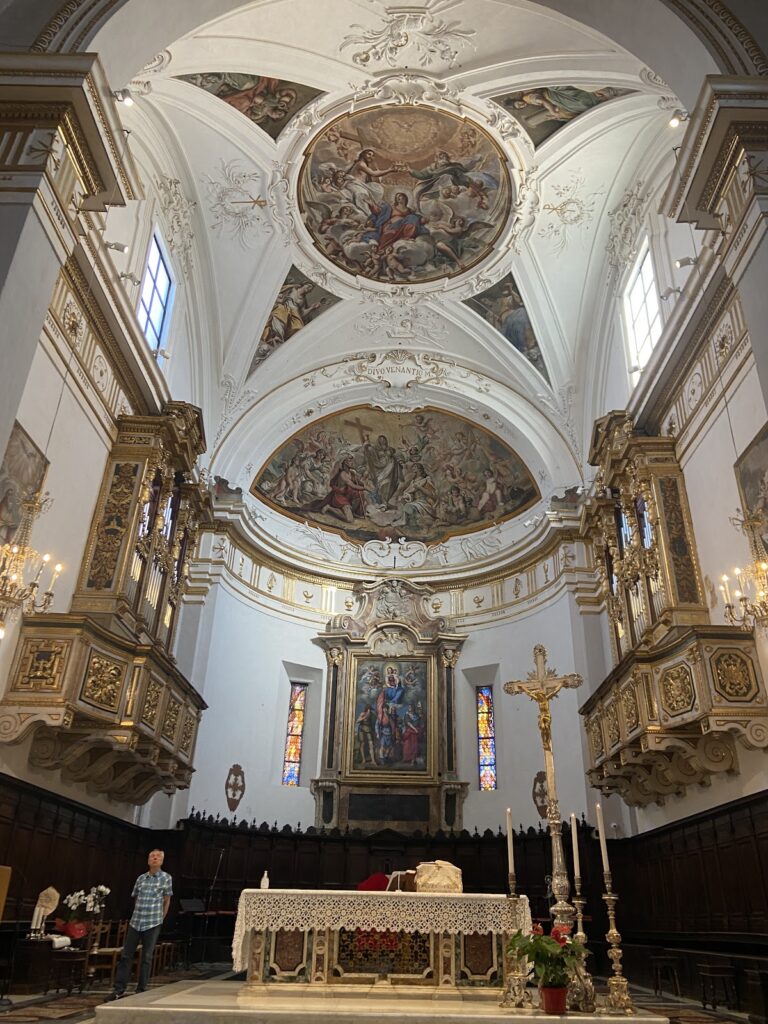
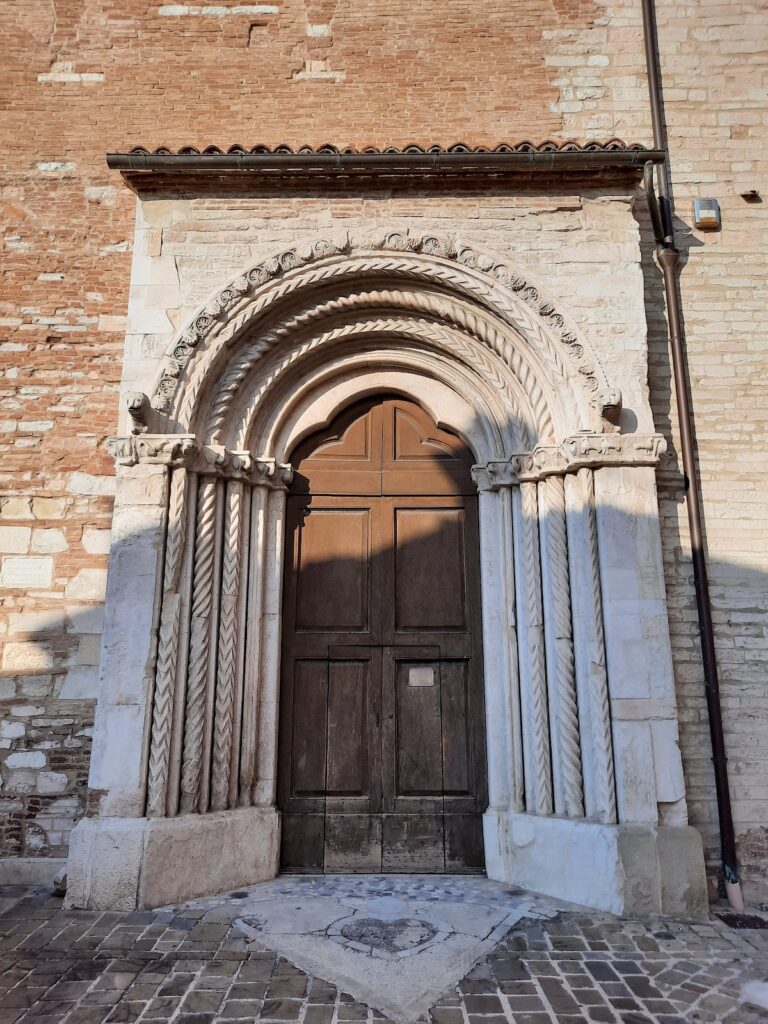
The surviving complex combines elements of the thirteenth-century church with later alterations. The original Romanesque portal remains in place, while the original trifora, a window divided into three openings, is concealed behind the attic, the upper part of the facade. The present church has a single nave flanked by lateral chapels. Its eighteenth-century interior is framed by a large arch above the main altar that belongs to the primitive church.
Choir Frescoes
Behind the altar arch, fragments of frescoes survive in the choir. They depict episodes from the life of Saint Francis and are attributed to Allegretto Nuzi and the Giottesque-Marchigian school, meaning the regional tradition influenced by the art associated with Giotto. The frescoes are dated to the fourteenth century and are attributed to followers of Giotto.
Cloister and Passion Chapel
A cloister, a covered ambulatory surrounding an open courtyard, adjoins the church and belongs to the original thirteenth-century phase of the complex. Within it, the Passion Chapel preserves frescoes painted by Simone De Magistris in 1569. The scenes represent episodes from the Passion of Christ. At the center of the vault, Christ in the Garden of Olives appears within a gilded frame, while the entire end wall is occupied by a Crucifixion. The lighting effects in the vault reflect knowledge of Lorenzo Lotto, and the frescoes show Venetian influence and a relationship to El Greco’s Marchigian triptych.
Chapels on the Right
Ottoni Chapel and Ramazzani
The first chapel on the right contains Ercole Ramazzani’s signed and dated Liberation of the Souls in Purgatory, painted in 1586. Saints Peter the Deacon, Gregory the Great, and Francis of Assisi are shown liberating souls from Purgatory, together with Blessed Camilla Battista Varani, a fifteenth-century Poor Clare revered as a blessed figure. The composition combines a doctrinal representation of Purgatory with the private family devotion of the Ottoni commission. Its visionary elements also adapt models associated with Lorenzo Lotto.
Palmezzano Altarpiece
The second chapel contains Marco Palmezzano’s large altarpiece, signed and dated 1501. Its principal image shows the Enthroned Madonna and Child between Saint Francis of Assisi and Saint Catherine of Alexandria. A Pietà among Saints occupies the lunette, the semicircular area above the main painting, while other saints appear on the lateral pilasters. The predella, the lower section of an altarpiece, includes Saint Adrian, the Martyrdom of the Franciscan Friars in Morocco, the Last Supper, Saint Francis of Assisi Receiving the Stigmata, and Saint Bonaventure.
The work retains its sumptuous Classicizing frame, designed and made for the painting. Its surviving ensemble includes the painted pilasters, lateral decorative elements, and four small ornaments on the outer arch of the lunette. The spacious composition recalls Giovanni Bellini, while its illusion of depth reflects the influence of Melozzo da Forlì. Its clear light and luminous color likewise relate to Bellini and other Venetian painters.
Razzanti Chapel
The third chapel belongs to the Razzanti family and contains seventeenth-century frescoes and canvases with varied attributions. The right-hand altarpiece, Saint Francis of Paola and the Miracle of the Furnace, has been attributed to Giovanni Serodine and dated to 1623–1625, although it has also been attributed to the Marchigian painter Giovan Battista Foschi. Foschi is also associated with the vault frescoes depicting Stories of the Virgin. The stucco decoration of the vault has been attributed to these artists or to artists from Ticino, possibly including the young Borromini. A painting of Saint Francis Xavier on the left wall is attributed either to Foschi or to Giuseppe Puglia.
Luca di Paolo Triptych
The fourth chapel preserves Luca di Paolo of Matelica’s 1470 triptych. It depicts the Madonna and Child with Saints Francis and Bernardino in glory, while the predella presents scenes from the life of Saint Bernardino. The work remains in excellent condition and retains its lateral pilasters and narrative predella. A partly lost inscription transmitted the date and named Filippo and Francesco di Giacomo Attucci as commissioners.
The triptych combines late Gothic decoration influenced by Gentile da Fabriano with Renaissance elements. Gold and silver details enrich the surface, while the carpentry ends in a horizontal cornice even though the individual compartments have pointed arches. A continuous flowering meadow unifies the composition, and the figures display a newer naturalism.
Other Renaissance and Reforming Works
Ramazzani and Eusebio da San Giorgio
A subsequent chapel contains two paintings by Ercole Ramazzani, an Allegory of the Immaculate Conception dated 1573 and an Ascension dated 1574. The latter is badly damaged. On the opposite wall stands Eusebio da San Giorgio’s signed and dated 1512 panel of the Enthroned Madonna and Child with Saints John the Evangelist, Andrew, Anthony of Padua, Nicholas of Tolentino, and the young John the Baptist.
Eusebio’s panel was made for the wealthy merchant Dionisio di Pietro di Berto, later known as Periberti. His business mark appears at the lower center in place of a noble coat of arms. The painting retains its original carved and gilded frame, which remains in fairly good condition.
Chapels on the Left
The left-side chapels contain several major sixteenth-century works. In the chapel nearest the presbytery, the Martyrdom of Saint Stephen is signed and dated 1569 by Gianfrancesco and Simone De Magistris and remains in its original frame. Their Adoration of the Magi, dated 1566, occupies the fourth chapel and has a large, richly decorated wooden frame.
The second chapel contains Durante Nobili’s Crucifixion of 1569, closely derived from Lorenzo Lotto’s 1531 version at Monte San Giusto. Its contemporary frame includes two musician angels, busts of Saint Roch and Saint Longinus, and a predella with the Resurrection, Deposition, and Descent into Limbo. The first chapel contains Simone Cantarini’s Madonna and Child with Saints.
Later Furnishings and Exterior Elements
The church also preserves seventeenth-century walnut confessionals decorated with twisted columns. Its Via Crucis, or Stations of the Cross, was executed between 1740 and 1750. Medallions from the first decades of the nineteenth century are attributed to the Franciscan Father Antonio Favini, who lived from 1749 to 1843.
The exterior staircase was built in 1970. At ground level in front of the church stands a bronze statue of Saint Francis of Assisi feeding the wolf, dating from the 1970s. Together with the medieval portal, the surviving choir fragments, the cloister, and the extensive cycle of chapel paintings, these elements reveal the complex’s accumulation of Franciscan, Renaissance, Catholic Reformation, Baroque, and modern phases.