San Fantin: A Renaissance Church in Venice

Site at a Glance
- Rating
- 4.6
- Popularity
- Very Low
- Country
- Italy
- Primary era
- Early Modern
- External website
- Open
- Eras represented
- Early Modern
- Civilizations
- Venetian
- Site type
- Religious
- Remains
- Church
On this page19 sections
History
San Fantin is a Roman Catholic Renaissance church in Venice, Italy, whose present building was constructed between 1507 and 1564. It stands in the San Marco district and belongs to the Patriarchate of Venice, the Roman Catholic jurisdiction headed by the patriarch of Venice. Today it is a rectorial and vicarial church, administered by a rector or vicar within the parish of San Moisè and the San Marco–Castello deanery.
Origins and Medieval Rebuilding
The church’s origins remain associated with several traditions. One places its foundation in the sixth century, when the Molino family is said to have established a private oratory. Another tradition dates it to about 850, while the more widely accepted foundation date is about 996. A church with the same dedication is mentioned as early as 966, and the earliest surviving documents concerning San Fantin date from 1127. Its establishment as a parish probably took place during the eleventh century.
The first church was connected with the patrician families Barozzi, Aldicina, and Equilia. Repeated fires led to its rebuilding in the late twelfth century, when the Pisani family took the initiative and donated a miraculous icon of the Virgin acquired from the East. By the fifteenth century, the church was also known as Santa Maria delle Grazie di San Fantino. The fifteenth-century building had three aisles, a form shown on Jacopo de’ Barbari’s map of Venice.
The Sixteenth-Century Church
The earlier church was demolished in 1506, and work on the present building began on 25 March 1507. Its reconstruction was supported partly by the testamentary gift of Cardinal Giovanni Battista Zeno, who left 10,000 ducats for the project. Antonio Abbondi, known as lo Scarpagnino, worked on the church until his death in 1549. Jacopo Sansovino then assumed responsibility, assisted by Alessandro Vittoria, and designed the domed apse. Later attributions also connect the work with Pietro Lombardo, Sebastiano Mariani, and Antonio Sorella. The building was completed in 1564.
After the rebuilding, San Fantin became the guild church of the Scaleteri, the Venetian guild of pastry and confectionery sellers. The guild adopted Saint Fantinus the Elder as its patron, giving the church a lasting association with the saint. In the eighteenth century, San Fantin became a collegiate church, a church served by a chapter of clergy.
Ecclesiastical Reorganization and Restoration
Napoleonic decrees issued in the Kingdom of Italy on 5 June 1805 began the suppression and reorganization of Venetian churches, monasteries, and parishes. In 1807 the parish of San Fantin and its chapter were suppressed and incorporated into San Moisè, while the church became a subsidiary church and lost its collegiate status. In 1810 it was transferred to the parish of Santa Maria del Giglio. The church returned to San Moisè in 1967.
Structural problems affecting the presbytery eventually led to the withdrawal of the church from religious worship, although the presbytery could still be used for exhibitions. After decades of restoration, San Fantin reopened to the public in 2018. It had also formerly been affiliated with Santa Maria Zobenigo, whose parish priest supplied it with holy water. The dedication commemorates Saint Fantinus the Elder, also called Fantino il Vecchio.
Remains
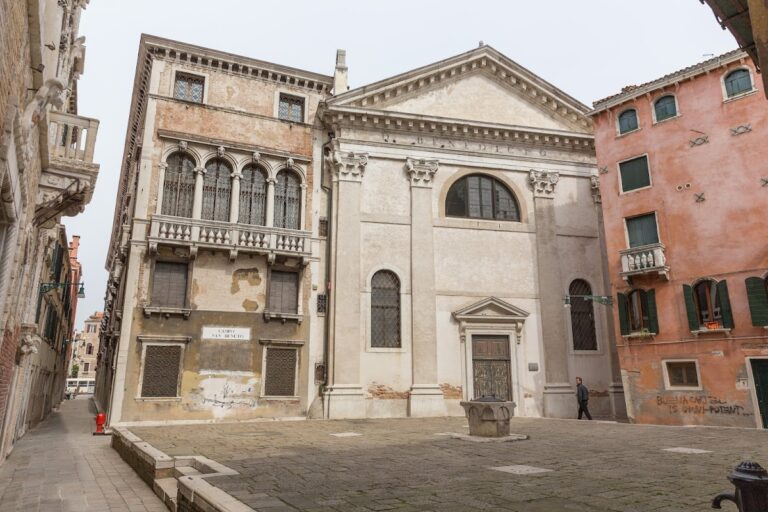
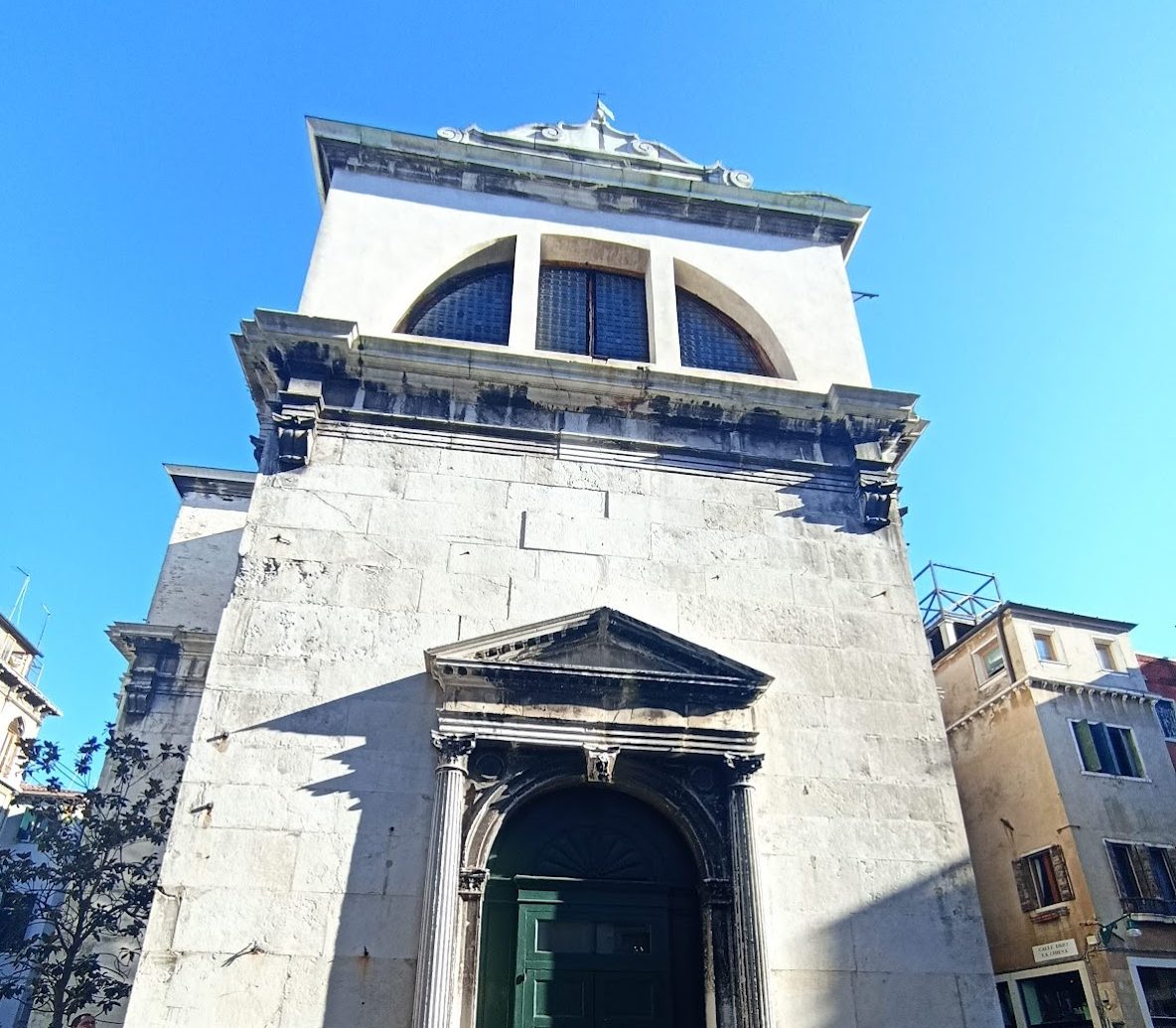
San Fantin is a Renaissance church set within Venice’s dense urban fabric. Its three-aisled body has stone exterior facing and a bell gable, while the facade is the building’s exposed architectural front toward Campo San Fantin. The interior follows a simplified version of the scheme used at San Salvador, replacing that church’s three domes with cross vaulting over the three aisles.
Facade and Entrance
Facade
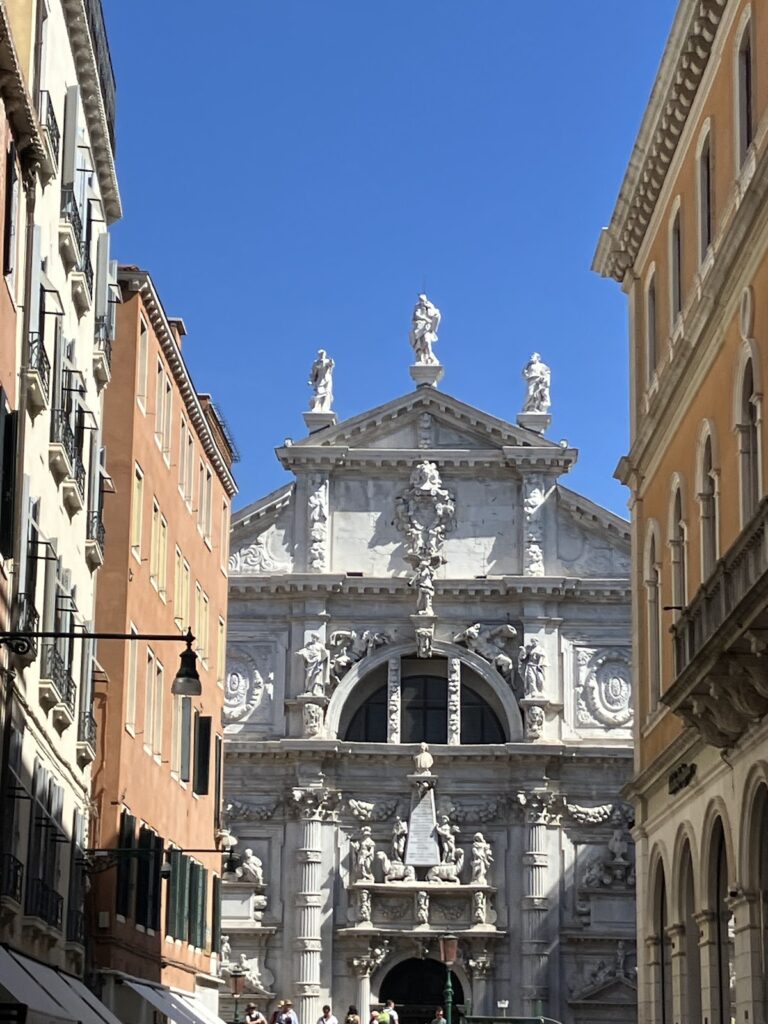
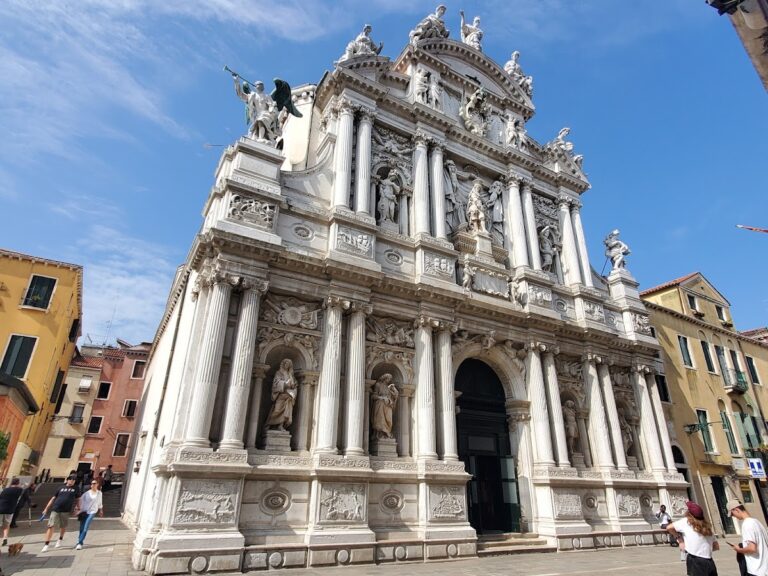
Antonio Abbondi’s facade is arranged in two levels separated by a stone cornice carried on consoles at the corners. The lower level is covered with stone slabs. The upper level is plastered and pierced by large thermal windows, which have semicircular tops derived from Roman architectural forms. Above the main entrance, a small, curving Baroque pediment crowns the composition.
Narthex and Musicians’ Gallery
A square narthex, or entrance hall, precedes the nave. It has three entrances on each side, and its wall carries Cesare dalle Ninfe’s Annunciation. Above the entrance to the central nave is a marble musicians’ gallery dated 1563 and probably designed by Sansovino. The gallery holds an eighteenth-century organ.
Presbytery and Sacred Furnishings
Presbytery and Apse
The nave ends in a square presbytery covered by a dome supported on four Corinthian columns. These classical columns have capitals decorated with acanthus leaves. Beyond the presbytery is a semicircular apse, with a crypt beneath it. The presbytery is attributed to Jacopo Sansovino.
High Altar and Relics
The high altar carries two marble statues by Giuseppe Bernardi Torretti, Saint Fantinus and Saint Martha, both dated 1756. Saint Fantinus appears as a Roman mounted martyr. This imagery arose from confusion between his epithet, meaning “horse keeper,” and the word for “cavalier.” A corresponding representation of the saint also appears in a tapestry preserved in the church.
The church preserves the body of Saint Marcellina, identified as the elder sister of Saint Ambrose, together with an arm bone of Saint Tryphon. Tryphon was regarded as the protector of Cattaro.
Presbytery Paintings and Funerary Monuments
On the left wall of the presbytery hangs Palma the Younger’s large canvas of Doge Alvise Mocenigo giving thanks to the Virgin for the victory at Lepanto, the 1571 naval battle in which the Holy League defeated the Ottoman fleet. On the opposite side stands the funeral urn of Bernardino Martini. Above the sacristy door is the elaborate funerary urn of Vinciguerra Dandolo, made by Tullio Lombardo. Nearby is a Holy Family probably painted by Francesco Bissolo, a work once attributed to Giovanni Bellini.
Transepts and Side Altars
Transept Paintings
The transept contains Palma the Younger’s Descent from the Cross, which formerly stood on the high altar. The left transept holds Lionardo Corona’s Crucifixion. Above a door is Andrea Vicentino’s Last Supper, while the altar contains Sante Peranda’s Visitation. The wall displays Alberto Calvetti’s Saint Cajetan of Thiene before the Virgin Mary.
Side Altars
One side altar holds a Madonna and Child on a gold ground, probably a sixteenth-century work by a Venetian-Cretan artist. Its lunette, the semicircular area above the altar, contains an eighteenth-century painting of the Dormition of Saint Joseph. Another altar has Liberale Cozza’s 1815 painting Jesuit and Canon Adoring the Sacred Heart.
Plague Votive Painting
Above a side entrance is Joseph Heintz the Younger’s large canvas of Saints John the Evangelist, Roch, and Theodore pleading before the Virgin for an end to the plague of 1630. The parish priest Giovanni Pomelli appears in the scene with them.
Other Interior Features and Artworks
Monuments and Holy-Water Stoup
A monument to Paresano Paresani stands at the end of the nave. Beside the door is a twelfth-century holy-water stoup made of Greek marble. Together with the church’s funerary urns, these features preserve elements of its devotional and commemorative furnishing across several centuries.
Recorded and Transferred Paintings
A record from 1908 listed two paintings by Giovanni Battista Piazzetta, Liberation of Venice from the Plague and Pietà. The Holy Family, Lionardo Corona’s Crucifixion, and a Visitation of Mary to Elizabeth attributed to Tintoretto were later transferred to other churches.