Longues Abbey: A Benedictine Monastery in Normandy


Site at a Glance
- Rating
- 4.6
- Popularity
- Low
- Country
- France
- Primary era
- Medieval
- External website
- Open
- Eras represented
- Medieval
- Civilizations
- Norman
- Site type
- Religious
- Remains
- Monastery
On this page7 sections
History
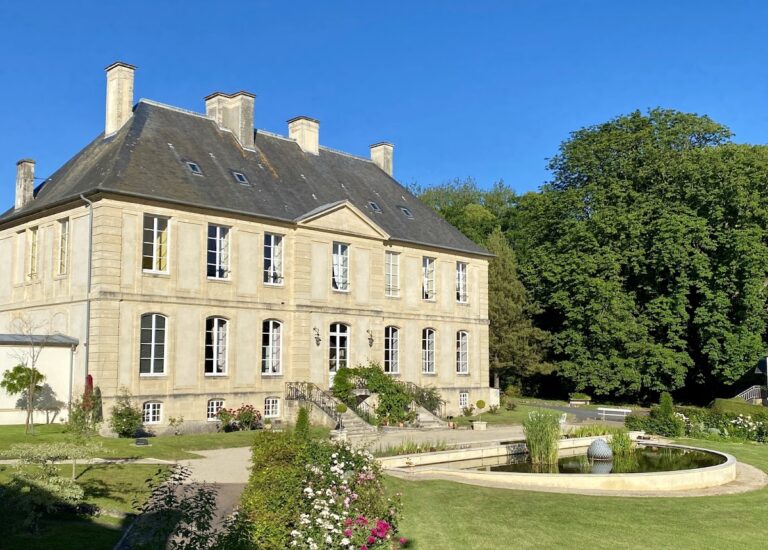
Longues Abbey is a former Benedictine monastery in Longues-sur-Mer, France, founded in 1168 during the Norman and Angevin period by Hugh Wac. Its foundation charters record successive donations approved by Henry II, King of England and Duke of Normandy, linking the monastery to the wider Anglo-Norman ruling order. As the first daughter house of Hambye Abbey, it became an important religious foundation in the Diocese of Bayeux.
Foundation and benefactors
Henry II and English and Norman nobles enriched the abbey with substantial gifts. The Bacon family of Molay and the d’Argouges family were among its principal benefactors, and members of both families were buried at Longues. These donations provided the land and property on which the monastery’s religious and economic life developed.
Commendatory administration and decline
From 1526, the abbey was administered by commendatory abbots, who held its title and revenues without necessarily residing there or directing the monks’ daily life. Jean d’Alloigny was its first commendatory abbot. In 1600, Longues was incorporated into the Cluniac order, a reform network within Benedictine monasticism that developed around the Abbey of Cluny and its affiliated houses.
The abbey’s income eventually exceeded 40,000 livres, but it then declined progressively. It closed in 1781 under its last abbot, Emmanuel-Louis de Cugnac, Bishop of Lectoure, when its conventual revenues were united with the Bayeux seminary. After closure, the former monastery became an agricultural estate. This new use altered, destroyed, and reassigned parts of the complex, while time further affected the surviving buildings.
Modern preservation
Restoration began under the North American Dewey family, owners from 1932 to 1964, and continued from 1964 under the d’Anglejan Chatillon family. Successive campaigns during the twentieth and twenty-first centuries helped preserve and enhance the abbey’s surviving heritage. Their work received distinctions including the 2016 VMF Special Prize, a 2016 accessibility award from the Foundation for Historic Monuments, the 2017 French Heritage Society Prize, and the first France Bois Forêt competition award for heritage in 2021.
In 2019, Longues Abbey was selected as Normandy’s emblematic monument for the French heritage lottery because its choir was close to collapse. Restoration saved the choir, which was inaugurated for a first Mass on 15 August 2022, about 240 years after worship ended at the abbey. The site is protected as a French historic monument. The chapel ruins were classified on 30 June 1915, while the former abbey and its grounds, underground remains, enclosure walls, standing buildings, and pond were classified on 31 January 2006. The former abbey farm’s barn, press-house residence, stable, surrounding land, subsoil, and enclosure walls were registered on the same date. The site was also identified as heritage in danger in 2019.
Remains
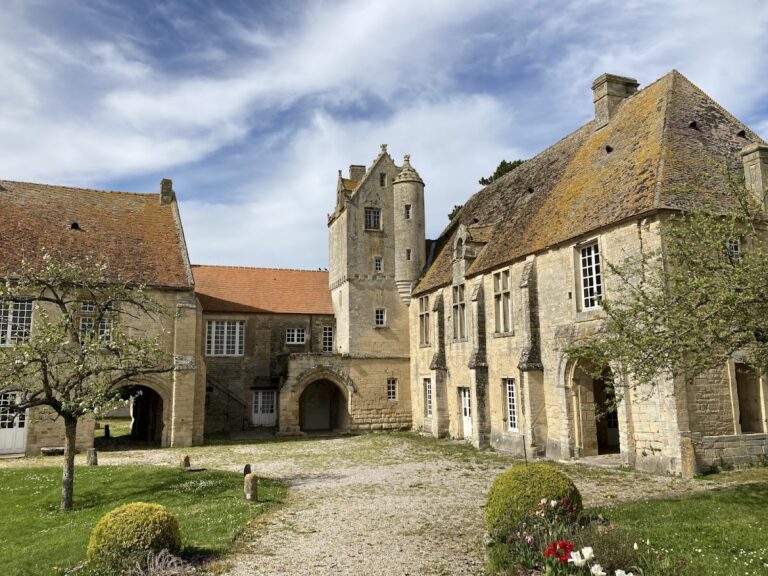
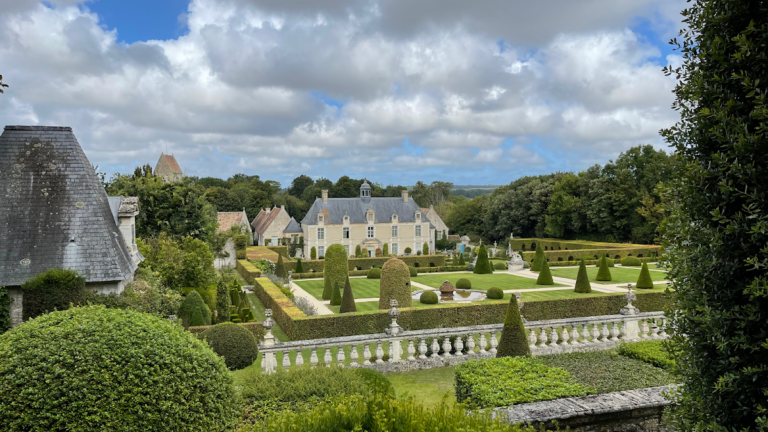
The surviving complex at Longues includes ruins, standing buildings, enclosure walls, grounds, subsoil, and a pond. It lies in Longues-sur-Mer, Calvados, approximately 300 metres south-southeast of the Church of Saint Lawrence. The remains combine religious buildings and later agricultural structures, preserving evidence of the abbey’s changing functions.
Religious remains
A small chapel contains earlier burials of members of the d’Argouges family. Among them is the tomb of Jacques d’Argouges, lord of Argouges at Vaux-sur-Aure and a vassal of the Molay-Bacon lord, who died on 6 September 1510. Longues Abbey also has a statue of Saint James the Greater and a monumental painting in the former abbatial residence. Its glazed paving tiles, produced by the Molay workshop, date from the final years of the thirteenth century or the fourteenth century. The abbey is among the Norman monuments with the greatest number of these tiles.
Agricultural and domestic buildings
The former abbey farm includes a barn, a press-house residence, and a stable, together with surrounding walls and associated ground. The restored building known as the hostelry, also described as the monks’ refectory, retains an Armorican-type roof structure. Restoration of this building was completed on 12 December 2023 after repairs to a roof structure severely damaged by wood-boring beetles. The work identified the roof as the oldest Armorican-type structure in Normandy currently known to the CNRS, France’s national public research organization.