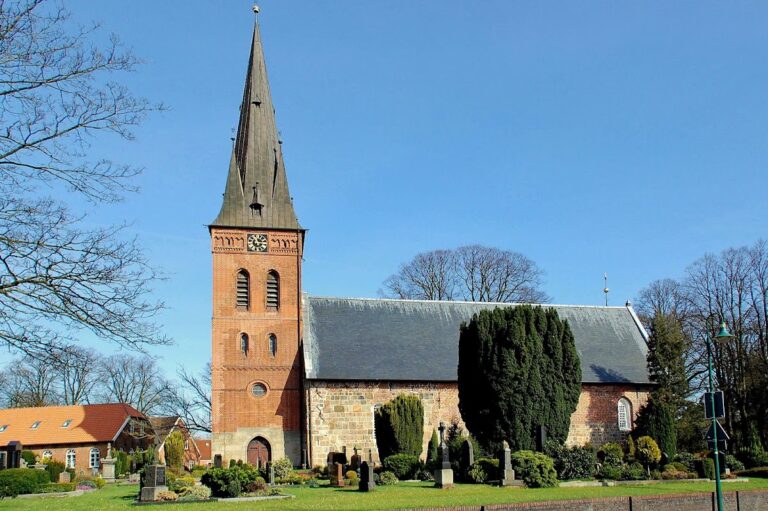
St. Johannes: A Medieval Evangelical Lutheran Church in Wiefelstede, Germany

Site at a Glance
- Rating
- 4.7
- Popularity
- Very Low
- Country
- Germany
- Primary era
- Medieval
- External website
- Open
- Eras represented
- Medieval, Early Modern
- Civilizations
- Holy Roman Empire
- Site type
- Religious
- Remains
- Church
On this page22 sections
History
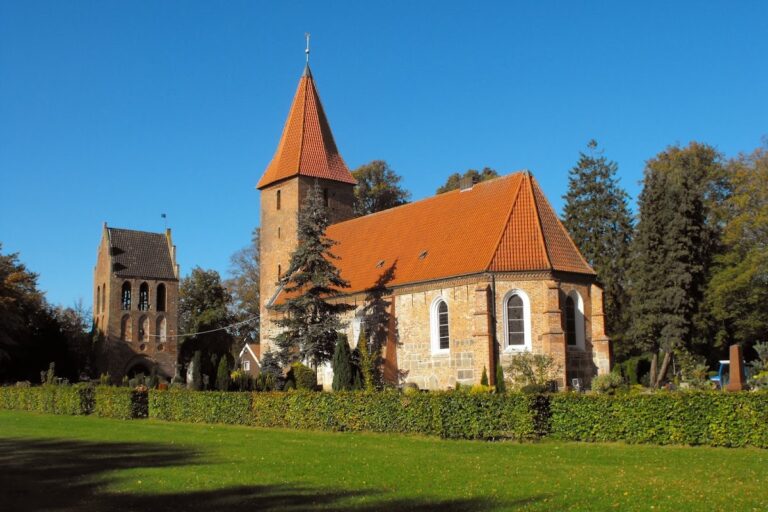
St. Johannes is an Evangelical Lutheran church in Wiefelstede, Germany, regarded as the oldest church building in the Ammerland and probably the oldest there built of stone from the outset. The present medieval building was begun around 1200 and was altered repeatedly through the fifteenth century. Its origins reach back further: in 1057, Archbishop Adalbert of Bremen probably consecrated a church at this location, making it the center of an early large parish in the historical Ammergau.
Early church and stone rebuilding
An earlier wooden church may have stood on the site, although this remains uncertain. Adalbert dedicated the church to John the Baptist, the Christian prophet and baptizer regarded as the forerunner of Jesus, and to Saint Radegundis, a sixth-century Christian queen and saint. Her association with a church in this region is otherwise unique. The stone church begun around 1200 preserved the location’s ecclesiastical role while establishing the surviving building’s earliest fabric.
Medieval expansion
During the late thirteenth century, the nave was lengthened westward by three bays and received a vault. The west tower was added in the same phase. In the fifteenth century, the square sanctuary area, known as the choir, was raised in brick, and the west tower was heightened. A separate bell or gate tower was built no earlier than the late fifteenth century. Its two bells were cast in Osnabrück by Johann Frese in 1503 and 1507.
Reformation and later furnishings
The church’s interior was furnished across several periods, from the Middle Ages through the Baroque era and into modern times. The large Passion altarpiece was probably made around 1520. Its scenes draw heavily on Albrecht Dürer’s Little Passion prints of 1508 to 1512. The end of commissions for new figural altars after the Reformation also supports this dating.
A baptismal font made in 1637 by the Oldenburg craftsman Johann Ludewig and a pulpit made in 1644 by the Oldenburg master Gert Borkemann belong to the seventeenth-century furnishings. A Last Supper painting from that century was probably connected with work carried out in 1669. It was temporarily placed in the lower section of the Gothic altarpiece, known as the predella.
The organ was built by Christian Vater and completed in 1731. Its construction followed a donation ordered in 1727 by Major Wolf von Böselager of Lehe. In return, he received a prestigious burial in the church, and his coat of arms was placed on the south wall. Johann Claussen Schmid of Oldenburg substantially rebuilt the instrument in 1862, removing half of its registers and fundamentally changing its arrangement. Alfred Führer restored it in 1935, followed by another restoration by his firm in 1982. From 2011 to 2014, Henk van Eeken carried out a comprehensive restoration that reconstructed later replacement parts and returned the organ’s arrangement largely to its 1731 form.
Church and community
The territorial ruler’s seat in the choir dates from the reign of Christian VI, king of Denmark and Norway from 1730 to 1746. Local rulers, officeholders, and a landowner in 1870 used the seat. Opposite it stands a corresponding seat reserved for the church jurates, lay officers who helped administer church property and affairs. Its grille bears the date 1732.
In 1957, the church council marked the nine-hundredth anniversary of the probable consecration by donating a statue of John the Baptist. St. Johannes continues to function as a focal point of local village life. Renovation work around 1980 included an investigation of the interior paintings. The blue nineteenth-century decoration on the vault ribs was restored, while the Gothic wall painting had already been restored, with alterations, in 1957.
Remains
Medieval structure and towers
The church is built of fieldstone, with construction changes visible in the masonry. Earlier walls use stones flattened mainly on their outer faces, while later work and repairs use more fully shaped, block-like pieces. The narrow choir square has a groin vault, formed by the crossing of two barrel vaults, and ends in a low semicircular apse. Small Romanesque round-arched windows pierce the apse, their openings deeply splayed through the wall.
The nave is wider than the choir and extends westward through the three bays added in the late thirteenth century. Its later masonry is made from more regularly laid rectangular blocks than the roughly worked fieldstones of the earlier structure. Iron anchors in the north and south walls of the choir and nave help support the masonry.
West tower
The west tower is integrated into the church, with its eastern wall forming the western wall of the nave. Its lower walls are almost three metres thick. The later upper section has a lean-to roof, reflecting the tower’s alteration and heightening during the church’s medieval development.
Separate bell tower
The freestanding bell or gate tower stands apart from the church. This type of passage tower has an opening through which a path or passage runs and also appears elsewhere in the Ammerland. The tower is built of brick, and its upper section is decorated with blind niches. Its bells bear the dates 1503 and 1507 and were cast by Johann Frese in Osnabrück.
Paintings and liturgical features
Choir decoration
The ribs of the choir vault carry blue painted decoration, probably from the early nineteenth century, accompanied by red arch or border patterns. On the north wall of the arch before the choir is a Gothic painting from the end of the fourteenth century. It shows Christ crucified with his head inclined, his arms extended, and blood issuing from his wounds. Mary and John stand beside the cross, while Peter, holding a key, and Paul, holding a sword and book, appear on the outer sides. The painting was restored in 1957.
Below the painting is a niche closed by a forged-iron grille with floral bands. It probably served to store liturgical vessels. Above the chancel arch, the name of Pastor Ernst Wilhelm Baars is surrounded and crowned by an honor crown. Baars served at St. Johannes from 1820 to 1837 and also chaired the agricultural society.
Passion altarpiece
The nearly four-metre-wide winged Passion altarpiece has a central shrine containing a multi-figured Calvary scene. Four Passion scenes flank the shrine, and eight more appear on the wings. Together, the scenes follow Christ’s Passion from the Mount of Olives to the Resurrection. A winged altarpiece has a central section with hinged side panels, while the predella is its narrow lower section. The present painted colors are not original, and paintings once placed on the outer sides of the wings have been lost.
A crucifix rises about 1.2 metres above the altarpiece. The ends of its crossbeam have trefoil forms, and the object probably served as a processional cross. It is probably an early-fourteenth-century work.
Last Supper painting
The seventeenth-century Last Supper painting hangs on the south side of the choir. It was based on a print by Jan Sadeler, a Flemish-Dutch engraver whose works served as models for other artists, and formerly stood in the predella of the Gothic altarpiece.
Baroque furnishings and organ
Pulpit and baptismal font
The pulpit’s flat-arched niches contain the four Evangelists, Matthew, Mark, Luke, and John, with their traditional symbols: a human or angelic figure, a lion, an ox, and an eagle. Angels’ heads decorate the underside of the sounding board and the outer sides of its base. The sounding board also carries sculpted floral forms, arabesques, and a central star. Its inscription reads, “Lord, open my lips, that my mouth may proclaim your praise.” Above the stair, crowned by an angel’s head, is the prayer, “O Lord, let it succeed.”
The 1637 baptismal font has a baluster-shaped oak base with Baroque decoration, including four winged angels’ heads. The surviving account of its manufacture records the cost of the wooden block, the craftsman’s payment, and two bundles of flax for his wife.
Ruler’s seats
The territorial ruler’s seat stands against the north wall of the choir. Its coat of arms is supported by two swans and accompanied by Christian VI’s monogram. The similar seat opposite has a grille dated 1732 and monograms referring to the church jurates Frerichs and Mienen.
Organ
Christian Vater’s organ originally had eighteen registers and an independent pedal. Nine of its original registers survive. Following the restoration completed from 2011 to 2014, approximately two-thirds of the instrument’s material remained historical, and its disposition, the arrangement of its stops, divisions, and controls, again largely corresponds to that of 1731. The wind system uses four wedge bellows with a pressure of 69 millimetres of water column. The organ has the couplers I/P and I/II and a tremulant.
Memorials and churchyard remains
Early sandstone sarcophagus cover
A trapezoidal sarcophagus cover made from reddish sandstone of the Upper Weser stands on the northwestern wall before the choir. Probably produced at the beginning of the twelfth century, it originally lay in front of the altar. It is the oldest surviving work in the church.
Grave stelae
Seven notable sandstone grave stelae from the seventeenth and eighteenth centuries stand in the churchyard, with several positioned to the left of the church door. The lower part of the gravestone for Gerdt Henninges is broken away. Its remaining imagery shows the deceased’s family kneeling beneath the crucified Christ, and its inscription states that Henninges died in an accident on 20 June 1634.
The complete Low German inscription on the Henninges stone is unique among more than 440 stelae of this period in the Oldenburg region. Its marking of the death as a fatal accident gives the monument an especially distinctive place among the churchyard’s memorials.
War graves and memorials
The churchyard contains graves and memorials associated with the wars of 1870 to 1871, 1914 to 1918, and 1939 to 1945. In the northwestern part is a grave for eleven Russian and Polish war dead. The northeastern area contains thirteen graves for German war dead.
Offering box and John the Baptist
Behind the altar stands an offering box made from an oak trunk. Forged-iron bands strengthen it, and its bow-shaped lock was later broken open. The box originally secured offerings collected for poor relief.
The statue donated in 1957 stands on a console in the northeastern corner of the nave. It depicts John the Baptist pointing toward Christ as the Lamb of God, giving a later visual expression to the dedication associated with the church’s early history.