St. Marien in Herford: A Gothic Evangelical Lutheran Church


Site at a Glance
- Rating
- 4.7
- Popularity
- Very Low
- Country
- Germany
- Primary era
- Medieval
- External website
- Open
- Eras represented
- Medieval
- Civilizations
- Holy Roman Empire
- Site type
- Religious
- Remains
- Church
On this page15 sections
History
St. Marien is an evangelical Lutheran church in Herford, Germany, built in the High Gothic period between 1290 and 1350 and consecrated in 1325. Standing on the Stiftberg beside the Luttenberg, it developed from a medieval religious foundation and became an important pilgrimage church associated with the Herford Vision.
Early foundation and Romanesque predecessor
The origins of the site are linked to a small Michaelskapelle built near a pre-Christian cult site. In 1011, Abbess Gotesda founded the religious foundation of Saint Mary at the Cross on the Mountain outside the Walls. This collegiate foundation, known as a Stift, supported daughters of the lesser nobility who could not enter Herford’s foundation for women of the high nobility.
A predecessor church with an early Romanesque cruciform plan was consecrated in 1018 by Meinwerk, Bishop of Paderborn. Parts of that earlier building were incorporated into the later Gothic church, preserving a visible connection between the eleventh-century foundation and the surviving structure.
Gothic church and changing religious use
The present church was constructed as a High Gothic hall church, a type in which the nave and side aisles are approximately equal in height. Its nearly square plan is known as the Westphalian square. During the Middle Ages and the early modern period, St. Marien served the collegiate foundation on the mountain and was also closely connected with the Herford Vision, a tradition of a Marian apparition.
The oldest known description of the vision, de visitatione beatae Mariae virginis, was rediscovered in 1982 and probably dates from the tenth century. The tradition helped make the church an important medieval pilgrimage destination, and pilgrimages to Herford have resumed in recent times.
St. Marien became an evangelical parish church in 1548. During the Napoleonic occupation, it was converted into a horse stable. In the nineteenth century the building became dilapidated and demolition was considered, but the nave and choir were retained. The old tower, which still originated from the Romanesque church, was demolished in 1904 and replaced with a new tower.
Restoration and modern parish life
Restoration in the 1950s removed the Neo-Gothic ceiling paintings and replaced the Neo-Gothic pulpit with a plain cubic pulpit. A comprehensive renovation and reconfiguration in 2003 and 2004 followed the donation of a new organ. The work adapted the church for frequent musical performances and other uses. It also removed the nineteenth-century pews and original floor slabs. The modern pulpit was later replaced by a Neo-Gothic one.
The First World War memorial tablets were removed from the church walls during the 2003 and 2004 renovation and are now at the Erika Cemetery in Herford. The church was placed under heritage protection in 1981. Its six bronze bells were cast in 1986 at the Rincker Bell and Art Foundry in Sinn, Hesse. For their consecration service, the Herford composer Johannes H. E. Koch composed the Stiftberg Bell Mass.
The community house west of the church is called the Ernst Lohmeyer House. It honors the theologian and university professor Ernst Lohmeyer, a member of the Confessing Church who was persecuted by the Nazi state.
Remains
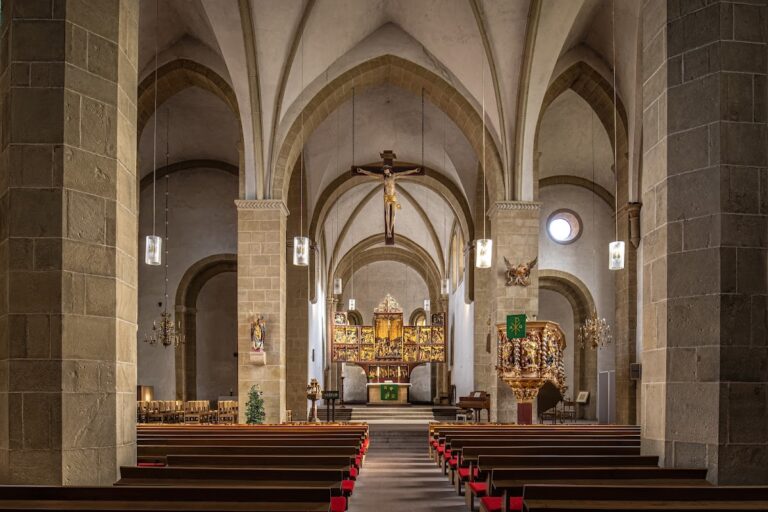
St. Marien survives as an almost square High Gothic hall church with transverse gabled roofs, a bright interior, and slender piers that rise through the unified space. The nave and choir retain the principal historic fabric, while sections of the Romanesque predecessor remain visible in the north and south walls. Because those earlier walls were incorporated into the Gothic building, the Marienschlussstein lies at the exact center of the church.
Historic fabric and interior arrangement
Church structure
The surviving nave and choir belong to the Gothic rebuilding of the church between 1290 and 1350. The earlier Romanesque walls remain part of the north and south sides, while the Romanesque tower was replaced in 1904. The 2003 and 2004 reconfiguration installed a new floor with underfloor heating and lighting suited to worship and other uses. The high altar was moved toward the rear, and a solid oak communion table was placed in front of the altar area.
High altar and crucifix
The high altar contains a tree stump said to date from the period of the Herford Vision. Its late Gothic reliquary tabernacle is made of red sandstone and takes the form of a sacrament tower, a tall Gothic tabernacle for the consecrated Eucharist. Several doves decorate the altar in memory of the vision.
A life-size Gothic crucifix that formerly served a rood-screen function now stands on the west wall of the gallery.
Organs and musical furnishings
Steinmann organ
The largest of the three organs is the Steinmann organ on the west gallery. Gustav Steinmann’s organ workshop in Vlotho built it in 1956 with 30 stops on two manuals and a pedal division. In 1975, a third manual was added as a Rückpositiv, a smaller organ division placed behind the organist and facing into the church. It can also be played separately as a choir organ, bringing the instrument to 40 stops. Its couplers are III/I, I/II, III/II, I/P, II/P, and III/P.
Collon organ
The Collon organ stands at the south wall and was inaugurated in 2004. Patrick Collon’s Manufacture d’Orgues de Bruxelles built the instrument as a purely mechanical organ with 32 stops on two manuals and a pedal division.
Tzschöckel positive
The smallest instrument is the portable, tuning-stable Tzschöckel positive, a small organ made by the Reinhart Tzschöckel organ-building company of Althütte. It has slider chests and mechanical action. Its five stops include a principal and a regal divided between bass and treble registers at h/c1. The instrument is used for baptisms and children’s church services.
Churchyard and adjoining building
Historic churchyard
The historic churchyard lies immediately beside St. Marien and is the only preserved historic churchyard in Herford.
Ernst Lohmeyer House
The Ernst Lohmeyer House stands west of the church at the corner of Stiftbergstrasse and Luttenbergstrasse, opposite the main entrance.