Kihelkonna St. Michael’s Church: A Medieval Lutheran Parish Church in Estonia


Site at a Glance
- Rating
- 4.8
- Popularity
- Very Low
- Country
- Estonia
- Primary era
- Medieval
- Eras represented
- Medieval, Early Modern, Modern
- Civilizations
- Crusader, Livonian Order
- Site type
- Religious
- Remains
- Church
On this page11 sections
History
Kihelkonna St. Michael’s Church is a medieval Lutheran parish church in Estonia, on Saaremaa Island. Founded around 1250 by the Catholic Livonian Order and the Bishopric of Ösel-Wiek, it was built in the medieval Gothic tradition and first mentioned in 1254. The church stood near an important harbour and beside a road connecting western Saaremaa with the rest of Estonia, giving it a religious and strategic setting during the Christianization of the eastern Baltic.
Foundation and medieval construction
The church formed part of the crusading effort to establish Christianity in Estonia. The Bishopric of Ösel-Wiek was a medieval Catholic diocese whose territory included the western Estonian islands, while the Livonian Order was a Catholic military order involved in the region’s Christianization and governance. Their joint foundation reflects the close connection between religious administration and military power in thirteenth-century Saaremaa.
Construction continued through the later thirteenth century. During the rebellion of 1260–1261, the building was still unfinished when the bishop was forced to cede it to monks. The walls and the lower part of the planned tower had already been completed, and the monks subsequently finished the church.
Religious and architectural change
Kihelkonna St. Michael’s was originally a Catholic church. The sixteenth-century Reformation, a religious movement that ended the church’s Catholic institutional affiliation and reshaped worship across northern Europe, brought the building into Lutheran use. It now belongs to the Kihelkonna parish within the Estonian Evangelical Lutheran Church.
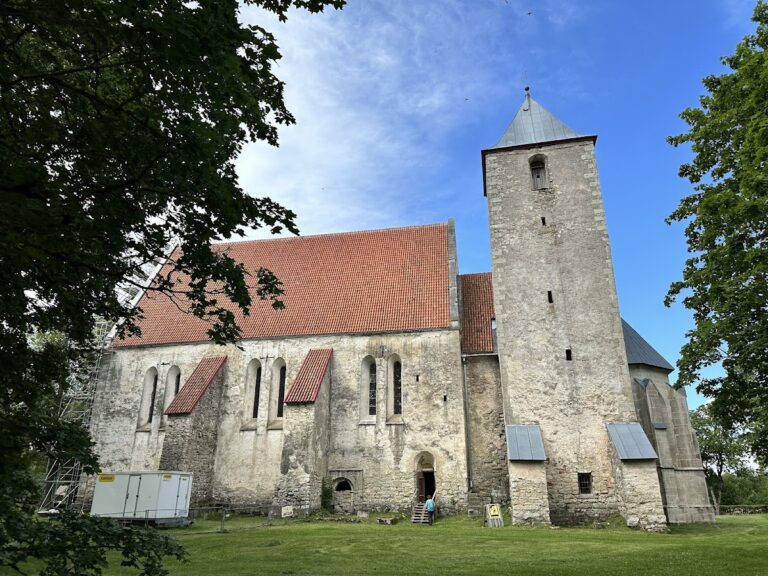
The church’s appearance remained substantially unchanged from the thirteenth century until the nineteenth century. A sacristy was added on the eastern side of the choir during the nineteenth century, and a western tower was built at the end of the century. The present tower dates from 1899 and introduced a neo-Gothic element to the medieval structure.
Repair, restoration, and continuing use
A repair campaign had produced a praised appearance by 1939. During the postwar Soviet period, neglect and officially promoted atheism contributed to deterioration. Defects noted in 1955 included damp-related greening of the walls and flaking plaster and paint.
After Estonia restored its sovereignty, different parts of the church underwent phased restoration between 1990 and 2006. Stained-glass windows designed by Dolores Hoffmann were installed in 1980, and the organ was fully restored in 2018. The church was recognized as a cultural monument in 1999. Its unusually high spire served mariners as a daytime navigation mark until 2009, while its continuing importance is now primarily sacred, historical, and cultural.
The detached belfry beside the church is protected separately as a monument. It was restored in 2009, after which its bell rang again, and a second bell was added in 2017.
Remains
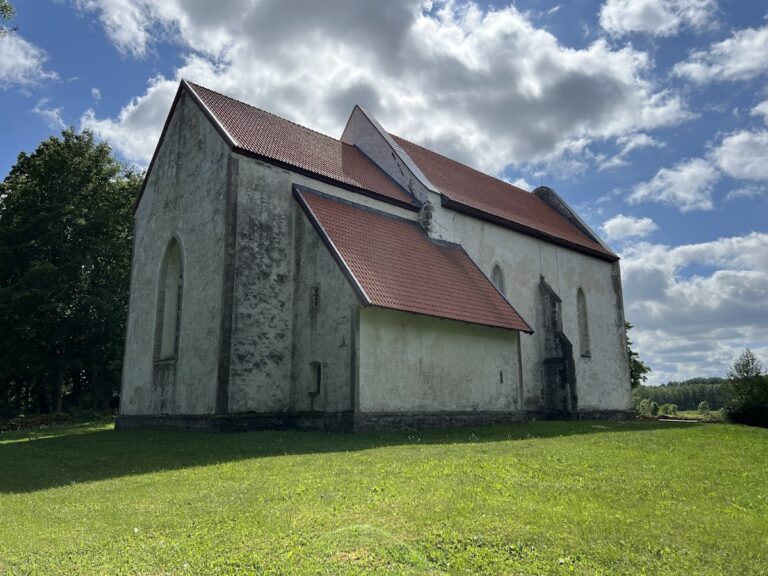
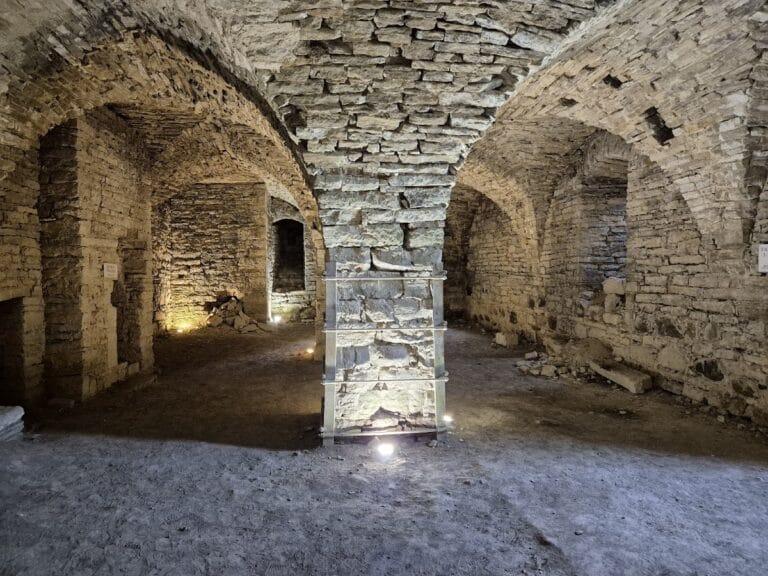
Kihelkonna St. Michael’s Church has a longitudinal plan and a medieval stone structure supplemented by nineteenth-century additions. Its original design included a western tower, an unusual arrangement on Saaremaa derived from Westphalian models associated with Catholic military orders. Stone stairs were built into the tower wall as an escape route intended for the order’s master in an emergency. The present western tower is a neo-Gothic addition with a neo-Gothic cupola and dominates the exterior, while the nineteenth-century sacristy stands on the eastern side of the choir.
Medieval fabric and exterior details
The church’s portals are unusual in the eastern Baltic, and the interior preserves architectural details connected with medieval ritual practice. A niche was made for a vessel of water used to rinse hands. Another small chamber may have served to restrain sinners or to accommodate crippled beggars, although its function remains uncertain.
Interior paintings and furnishings
Vaults and altarpiece
Thirteenth-century paintings survive on the vaults. They were made al secco, a technique in which pigment is applied to dry plaster rather than wet plaster. The church also retains high whitewashed vaults. A Renaissance altarpiece dating from 1591 depicts the Last Supper.
Memorials and pulpit
Sixteenth-century furnishings include copper ornaments and a tombstone bearing coats of arms. A further coat of arms and a carved epitaph belong to the seventeenth century. The epitaph, dated 1650, was made by the local carpenter Balthasar Raschky. The pulpit was begun in 1604 and completed in the 1790s, and it is separately recognized as a cultural-heritage object. An eighteenth-century grave has a marble tombstone.
Organ
Johann Andreas Stein built the church organ in 1805. It originally had 14 registers, and Friedrich Weissenborn enlarged it in 1890 by adding a second manual and four further registers. Restored in 2018, the instrument is described as the oldest organ in Estonia and the only surviving instrument by Stein.
Detached belfry and cemetery
The detached bell tower dates from 1638 and preserves the separate bell-ringing arrangement used before the western tower was constructed at the end of the nineteenth century. It is the oldest surviving detached church belfry in the Baltic region and the only surviving example of its type in Estonia. A sundial stands in the church cemetery.