Basilica di Santa Maria dei Servi: A Gothic Servite Church in Bologna


Site at a Glance
- Rating
- 4.6
- Popularity
- Medium
- Country
- Italy
- Primary era
- Medieval
- External website
- Open
- Eras represented
- Medieval, Early Modern, Modern
- Civilizations
- Italian, Papal States
- Site type
- Religious
- Remains
- Basilica
On this page20 sections
History
Basilica di Santa Maria dei Servi is a Roman Catholic church in Bologna, Italy, dedicated to the Virgin Mary and built for the Servite Order, a Catholic religious community devoted especially to Mary and meditation on the suffering of Christ. Its foundation is dated to 1346, while another record gives 1 November 1345 as a construction date. The church was supported by Taddeo Pepoli, a wealthy Bolognese banker and political ruler whose donation enabled the project. Probably designed by the Bolognese architect Antonio di Vincenzo, the original church was completed in 1383.
Foundation and medieval enlargement
Enlargement and embellishment began in 1386 under Andrea Manfredi da Faenza, a Servite friar who became superior general of the order. The work continued until his death in 1396 and was completed during the fifteenth century. The later work introduced few changes to the basilica’s overall design. Andrea da Faenza was buried in the church, where his tomb slab remains near the beginning of the ambulatory.
The monastery was attached to the church from its foundation to house the Servite friars. A complex with a cloister, chapter house, refectory, and dormitory was documented in the 1370s. Under Andrea da Faenza, the monastery expanded to three cloisters, creating a substantial religious complex beside the basilica.
Fifteenth-century additions
Several major external elements date from the fifteenth century. The apse exterior was built in 1437, and the bell tower was erected in 1453. The portico developed more gradually. Bologna authorized Andrea Manfredi to build the section along the church’s left side in 1392. Further arcades were added in 1492 and between 1515 and 1521, followed by additional work in the seventeenth century.
The portico’s fifteenth-century frescoes were produced by artists from Emilia. A new decorative scheme applied after restoration in 1628 largely covered the earlier paintings. The portico reached its present quadrangular form in 1864 under Giuseppe Modonesi, when the church of Saint Thomas was demolished to make space for the extension.
Later changes and changing uses
The church was repeatedly altered and redecorated in later centuries, often through bequests from wealthy benefactors. During the seventeenth century, one of the side chapels was converted into a sacristy dedicated to Saint John the Evangelist. The basilica also became an important setting for Bologna’s musical life. Four organs were housed there during the seventeenth century, and a musical chapel was established beside the sacristy. The Cappella Musicale Arcivescovile di Santa Maria dei Servi, consisting of choir and orchestra, is one of Bologna’s oldest institutions.
Napoleonic troops arrived in Bologna in 1797, after which the church and monastery were converted into a barracks. The church became a parish in 1802. Following the Restoration in 1815, the Servants of Mary recovered possession. Since the end of the Second World War, the oldest parts of the monastery attached to the basilica have housed a Carabinieri barracks.
In March 1954, Pope Pius XII granted the church the title of minor basilica. This papal designation recognizes a church’s particular liturgical, historical, or devotional importance and is distinct from the architectural use of the word basilica. The church’s musical tradition continues in its modern pipe organ, built by Tamburini in 1968 to a design by Luigi Ferdinando Tagliavini and inaugurated on 1 April of that year.
Remains
Plan and exterior
Basilica and facade
The basilica is approximately 100 metres long and 20 metres wide. Its plan forms a Latin cross, although the transepts do not extend beyond the aisles. The building has a Gothic appearance, with pointed arches throughout. Its plain brick facade was constructed in several phases and remained undecorated. A circular oculus was intended to hold a rose window, but the window was never installed.
Inside, the three aisles are covered by quadripartite rib vaults, each divided into four sections by intersecting ribs. The vaults are carried by pointed arches and brick ribs. Stout round columns separate the central nave from the side aisles. Their shafts are faced with red marble, while their bases and leafy capitals use contrasting pale stone. Above the arcades, plastered walls contain high circular windows beneath the Gothic vaults. The unusual rhythm of the interior alternates circular columns with octagonal piers.
Portico and atrium
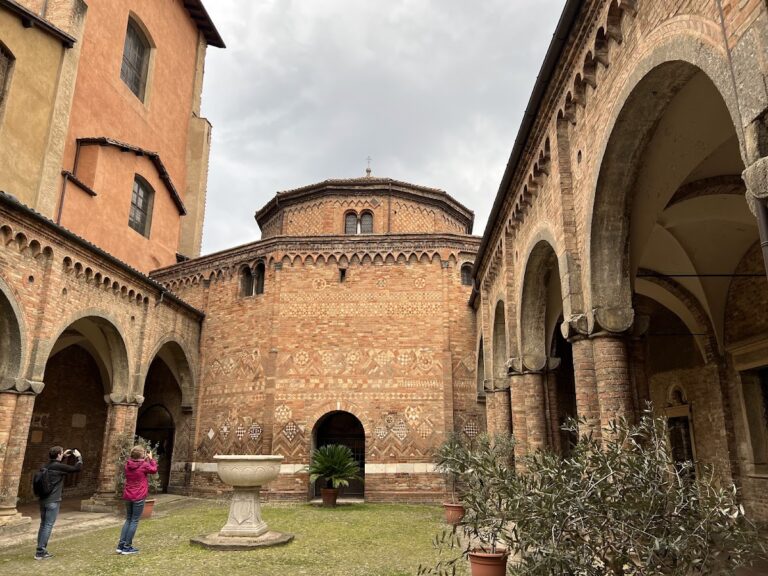
In front of the church, the portico forms a spacious quadrangular atrium, an open or partly enclosed forecourt before a church. Round-headed arches rest on elegant Verona-marble columns. The arcade encloses the small square without interruption, is closed on one side by convent buildings, remains open to the street on two sides, and extends along the entire left side of the basilica.
At the facade, the arcade becomes a five-arched narthex, a broad entrance porch or vestibule extending across the front of the church. It has a decorative cornice and circular mouldings in the spandrels, the spaces between the arches and their surrounding frames. These mouldings echo the circular oculus in the facade.
Bell tower and bells
Tower structure
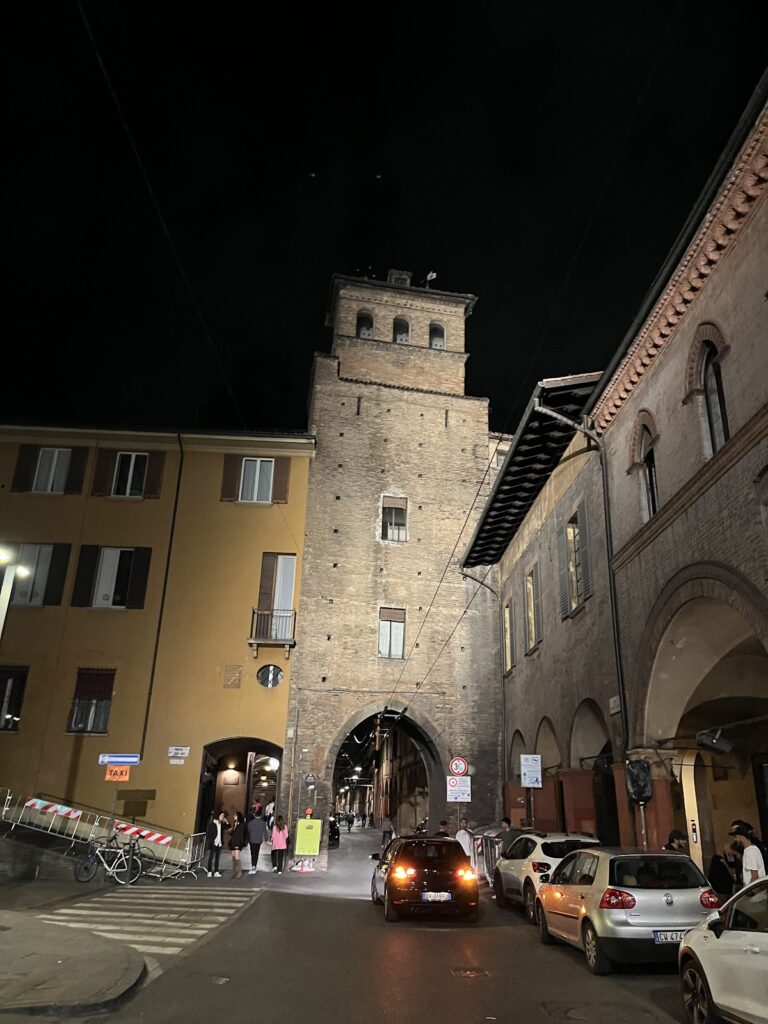
The massive bell tower rises beside the apse. Four corner piers support a tall spire resembling the one at the Basilica of San Domenico, bringing the tower’s height to 52 metres. The bell chamber has large, round-headed, single-light openings closed by characteristic louvres.
Bell chamber
Five bells hang in the chamber. The largest, tuned to E-flat 3, has a diameter of 130 centimetres and weighs approximately 1,600 kilograms. Pietro Francesco Censori cast it in 1639. The mezzana, tuned to A-flat 3, measures 97.5 centimetres across, weighs about 650 kilograms, and was cast by Leone Vernizzi in 1507. The mezzanella, tuned to B-flat 3, was cast by Cesare Landi in 1770. It measures 86.8 centimetres in diameter and weighs approximately 450 kilograms.
The smaller bell, also cast by Cesare Landi in 1770, is tuned to C 4, measures 78.7 centimetres, and weighs about 320 kilograms. The smallest bell associated with the large bell is tuned to E-flat 4, has a diameter of 65.5 centimetres, weighs approximately 180 kilograms, and was cast by Serafino Golfieri in 1847. The bells have characteristic Bolognese wooden stocks and are mounted in an iron frame. The three smaller bells use a chain-operated electrical system for automatic ringing, while the two larger bells are not electrified. The smallest bell is practically impossible to sound by the manual double-ring method because of its position and mounting.
Chapels and artworks
Right-hand chapels
The shallow chapels along the right side of the nave contain works from the sixteenth to the eighteenth centuries. The first chapel holds Marcantonio Franceschini’s The Virgin Giving the Habit to the Seven Founding Saints of the Servite Order, dated 1727. Above it is a God the Father by Guercino. The same chapel contains Giulio Morina’s The Presentation in the Temple from 1594, Bernardino Baldi’s Saint Francis Praying for the Souls in Purgatory, and a 1603 bust of Domenico Landinelli.
The third chapel contains Ercole Graziani’s The Death of Saint Giuliana Falconieri, dated approximately 1737. The fourth has Dionisio Calvaert’s Paradise from 1602, a Saint Joseph with the Christ Child by Luigi Crespi, and seventeenth-century wooden statues of Faith and Charity by Giovanni Lamberti, made after a design by Calvaert.
The sixth chapel contains a Crucifix by Giovanni Battista Bolognoni the Elder, dated 1665, together with Bartolomeo Cesi’s Saint Teresa of the Child Jesus, a fragmentary fresco of the Mystical Marriage of Saint Catherine attributed to Lippo di Dalmasio, and the tomb of Blessed Venanzio Maria Quadri. The eighth chapel contains a Trinity by Jacopo Alessandro Calvi.
Left-hand chapels
The first chapel on the left contains Angelo Piò’s Our Lady of Sorrows. The second has Francesco Albani’s Noli me tangere, dated 1644. A side entrance is surrounded by the monument to Ludovico Gozzadini, made by Giovanni Zacchi around 1540.
The fifth chapel contains Francesco Albani’s Saint Andrew the Apostle, dated 1641, while the sixth holds Pietro Faccini’s Assumption. The seventh is the Bolognetti Chapel, where Innocenzo da Imola’s Annunciation is set within a valuable frame by Andrea Formigine. The chapel also contains frescoes known as The Glory Taken from Raphael. The eighth chapel has Christ Crucified Healing Pellegrino Laziosi by Domenico Viani and Pier Francesco Cavazza, as well as an Ecce Homo by Bartolomeo Sirani in the pier.
Choir, ambulatory, and sacristy
Choir and radial chapels
The choir is surrounded by an ambulatory, a passage that encircles the choir or apse, and opens onto three radial chapels. Traces of frescoes by Vitale da Bologna survive on the walls at the beginning of the ambulatory. The area also contains Vincenzo Onofri’s polychrome terracotta altarpiece of the Virgin and Child with Saints Lawrence and Eustace, dated 1503, and an original fresco polyptych with terracotta framing by Lippo di Dalmasio. A polyptych is an artwork composed of several panels.
The high altar has a marble tabernacle showing the Risen Christ between the Virgin and Saint John the Baptist, with Saints Peter and Paul, made by Giovanni Angelo Montorsoli, a sixteenth-century sculptor and architect who had been a pupil of Michelangelo. Fourteenth-century wooden choir stalls stand behind it.
Near the beginning of the ambulatory are Alessandro Tiarini’s Presentation of Mary in the Temple, Andrea da Faenza’s tomb slab, surviving fourteenth-century frescoes, and Vincenzo Onofri’s monument to Gian Giacomo and Andrea Grati. The first radial chapel contains a Virgin and Child with Angels, traditionally attributed to Cimabue but regarded as a work of his workshop, and Lippo di Dalmasio’s Virgin and Child with Saints Cosmas and Damian.
Sacristy and side frescoes
The sacristy contains three Stories of Saint John the Baptist by Mastelletta, painted between 1620 and 1623. It also holds a terracotta relief of the Adoration of the Virgin, attributed to Donatello and Bartolomeo Bellano, painted by Neri di Bicci and dated approximately 1455 to 1460.
The lunettes along the church’s sides retain partial seventeenth-century frescoes depicting episodes from the life of Saint Philip Benizi, a thirteenth-century Servite friar and saint who became a leading figure of the order. The paintings were worked on by Carlo Cignani and his workshop, Giovanni Peruzzini, Giuseppe Maria Mitelli, the young Filippo Pasquali, and others. Small fragments of the earlier fifteenth-century decoration also survive, including a Madonna within an aedicule, a small architectural frame resembling a miniature shrine. Four lunettes were detached in 1958, restored, and placed in the former monastery, while most of the later lunettes are heavily faded.
Monastery and musical heritage
Monastery artworks
The former monastery contains Alessandro Tiarini’s Madonna of the Sanctuary of Mondovì in Glory with Saints, Guido Reni’s Saint Charles Borromeo and Angels from 1613, and a Virgin and Child by Giovanni da Modena. These works remain associated with the monastery complex that developed beside the basilica for the Servite community.
Pipe organ
The Tamburini pipe organ, opus 544, was built in 1968 to a design by Luigi Ferdinando Tagliavini and inaugurated on 1 April that year. Its transmission is mechanical for the manuals and pedal and electro-pneumatic for the stops. The instrument has three 61-note keyboards, a 32-note concave-radial pedalboard, and approximately 5,000 pipes divided among 60 stops.