St Margaret’s Church, Barking: A Medieval Parish Church beside Barking Abbey


Site at a Glance
- Rating
- 4.6
- Popularity
- Very Low
- Country
- United Kingdom
- Primary era
- Medieval
- External website
- Open
- Eras represented
- Medieval, Modern
- Civilizations
- English
- Site type
- Religious
- Remains
- Church
On this page8 sections
History
St Margaret’s Church, Barking is a medieval parish church in the United Kingdom, originating as a chapel for local people within the grounds of Barking Abbey in 1215. Its oldest surviving part, the chancel, was built in the early thirteenth century during the reign of King John. The church stands south of the former abbey church, near the surviving abbey ruins, and remains dedicated to Margaret the Virgin, also known as Margaret of Antioch, a Christian saint traditionally associated with Antioch and venerated as a virgin martyr.
From abbey chapel to parish church
The building was said to have become a parish church in 1300 through the action of Anne de Vere, abbess of Barking Abbey. Until the 1390s, the parish formed a rectory held by the abbey and was divided between the Northstrete and Southstrete vicarages. A rectory was an ecclesiastical office connected with parish income and administration, while a vicarage was the office and benefice of a vicar serving the parish. Severe flooding in the late fourteenth century created financial difficulties, and the two vicarages were merged from 1398 onwards. Worship was led by a chaplain from the abbey.
The church remained a parish church after Barking Abbey was dissolved during the Reformation. Its rectory and advowson passed to the Crown, which leased them to Mary Blackenhall for 21 years in 1540. The advowson was the legal right to appoint or present a parish’s clergy.
The All Souls College grant
In 1557, Robert Thomas and Andrew Salter purchased the rectory and advowson using money from the estate of William Pownsett of nearby Loxford. They granted both to All Souls College, Oxford. The grant required the vicar to pray each Sunday for Pownsett, his parents, and his benefactors. It also required an annual distribution of 6 shillings and 8 pence among twenty poor people on the anniversary of Pownsett’s death, an annual payment to the college for two poor scholars, and residence in the parish for all but 80 days of each year.
All Souls College presented the vicar in 1560, but the Crown challenged the college’s right at the next vacancy. A lawsuit overturned the Crown’s challenge. Sir John Petre reconfirmed the grant in 1594, although he omitted the obligation to pray for the dead. The right of presentation is now shared by All Souls College, the Bishop of Chelmsford, and the churchwardens.
Later history and continuing parish life
Captain James Cook, the eighteenth-century British maritime explorer, cartographer, and naval officer, married Elizabeth Batts at the church on 21 December 1762. The nave, chancel, and sanctuary received plaster ceilings in 1772, while the plaster was removed from the nave ceiling in 1842.
The interior was restored between 1929 and 1936, with Charles Winmill and George Jack involved in the work. St Margaret’s became a Grade I listed building in 1954. Grade I is the highest category of listing for buildings of exceptional architectural or historic interest in England.
In the late 1970s, the parish became part of a team parish with Christ Church and St Patrick’s. On 1 January 2017, both churches gained separate parishes taken from the team-parish area, leaving St Margaret’s with a smaller parish. Its parish has three churchwardens rather than two. The church remains an active Church of England parish church in the Diocese of Chelmsford, within the Province of Canterbury, with an Anglo-Catholic and open evangelical tradition.
Burials and memorial associations
Several figures connected with the area’s history were buried at St Margaret’s. Daniel Day, founder of Fairlop Fair, was interred in a coffin made from a bough that had fallen from the Fairlop Oak. Fairlop then formed part of the ancient parish of Barking. Henry Fanshawe, a Member of the English Parliament during Elizabeth I’s reign and Queen’s Remembrancer from 1565 until his death in 1568, was also buried at the church. Sir Charles Montagu of Cranbrook Hall, who sat in the House of Commons from 1614 to 1625, was buried here as well.
Remains
Church building
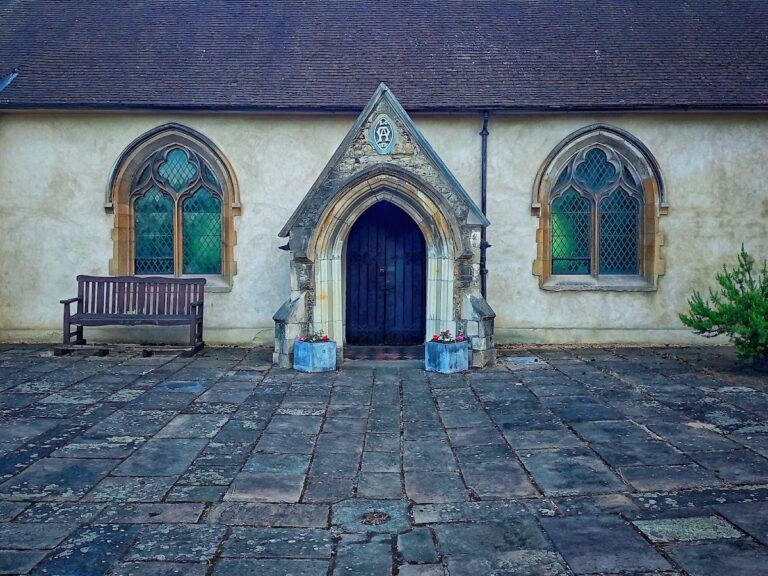
St Margaret’s stands within the grounds of Barking Abbey, south of the former abbey church and close to the abbey ruins. The building is approximately 134 feet (41 metres) long and 64 feet (20 metres) wide, and reaches about 75 feet (23 metres) in height. Its earliest surviving element is the chancel, the eastern part of the church used by the clergy, which dates from the early thirteenth century. The present bell tower was added in the late fifteenth century.
The nave, the main area for the congregation, the chancel, and the sanctuary, the most sacred area around the altar, received plaster ceilings in 1772. Plaster was removed from the nave ceiling in 1842. A late-twentieth-century extension along the south side contains an office, bookshop, and refectory.
Memorials and public sculpture
The church contains several memorials, including a mural monument to Sir Charles Montagu. The monument shows a small effigy of Montagu fully armed and seated in a military tent during a campaign.
In front of the church is a sculpture made from two stones taken from the remains of medieval London Bridge. Installed in 2007, it faces the ruins of Barking Abbey and formed part of a group of public artworks placed in Barking Town Centre by Joost Van Santen.