Ahmad Al-Badawi Mosque: A Sufi Shrine and Mosque Complex in Egypt


Site at a Glance
- Rating
- 4.5
- Popularity
- Medium
- Country
- Egypt
- Primary era
- Medieval
- Eras represented
- Medieval, Early Modern, Modern
- Civilizations
- Mamluk
- Site type
- Religious
- Remains
- Mosque
On this page10 sections
History
Ahmad Al-Badawi Mosque is an active Sunni Sufi mosque and shrine complex in Tanta, Egypt, built around the mausoleum of Ahmad al-Badawi, a Moroccan-born mystic and founder of the Badawiyya, also called the Ahmadiyya, one of Egypt’s major Sufi orders. The site became a major religious center in the Nile Delta and is regarded as the largest mosque in Tanta and Gharbia Governorate.
From mausoleum to Sufi lodge
Ahmad al-Badawi died in Tanta on 24 August 1276, at about 79 years of age. After his death, his student and successor Abd al-Aal built a large retreat beside the grave. The retreat later became a khanqah, a Sufi institution for communal residence, instruction, and worship, where members of the Badawiyya order could live and practice.
Mamluk and eighteenth-century expansion
Under the Mamluk Sultan Al-Nasir Muhammad, the site was incorporated into a mosque. The Mamluk Sultanate was the medieval Islamic state that ruled Egypt and Syria, and its architecture was known for monumental stone buildings, domes, minarets, and elaborate muqarnas. The complex was enlarged under Sultan Qaytbay.
During the rule of Ali Bey al-Kabir, an eighteenth-century Mamluk leader who governed Egypt with substantial autonomy from Ottoman authorities, a major domed mosque was established around the shrine. A copper enclosure was placed around Ahmad al-Badawi’s grave. Ali Bey also endowed agricultural land and real estate to support the mosque, its scholars, poor residents, students, and followers of the Badawiyya order.
Educational role and modern rebuilding
In the twelfth Islamic century, the mosque became an institute for Islamic sciences modeled on Al-Azhar, Cairo’s historic center of Islamic learning and a major Sunni institution. It had more than 2,000 students and its own shaykh, whose status was comparable to that of the shaykh of Al-Azhar. The complex reached its greatest prosperity during the fourteenth Islamic century.
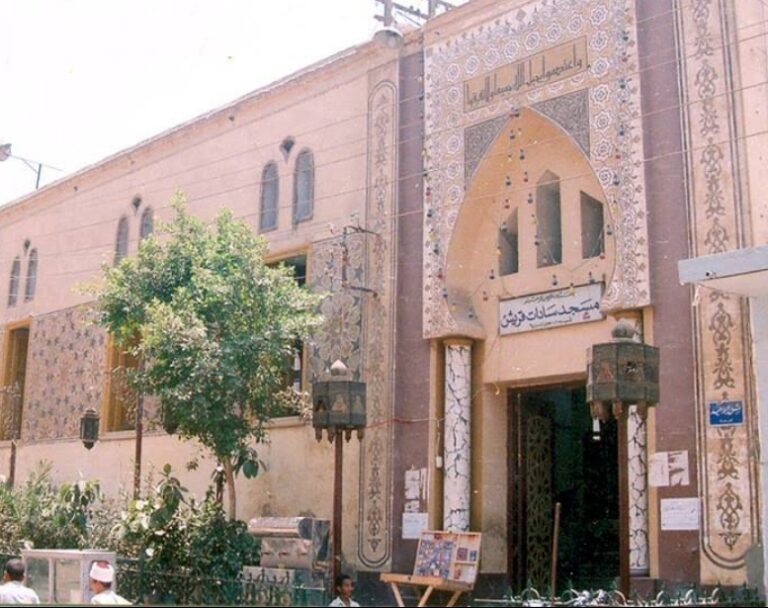
Earlier enlargements took place under Abbas I, Muhammad Said, Khedive Ismail, Abbas II, and King Fuad. During the 1960s, the entrance with its two minarets was built and an iwan, a vaulted hall open on one side, was added. Further expansion followed in 1975 during the presidency of Anwar Sadat. The mosque was renovated in 2005 and renewed again in 2008.
Religious celebrations
Ahmad Al-Badawi Mosque remains an important Sunni pilgrimage destination. Its annual Mawlid, a festival commemorating the religious significance of a revered figure, has attracted as many as three million pilgrims and involves 67 Sufi orders. A separate week-long Rajabi festival is held each year during the first half of April, associated with the Islamic month of Rajab.
Remains
Layout and architectural form
The mosque is a square building organized around a central courtyard enclosed by four arcades. A high dome covers the courtyard, while the rebuilt complex occupies approximately one and a half feddans, a traditional Egyptian land measure of about 4,200 square metres. Seven entrances serve the building, with four on the western side and one on each of the other three sides. Three domes and three minarets define the complex, whose funerary mosque design combines Mamluk and neo-Mamluk forms. The entrance is associated with the two minarets added during the 1960s. Muqarnas, tiered honeycomb-like architectural forms, appear in the exterior and interior decoration, and the mihrab, the niche marking the direction of prayer, incorporates pieces of rare mosaic material.
Shrine and associated objects
Burial area
On the southern, or qibla, side of the mosque are the graves of Ahmad al-Badawi, his student Abd al-Aal, and Shaykh Mujahid. A copper zarih, an ornamental enclosure around a saint’s tomb, surrounds Ahmad al-Badawi’s shrine.
Objects linked to Ahmad al-Badawi
The mosque preserves objects associated with Ahmad al-Badawi, including a rosary approximately 10 metres long with 1,000 beads, together with his turban, garment, and wooden staff.