Santa Lucia dè Magnoli: A Historic Parish Church in Florence


Site at a Glance
- Rating
- 4.5
- Popularity
- Very Low
- Country
- Italy
- Primary era
- Early Modern
- External website
- Open
- Eras represented
- Medieval, Early Modern, Modern
- Civilizations
- Grand Duchy of Tuscany, Holy Roman Empire, Republic of Florence
- Site type
- Religious
- Remains
- Church
On this page16 sections
History
Santa Lucia dè Magnoli, also known as Santa Lucia dei Magnoli, is a Roman Catholic church in Florence, Italy, founded in 1078 and now predominantly Renaissance in appearance. Located on Via de’ Bardi in the Oltrarno district, it is dedicated to Saint Lucy of Syracuse, an early Christian martyr, and serves as the seat of a parish within the Archdiocese of Florence.
Foundation and medieval development
The church was established by the knight Uguccione Della Pressa, who owned mills on the Arno. After his death, his son Magnolo completed the foundation, and responsibility for the church passed to his descendants. Their connection gave rise to the name “dei Magnoli.” The church was also known as Santa Lucia “de’ Bardi,” after the nearby houses of the Bardi family, and as “delle Rovinate,” “alle Rovinate,” or “tra le Rovinate,” names associated with an area affected by repeated landslides.
Between 1173 and 1175, Santa Lucia was incorporated into Florence’s Oltrarno walls. It later belonged to the city’s 36 parishes within the final circuit of walls, constructed between 1284 and 1345. The church stood beside institutions connected with pilgrimage and charitable care. A hospital dedicated to Saint Lucy was later incorporated into Palazzo Canigiani, while a lazaretto, an institution used to isolate people affected by contagious diseases including leprosy, stood in front of the church along the urban continuation of the ancient Roman Via Cassia.
Saint Francis of Assisi stayed at the lazaretto during his first visit to Florence in 1211. A tabernacle erected in 1956 commemorates this association. The church’s patronage was granted to the Benedictine monastery of San Miniato al Monte in 1246 and passed directly to the Bishop of Florence in 1373.
Patronage and Renaissance transformation
In 1421, the Florentine political figure and art patron Niccolò da Uzzano obtained the patronage of Santa Lucia and sponsored a restoration. He also commissioned Lorenzo di Bicci to decorate the main chapel with scenes from the life of Saint Lucy. The commission included a portrait of Uzzano himself. The church, originally Romanesque and later Gothic, was subsequently remodelled in the Renaissance.
A major physical change occurred in 1547, when the hill in front of the church collapsed together with the buildings on it. This event reinforced the popular name Santa Lucia delle Rovinate. The remodelled church was consecrated on 1 May 1584 by Cardinal Alessandro de’ Medici, who later became Pope Leo XI. In 1638, Santa Lucia was raised to the rank of a priory, a religious institution administered by a prior.
Seventeenth- and eighteenth-century additions
An oratory dedicated to Saints Lucy and Lawrence was built beside the church in 1641 for the Company of the Most Blessed Sacrament, a lay religious association organized for devotional and ritual purposes. The church also received relics through the efforts of Girolamo Rosati, an apostolic protonotary who served as its prior from 1637. The relics were donated in 1644 and 1652.
The Chapel of Loreto was built in 1714–1715 for a confraternity founded in 1692. Cosimo III, the Medici grand duke of Tuscany, transferred to the chapel a venerated Black Madonna that had previously stood in an over-door shrine at the Sanctuary of the Holy House of Loreto. The image had been kept at Santa Maria degli Ughi between 1692 and 1705. The new chapel was conceived in relation to the Holy House of Loreto, a Catholic shrine traditionally believed to preserve the house associated with the Virgin Mary.
The altars were rebuilt in 1732, and further restorations followed in 1752 and 1837. A later intervention by the monuments heritage authorities strengthened the church’s Renaissance appearance while retaining Baroque additions. The church continues to function as a Catholic place of worship and includes a Polish-language Mass among its religious services.
Paintings and later conservation
Domenico Veneziano’s Sacra Conversazione, a devotional image of the Madonna and Child surrounded by saints in a unified sacred setting, was painted around 1445 for Santa Lucia. Known as the Santa Lucia dei Magnoli Altarpiece, it was transferred to the Uffizi, and a copy was later placed beneath the choir loft. The present main altarpiece was installed above the high altar in 1941.
The church’s artistic history also includes a series of frescoes and a panel commissioned from Bicci di Lorenzo by Niccolò da Uzzano for the presbytery. Further works were added during the Baroque period and in later restorations, preserving the building’s layered history within a largely Renaissance setting.
Remains
Santa Lucia dei Magnoli presents a predominantly Renaissance structure with Baroque embellishments. Its gabled façade is finished with faux rustication in sgraffito, a technique in which a surface layer is scratched to expose a contrasting layer below. The central portal is crowned by a glazed terracotta lunette showing Saint Lucy between two angels, made by Benedetto Buglioni around 1510–1520.
Façade and exterior features
Front elevation
Three openings light the upper façade: a circular splayed oculus and two broad, round-headed single-light windows. A plaque dated 1646 records an order by the Otto magistrates prohibiting games in the vicinity of the church. At the rear, visible from Lungarno Torrigiani, a two-opening bell-gable rises above the building. The centre of the apsidal end wall preserves the outline of a former pointed-arch window, with the coat of arms of the Uzzano family above it.
Nave and lateral altars
Main nave
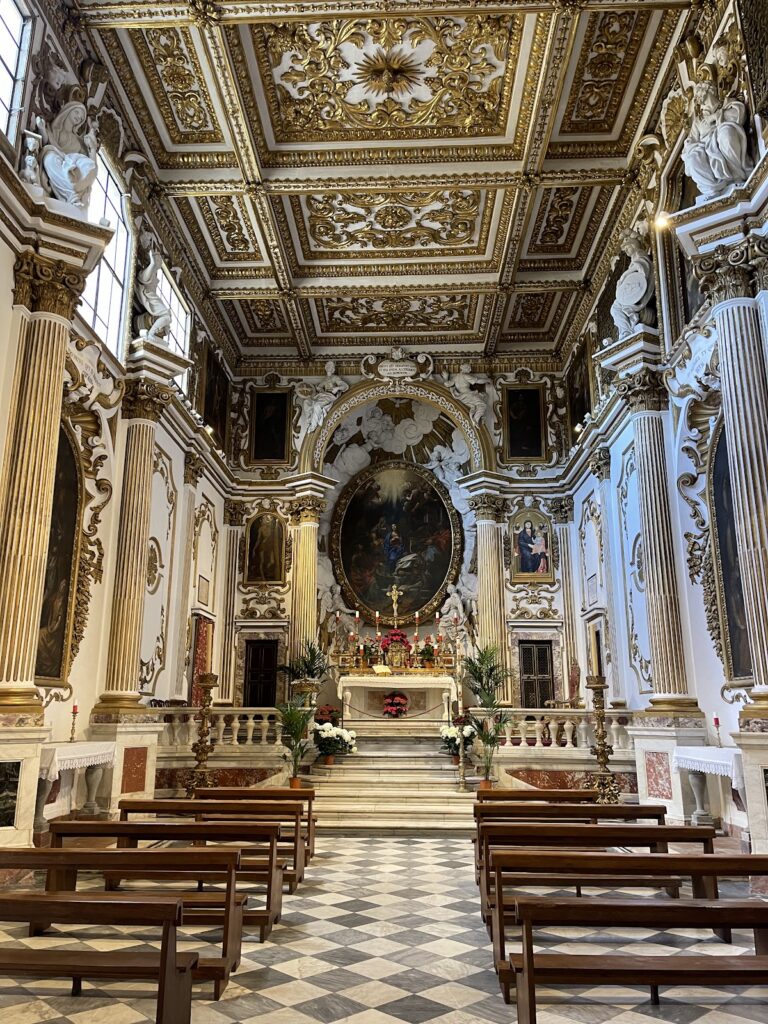
The interior has a single nave covered by a painted wooden ceiling. Paolo Sarti painted its nineteenth-century Glory of Saint Lucy, while Gaetano Carraresi added monochrome architectural decoration. Six lateral altars made from pietra serena, the grey sandstone widely used in Florentine Renaissance architecture, were constructed in 1732.
Right-hand altars
The first altar on the right contains Christ in Glory with the Madonna and Saints, attributed to Fabrizio Boschi and dating from the first half of the seventeenth century. It was under the patronage of the Nasi family. The second altar houses numerous relics donated through Girolamo Rosati. The third altar was commissioned by the Bigallo Magistracy, a Florentine charitable and administrative institution associated with assistance to the poor and the management of charitable foundations, and placed under the patronage of the Bardi Larioni family.
The third altar contains a seventeenth-century copy by Ottavio Vannini of Andrea del Sarto’s Disputation on the Trinity, painted in 1517. The copy replaced the original in 1620 after the original was removed from San Jacopo tra i Fossi at the order of Grand Duchess Maria Magdalena of Austria. Following the suppression of that church, Vannini’s copy spent a period in the deposits of the Florentine Galleries before being installed at Santa Lucia in 1862 as compensation for the temporary transfer of Domenico Veneziano’s altarpiece.
Left-hand altars
The first altar on the left contains a panel of Saint Lucy painted by Pietro Lorenzetti around 1320. The altar was under the patronage of the Del Nente family. The second altar contains Jacopo Chimenti’s Madonna and Child with Saints Anthony Abbot, John the Baptist, Bernard of Clairvaux, and Charles Borromeo, painted around 1606–1609 under the patronage of the Barucci and Del Ruota families.
Opposite the right-hand third altar, the altar under the patronage of the Tucci family contains a canvas of Saint Christina by Francesco Curradi. Beside the rear portion of the nave, a Crucifix associated with the Company of the Whites was made by Baccio da Montelupo.
Chapel and apse
Side chapel
A side chapel opening at the rear of the right-hand nave wall contains Jacone’s 1523 panel Double Intercession and Saints. Its unusual subject presents the Madonna interceding with Jesus, while Jesus intercedes with the Father. The same altar also contains a seventeenth-century copy by Cristofano Allori of the Annunciation venerated at Florence’s Basilica of Santissima Annunziata.
Apse and high altar
The nave ends in a square-plan apse that is narrower than the nave. Its groin vault carries rich raised stucco decoration. The high altarpiece, transferred from the church of Saints Jerome and Francis at the Costa and kept at Santa Lucia since 1878, depicts the Madonna and Child with Saint Anne and Saints Martin, John the Baptist, Pope Sylvester I, and Philip Benizi. It is attributed to a sixteenth-century Florentine painter identified as Giovanni Scheggini, known as Graffione.
Against the rear wall of the apse stands the Mascioni pipe organ, opus 827, built in 1963. It has electric action, 17 stops, two manuals, and a pedalboard. Above the organ, between two rectangular windows, is a canvas attributed to Pier Dandini or a follower. The painting depicts the Martyrdom of Saint Lucy and dates from the first decade of the eighteenth century. A glazed-plaster tabernacle made by Vincenzo Marinelli in 1837 stands on the left wall and houses the holy oils.
Chapel of Our Lady of Loreto
The Chapel of Our Lady of Loreto opens from the beginning of the right-hand nave wall. Built in 1715 by the Loreto confraternity, it is rectangular and covered by a barrel vault. Its dimensions were designed to match those traditionally assigned to the Holy House of Loreto.
Traces of the chapel’s original fresco decoration survive, reflecting its intended resemblance to the fourteenth-century decoration of the Holy House. A niche contains a wooden statue of Our Lady of Loreto from the sanctuary, dressed in an embroidered garment donated by Anna Maria Luisa de’ Medici, a Medici noblewoman and patron of the arts. On the opposite wall are panels of the Announcing Angel and the Announced Virgin. Formerly placed beside Lorenzetti’s Saint Lucy, they are attributed either to Jacopo del Sellaio, with a date of 1473, or to Filippino Lippi, from the beginning of the sixteenth century.