St. Martha: A Gothic Church and Stained-Glass Monument in Nuremberg


Site at a Glance
- Rating
- 4.8
- Popularity
- Low
- Country
- Germany
- Primary era
- Medieval
- External website
- Open
- Eras represented
- Medieval, Modern
- Civilizations
- German, Holy Roman Empire
- Site type
- Religious
- Remains
- Church
On this page9 sections
History
St. Martha is a Gothic church in Nuremberg, Germany, founded in 1363 together with an associated pilgrims’ hospital. Dedicated to Saint Martha, the Christian figure traditionally associated with hospitality and service, the church became an important setting for worship and artistic patronage in the medieval city. Its surviving stained glass, produced from about 1385 to 1430, forms one of the central elements of its historical importance.
Foundation and consecration
The foundation promise was made in 1356 by Agnes Pfinzing and Conrad von Waldstromer, the parents of Conrad and John von Waldstromer. Their sons carried out the foundation in 1363. St. Martha was consecrated on 24 March 1385, when its three altars were dedicated to the Holy Trinity, the Virgin Mary, and the Twelve Apostles.
From about 1390 to 1430, wealthy Nuremberg patrician families endowed the church with successive groups of stained-glass windows. These commissions connected the church to the city’s influential families and to the skilled workshops that produced glass for institutions beyond Nuremberg.
Reformation and changing use
The Reformation, the sixteenth-century religious movement that led to the formation of Protestant churches, brought a decisive change. St. Martha and its pilgrims’ hospital were closed in 1526. The former church then served theatrical performances and as a rehearsal space for the Nuremberg Meistersingers, urban masters of German-language song who organized formal singing associations and staged performances. They maintained their own stage in the building until performances there were prohibited in 1614.
Renovation began in 1615, and the building returned to ecclesiastical use by 1627. In 1800, St. Martha was transferred to the Evangelical Reformed congregation, a Protestant tradition within the Reformed branch of Christianity. Its statues and altar were removed and transferred to St. Lawrence Church.
War damage, fire, and rebuilding
On 21 February 1945, an aerial bomb dropped by a United States Army Air Forces bomber damaged the roof and the chancel vault. The damage was relatively slight, and repairs were completed by 1946.
A far more destructive event occurred in the early hours of 5 June 2014, when a fire consumed the entire roof structure. The burning roof collapsed into the nave, the principal space used by the congregation, destroying the organ and two of the three bells and severely weakening the building. During the work that followed, services were held in the neighboring Roman Catholic Church of St. Clare.
St. Martha was rebuilt rather than returned completely to its earlier interior form. The historic walls were repaired, while a modern interior designed by Florian Nagler introduced a simple raised wooden ceiling. The church officially reopened on 10 November 2018, with the rebuilding carried out by Florian Nagler Architekten. It is now part of the Evangelical Reformed Church, a station on Nuremberg’s Historical Mile, and a protected historic monument.
Remains
Setting and medieval fabric
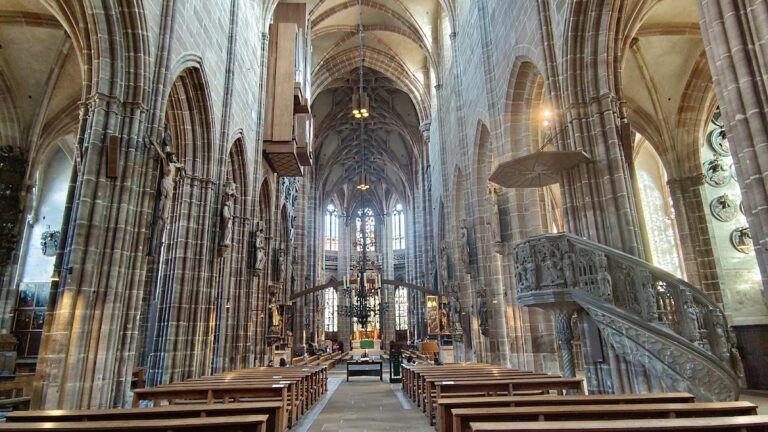
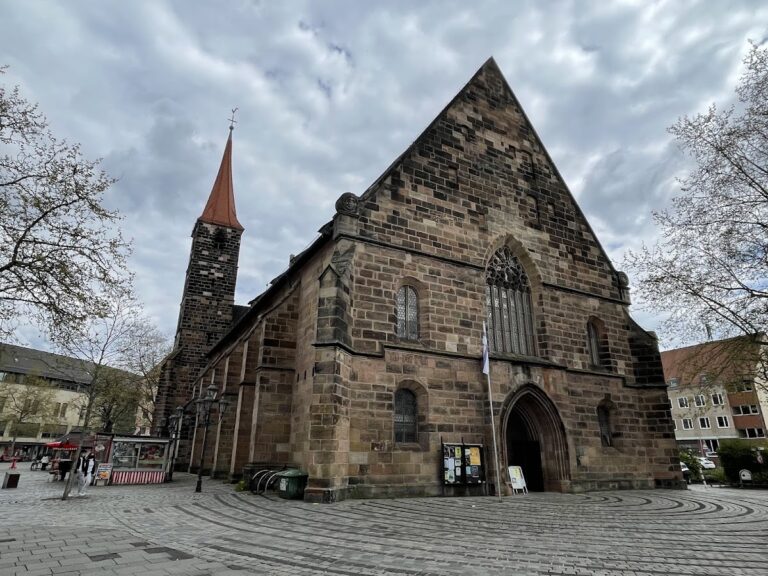
St. Martha stands back from Königstraße in Nuremberg’s old town, occupying a gap between two houses. An alleyway between the buildings leads to the entrance. The church lies diagonally opposite St. Clare’s Church and between the Königstor and St. Lawrence Church. Its historic walls survive with visible traces of the 2014 fire, while the rebuilt interior is distinguished by the raised wooden ceiling. The chancel, the eastern part of the church containing the main altar and liturgical space, retains its historic form.
Medieval stained glass
The chancel windows and the windows at the eastern ends of both side aisles preserve a substantial part of the church’s medieval glazing. The side aisles run alongside the nave, and together these surviving windows contain approximately 150 individual panels made from about 1385 to 1430.
The chancel glazing forms a connected theological program commissioned by different patrician families. Its imagery follows sacred history from the Creation of the world to the Last Judgment. One notable subject is the “Fifteen Signs before the Last Judgment,” shown in the Rieter Window. These themes reflect the crisis-consciousness associated with the aftermath of the Great Plague in the mid-fourteenth century.
The glass was made by capable Nuremberg workshops whose work was exported well beyond the city in the late fourteenth and early fifteenth centuries. Some of the most artistically important nave windows were produced by glass painters who also worked around 1400 for Erfurt Cathedral, Ulm Minster, and the Electoral Palatine residence at Amberg. The preserved glazing was refitted in the chancel during the rebuilding.
Organ and interior furnishings
The organ destroyed in the 2014 fire had been built in 1990 by Peter Vier of Friesenheim. It contained 30 speaking stops, meaning organ controls that select distinct ranks of pipes, including two preparation stops, and was arranged across two manuals and pedal with mechanical actions. The first manual also functioned as a coupling manual.
The present organ was built in 2019 by the Lutz Organ Manufactory of Feuchtwangen. It is a slider-chest instrument, using movable sliders to admit air to selected ranks, with 31 stops including four extended pedal stops. It has two manuals and pedal, Neidhardt’s “small town” temperament, mechanical key action, and mechanical and additional electric stop action in a double-action system. Its equipment includes manual and pedal couplers, an electronic setter with 20 groups of 1,000 combinations, a USB port, a crescendo roller with three programmable rollers, page-turning controls for digital music on tablets, and controls for the swell.
Bells and surviving metalwork
A fourteenth-century hour bell cast by the bell founder Hans Glockengießer once hung unused in the small turret on the west gable. It survived the fire but broke into three pieces during recovery. The Lachenmeyer Bell Welding Works repaired it, and it sounded again in the chancel on 4 October 2015 after an interval of 60 years.
After the Second World War, two replacement bells were cast in 1950. They sounded on A1 and D2 and were named for the Reformers John Calvin and Ulrich Zwingli. The two bells destroyed in the 2014 fire were replaced by new castings made by the Rincker Bell and Art Foundry in 2017. All three bells are now installed in the attic belfry, with the arrangement modified to incorporate the surviving historic bell into the complete peal.