Kfar Bar’am: An Ancient Jewish Settlement and Synagogue Complex in Israel


Site at a Glance
- Rating
- 4.5
- Popularity
- Medium
- Country
- Israel
- Primary era
- Classical
- External website
- Open
- Eras represented
- Classical, Medieval
- Civilizations
- Byzantine, Roman
- Site type
- Religious
- Remains
- Synagogue
On this page8 sections
History
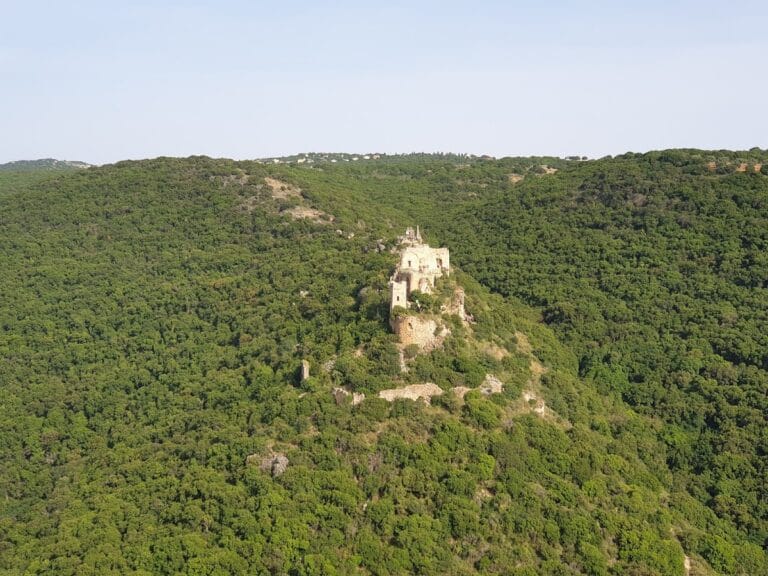
Kfar Bar’am is an ancient Jewish settlement and synagogue complex in Israel, in the Upper Galilee, associated with the periods of the Mishnah and Talmud. Its larger synagogue is generally dated to the Roman period, probably around 220 CE, although some archaeological interpretations place the surviving synagogue remains in the late fourth or early fifth century. The site reflects the long religious and communal history of Jewish life in Galilee during late antiquity.
Jewish Settlement and Medieval Traditions
Kfar Bar’am was probably abandoned during the Mamluk period, the era when Mamluk sultanates ruled the eastern Mediterranean, although Jewish habitation continued into the fifteenth century. Medieval Jewish travelers still described its synagogues. In 1210, Samuel ben Samson wrote of a beautiful synagogue standing above a Jewish grave, and later travelers praised the building as exceptionally magnificent.
Rabbi Moses Basula recorded the ruins in 1523 and linked the synagogue with Simeon bar Yochai, a second-century Jewish sage traditionally associated with the period of the Bar-Kochba revolt of 132–135 CE. A related tradition holds that the synagogue was built in his honor and bore his name, although the building is dated at least a century later than his lifetime. Jewish tradition also identifies Kfar Bar’am as the burial place of Pinchas ben Yair, a second-century Jewish religious figure. Other local traditions connect graves in the area with Mar Zutra, the prophet Obadiah, Nachman Katufa, Esther, and the prophet Isaiah.
Christian Occupation and Modern Investigation
After a period of Muslim occupation, the village was entirely Christian by the nineteenth century and included Maronite and Melkite inhabitants. The Maronites and Melkites are distinct Christian communities with longstanding traditions in the eastern Mediterranean. A Maronite church on the site was in regular use, but the Galilee earthquake of 1837 badly damaged both the church and the synagogue remains. The church south of the synagogues remains standing and is used on holidays and for special events.
Edward Robinson, an American biblical scholar and explorer, identified the ruins as synagogues in 1852. In 1928, the archaeologist Lipa Sukenik excavated a relief from one of the buildings and dated the Bar’am synagogue to the third century. Earlier interpretations had also proposed different dates. Ernest Renan assigned the northern synagogue, or at least its lintel, to the second century, while Heinrich Kohl and Carl Watzinger used its artistic and architectural features to establish its period.
Kafr Bir’im was captured by the Israel Defense Forces on October 31, 1948, during Operation Hiram, a military operation in the final phase of the 1948 war, and its inhabitants were forced to leave. Kibbutz Bar’am was founded nearby on June 16, 1949, by demobilized Palmach soldiers. The communal settlement took its name from Kfar Bar’am. The ruins now lie within Bar’am National Park and have been restored as an archaeological site. Photographs published in 1901 also inspired the Jewish Hospital of Philadelphia, now the Albert Einstein Medical Center, to build the Henry S. Frank Memorial Synagogue on the model of Bar’am and other ancient synagogues.
Remains
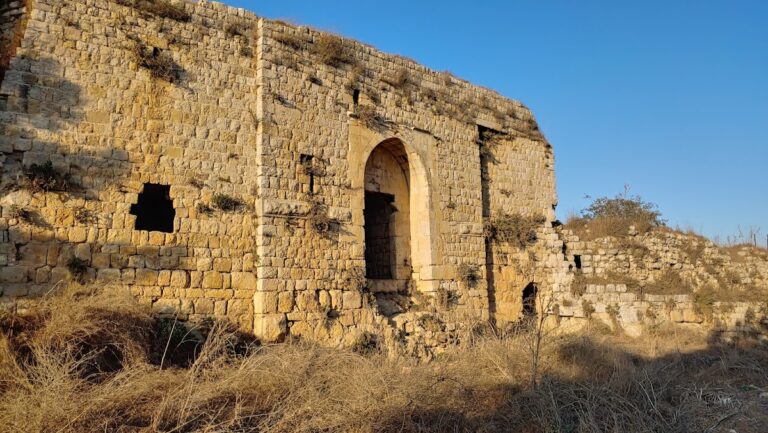
The site preserves two former Jewish synagogues built chiefly of basalt, the standard building stone of the area. The larger building survives to its second story and has been restored, while the smaller synagogue survives in much more limited form. Their remains occupy the principal archaeological area, with the Maronite church standing to the south.
Synagogue Remains
The Larger Synagogue
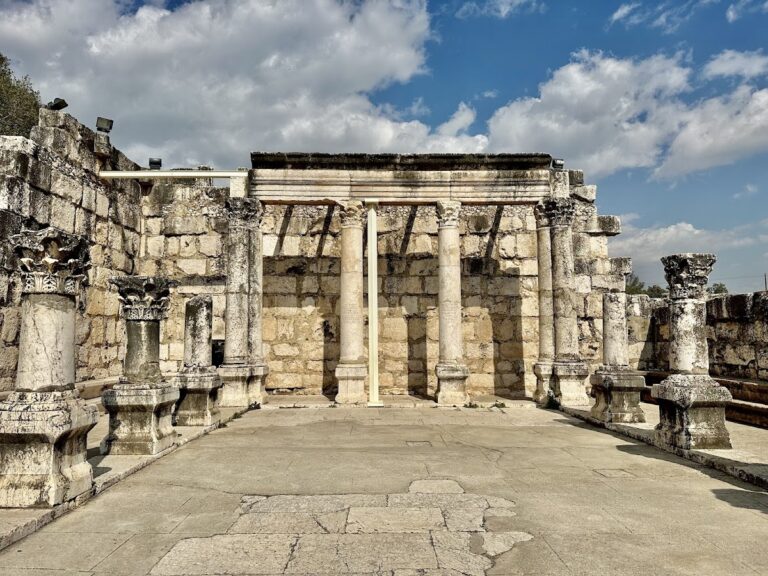
The larger synagogue has a south-facing facade oriented toward Jerusalem. Its entrance arrangement includes three doorways, with a covered portico carried by stone columns. Some of the porch columns remain in front of the entrance, and their bases use the classical Attic form, a distinctive type of column base. The portico is described as having six supporting columns, while eight porch columns were originally present.
An inscription beneath the facade’s right-hand window states in translation, “Elazar bar Yodan built it.” The wording identifies Elazar bar Yodan as the builder and preserves a Jewish Aramaic personal name. Inside, rows of columns divided the hall into three aisles and an ambulatory, a passage running around or behind the main interior space.
The building also contains unusual three-dimensional stone sculpture, including a pair of lions comparable to a pair found at Chorazin. A carved frieze shows a winged victory and animals and may also include human figures. These sculptural elements form part of the synagogue’s surviving architectural decoration.
The Smaller Synagogue
The smaller synagogue is represented by limited architectural remains. Its lintel, the horizontal stone spanning a doorway, carried the inscription, “Peace be upon this place, and upon all the places of Israel.” The original lintel is held in the Louvre, while a replica is exhibited at the Bar-Dor Museum on Kibbutz Bar’am.
Maronite Church
The Maronite church stands south of the synagogue remains. It was in regular use when the village was Christian in the nineteenth century and was badly damaged in the 1837 Galilee earthquake. The standing building continues to serve the Maronite community on holidays and for special events.