St. Lawrence Church Tönning: A Medieval Lutheran Church in Germany


Site at a Glance
- Rating
- 4.5
- Popularity
- Very Low
- Country
- Germany
- Primary era
- Early Modern
- External website
- Open
- Eras represented
- Medieval, Early Modern, Modern
- Civilizations
- Danish
- Site type
- Religious
- Remains
- Church
On this page15 sections
History
St. Lawrence Church Tönning is a medieval-origin Lutheran church in Tönning, Germany, on the Eiderstedt Peninsula. A church stood on the site by about 1186, and the building was enlarged and altered repeatedly over the following centuries. Dedicated to Lawrence of Rome, a third-century Christian deacon and martyr, it preserves Romanesque, Gothic, and Baroque phases within a long history of religious and civic change.
Medieval origins and the Reformation
The earliest church on the site belonged to the medieval Christian tradition of the region. Part of its original Romanesque fabric, including small round-arched windows, survives in the north wall. The church was probably badly damaged by forces from Dithmarschen during the fifteenth century. The south wall was subsequently renewed with large Gothic windows, giving the building a strong contrast between its earlier and later medieval work.
The Reformation, the sixteenth-century movement that led many western European churches away from Roman Catholic structures, reached Tönning in 1527. St. Lawrence Church then became Lutheran. The congregation later joined the Evangelical Lutheran Church in Northern Germany. In 2008 it merged with the congregations of St. Nicholas Church in Kotzenbüll and St. Lawrence Church in Kating to create the Tönning-Kating-Kotzenbüll congregation.
Seventeenth-century rebuilding
The earlier low choir was replaced around 1633 by the present choir. Although this work belongs to the early Baroque period, its form was Gothic. The choir’s altar was created in 1634, while the 1635 rood screen, a partition separating the choir from the nave, established the division between the altar area and the congregational space.
The church’s first organ was installed in 1593. A major instrument followed in 1681, when the organ builder Joachim Richborn constructed a Baroque organ. A separate gallery organ was established through a bequest made in 1739 by councilman Peter Tetens, who acted because the main organ was then in poor condition.
Bombardment and Baroque renewal
During the Great Northern War, a conflict fought from 1700 to 1721 between Sweden and a coalition led by Denmark, Saxony-Poland, and Russia, Tönning was besieged and bombarded by the Danish king’s army in April and May 1700. The church and its tower suffered heavy damage, and the tower spire fell into the nave. Both structures consequently required extensive renewal.
Repairs in 1703 and 1704 included a continuous wooden barrel vault over the nave and choir, together with a large ceiling painting. The present Baroque tower crown was built between 1703 and 1706, partly financed by a lottery. At completion, the tower reached 92 metres and was the tallest in the Duchy of Schleswig. Cannonballs set into the masonry still recall the bombardment.
Later repairs and musical history
The tower was struck by lightning in 1795 and again in 1886. A new clock was installed in 1879. In 1938 an aircraft hit the spire, which received only a provisional repair. Its copper plates were requisitioned for wartime purposes in 1944 and replaced with zinc. Copper roofing was restored in 1961, followed by further renewal of sections of the tower masonry in 1966 and 1967.
The main organ was rebuilt substantially by Marcussen in 1848 and reconstructed by Wilhelm Sauer in 1902. Hans Joachim Düngel altered it in 1961, and Hinrich Otto Paschen renewed it in 1978 while retaining its accumulated historic case. The gallery organ received a new work by Kemper in 1948. Paschen renewed its action and parts of its mechanism in 1968, and the instrument was comprehensively overhauled in 1991.
A major twentieth-century renovation was funded through the inheritance of Gert Cornils Davids, who was born in Tönning. The project sought to preserve the old fabric while also changing parts of the building. In 1956 the roof, floor, and pews were renewed, heating was installed, and the north gallery was removed. New windows were placed in the altar area in 1959, parts of the south wall were renewed in 1964, and sections of the tower masonry were replaced in 1966 and 1967. The altar was restored by Barbara Rendtorff in 1962 and 1963.
Remains
Brick church and tower
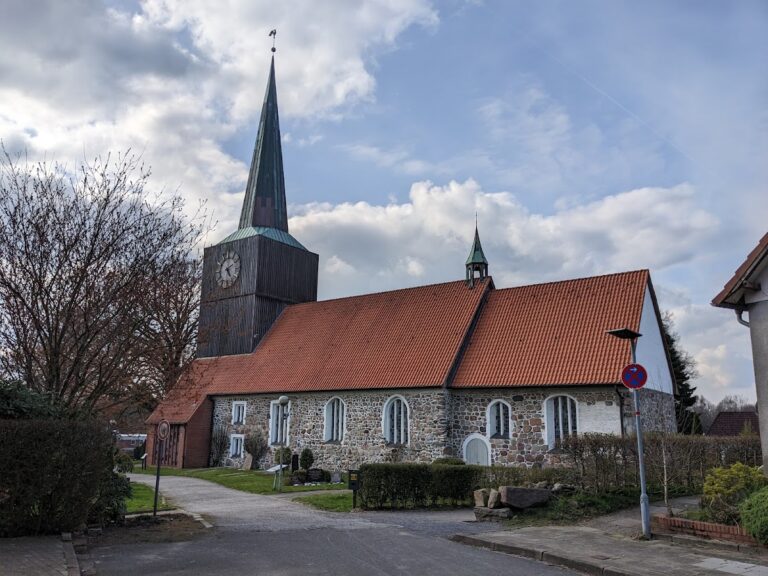
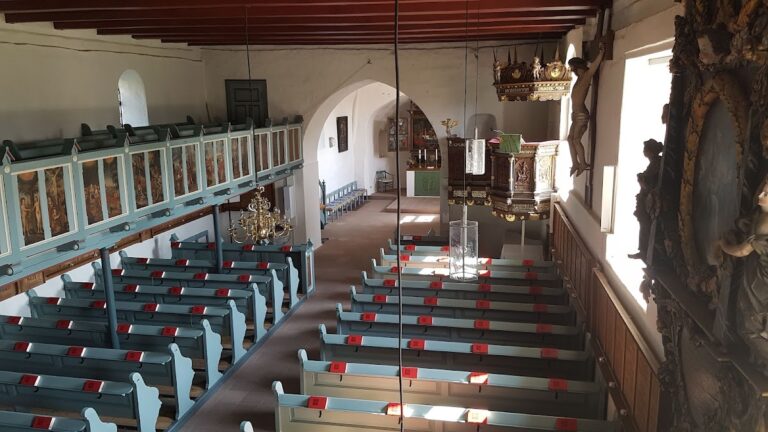
St. Lawrence Church is a brick-built hall church. The north wall retains part of the original Romanesque structure, including small windows with rounded arches. The later south wall has large Gothic windows, whose size and form reflect the rebuilding of that side after medieval damage. The low earlier choir was replaced by the present choir around 1633, while the choir’s marble floor belongs to the surviving interior arrangement.
Baroque tower
The brick tower stands on a fieldstone base dating from its construction period and forms the church’s most conspicuous Baroque feature. It is 62 metres high and is the second-highest church tower in Southern Schleswig. Late-sixteenth-century views show an earlier low gabled roof with a bell frame. Later changes introduced a slender pyramidal spire, which was partly burned by lightning in 1686 and then rebuilt in its earlier form.
Master builder Jacob Bläser designed the present crown in imitation of the tower of St. Trinitatis Church in Altona. That design had previously been copied on a smaller scale at St. Magnus Church in neighbouring Tating. The tower contains cannonballs in its masonry, an iron anchor bearing numerals on its south side, and the year 1708 on two sides of the clock face. The year 1961 also appears on the clock face in connection with the restoration of the copper roof. Together with the four towers of Tönning Castle, later destroyed, the church tower once formed part of the town skyline.
Choir and carved furnishings
Rood screen and rood cross
The 1635 rood screen is a half-height partition carved from oak. Its upper part forms a gallery reached by a spiral staircase. Thirty-three brass columns pass through the screen, each carrying a donor’s name. Above the central opening are carved coats of arms and the initials of Johann Adolph Kielmann von Kielmannsegg and Marie Elisabeth, born von Osterhausen.
A Late Gothic rood cross group from around 1500 hangs above the screen. It shows a realistically rendered, emaciated Christ dying on the cross, with Mary and John beside him. Square panels at the ends of the cross bear the symbols of the four Evangelists, Matthew, Mark, Luke, and John.
Altar and baptismal font
The marble-floored choir contains an eight-metre-high painted wooden altar. Its central image represents the Crucifixion, with the Last Supper below and the Resurrection above. The altar’s basic form dates from 1634, and further carving was added after the damage of 1700. The painters of the upper two Mannerist images are unknown, although their style resembles the work of Marten van Achten and his workshop. Barbara Rendtorff restored the altar in 1962 and 1963.
The choir’s baptismal font is made of black marble and alabaster. The church chronicle associates its donation in 1641 with the shoemaker Broder Peters and identifies Hans Ochs as its probable maker. Six reliefs decorate the font. One shows Peters’s house marks, including a boot and shoemaking tools, while the others depict the birth, circumcision, and baptism of Christ, Christ’s invitation to children, and Christ’s conversation with Nicodemus. The cover, made in 1704, carries six musical putti among vine-like carving and is crowned by John the Baptist and a dove representing the Holy Spirit.
Pulpit and ceiling painting
The Baroque pulpit dates from 1703 and was probably made by Hinrich Röhlke of Hamburg. Jacob and Jürgen Ovens and Jürgen Möller donated it. Garlands, foliage, hanging forms, and other richly carved and gilded ornament cover its surfaces, while an inscription beneath the floor names the donors. A Pentecost painting with a clearly visible dove decorates the underside of the sounding board. Moses, surrounded by the four Evangelists, crowns its upper side.
Barthold Conrath of Hamburg painted the monumental wooden barrel vault in 1704. The work was extensively restored in 1961 and is regarded as one of the important Baroque ceiling paintings in Schleswig-Holstein. The congregational pews date mainly from the early eighteenth century and include intermediate pieces from an older seventeenth-century set. Several richly decorated epitaphs, memorials dedicated to deceased people, are also preserved in the church.
Organs
Main organ
The main organ retains a historic case associated with Richborn’s 1681 Baroque instrument. Sauer’s 1902 reconstruction added side fields to accommodate large pneumatic windchests. In 1978 these additions were moved slightly backward, making the earlier Baroque appearance more visible. The organ has 41 stops distributed across three manuals, the keyboards played by the hands, and a pedal keyboard played by the feet. It has electric stop action and mechanical key action, with the listed couplers SW/HW, BW/HW, BW/SW, HW/P, SW/P, and BW/P. Its aids include 4,000 setter combinations, a crescendo roller, and individual reed stops.
Gallery organ
The gallery organ stands on the rood screen and supplements the main organ. It occupies a historic case and combines a rood screen with an organ, an unusual arrangement in Schleswig-Holstein. Its 1948 Kemper work, later mechanical renewals, and 1991 overhaul form part of the church’s continuing musical history.