Chiesa di Santa Maria dei Servi: A Gothic Servite Church in Padua


Site at a Glance
- Rating
- 4.6
- Popularity
- Low
- Country
- Italy
- Primary era
- Medieval
- External website
- Open
- Eras represented
- Medieval, Early Modern
- Civilizations
- Venetian
- Site type
- Religious
- Remains
- Church
On this page21 sections
History
Chiesa di Santa Maria dei Servi is a fourteenth-century Gothic Roman Catholic parish church in Padua, Italy, built between 1372 and 1390 under the Carrara dynasty. Formally known as the Church of the Nativity of the Blessed Virgin Mary at the Servites, it was founded at the initiative of Fina Buzzaccarini, wife of Francesco I da Carrara, the ruler of medieval Padua. The church belongs to the vicariate of the Cathedral Basilica of Santa Maria Assunta and is dedicated to the Servite Order, a medieval Italian religious order devoted especially to the Virgin Mary and meditation on her sorrows.
Foundation under the Carrara dynasty
The church rose on the ruins of the palace of Nicolò da Carrara. That building had been demolished after Nicolò betrayed the Carrara lordship in 1327 by supporting the Scaligeri, the ruling family of Verona whose expansion brought it into conflict with Padua. Fina Buzzaccarini began the new church in 1372, but she died in 1378 before the work was complete. She entrusted its continuation to her sister Anna, abbess of the convent of San Benedetto.
In 1393, Francesco Novello da Carrara, Fina’s son and lord of Padua, placed the church in the care of the Servites. The Order of the Servants of Mary then became associated with the church and its adjoining religious complex. That complex included the Servite convent, the Oratory of Sant’Omobono, and the oratory of the confraternity of Santa Maria del Parto. The convent also hosted Fra Paolo Sarpi, while the church became a place of burial for members of Padua’s legal, academic, medical, and aristocratic circles.
Expansion and later administration
The building was embellished during the sixteenth century. Bartolomeo Campolongo commissioned the long portico along the street, completed in 1510 or 1511. Its columns came from the dismantled fourteenth-century Chapel of the Ark at the Basilica of Saint Anthony of Padua. The church contains the tombs of the jurist Paolo da Castro and his son Angelo, a consistorial advocate, as well as the Servite friar Girolamo Quaini, professor of sacred Scripture at the university. Other burials include Count Emilio Campolongo, the physicians Raimondo Forti and Girolamo Olzignani, and Ottonello Pasino.
In 1807, the Servite Fathers were expelled and the church was confiscated as state property. It continued as a parish under secular diocesan clergy. Restoration during the 1920s, including the campaign of 1927, removed heavy nineteenth-century alterations and recovered the austere character of the fourteenth-century building. The convent was demolished in the 1950s, while the church returned to ecclesiastical ownership in 1963.
Return of the Servites
The church later underwent further restoration. The bell tower was repaired in 2004, and the wooden crucifix associated with Donatello received detailed conservation that removed a bronze-colored coating applied in the nineteenth century. In June 2014, the bishop of Padua accepted the request of the Superior of the Order of the Servants of Mary for the order to return to its historic church after 207 years of administration by secular clergy. The formal handover took place on 6 September 2014.
Remains
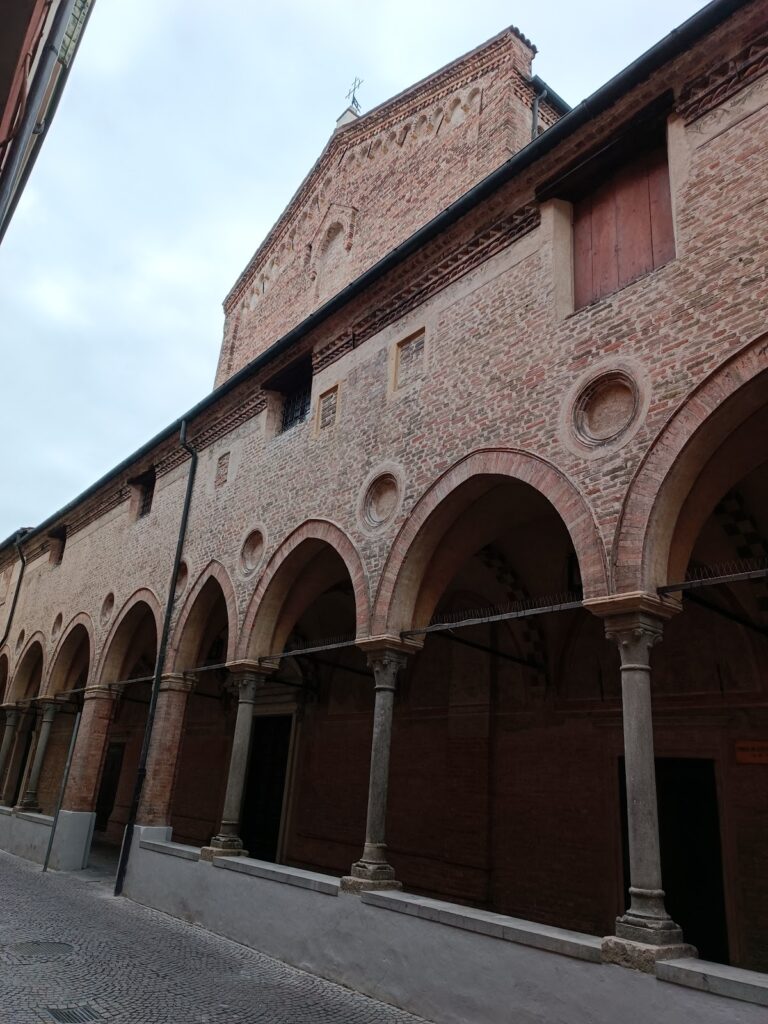
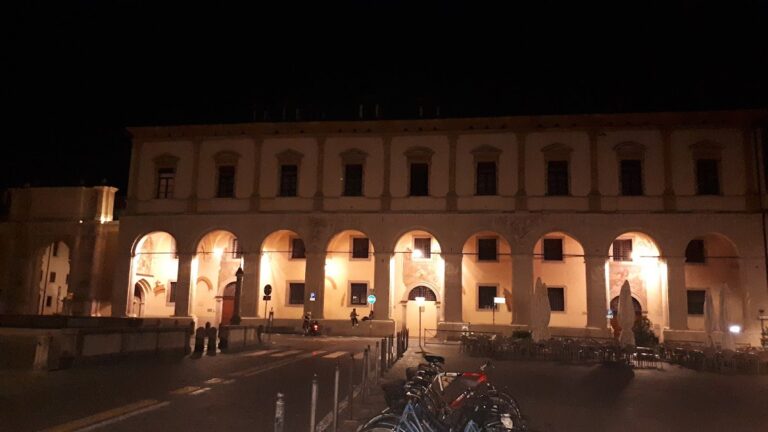
The church is a long Gothic structure oriented from north to south and running parallel to Via Roma. It measures approximately 57 metres in length and 17 metres in width. A gabled façade projects toward a small forecourt, while the street-facing side is sheltered by the later portico. The interior forms a large hall ending in a polygonal apse flanked by two chapels.
Façade and portico
Gabled façade
The façade is articulated by pilasters and arches. Its principal entrance is an elegant Gothic-Lombard portal made of Vicenza stone, above which is an oculus. The outer walls contain single-light windows with trefoil-shaped heads, placed between pilasters and arches. The apse is concealed by the surrounding buildings.
Street portico and Gothic entrance
The portico along the long side of the church was commissioned by Bartolomeo Campolongo and completed in 1510 or 1511. Its ten octagonal columns are made of red marble and were reused from the fourteenth-century Chapel of the Ark at the Basilica of Saint Anthony. Beneath the portico stands a large Gothic portal from the final decades of the fourteenth century. It combines blocks of white and red marble with fifteenth-century wooden doors carved in a Lombard manner.
Bell tower and bells
Medieval tower
A fourteenth-century bell tower rises above the chapel on the right side of the church. Pilasters and arches divide its surfaces, while the belfry has paired Gothic-arched windows. The tower was restored in 2004, when its bells were electrified.
Four bells
The tower contains four bells. The D bell, called Santa Giuliana, measures 127 centimetres across and weighs 1,280 kilograms. The E bell, Sant’Egidio, is 111 centimetres in diameter and weighs 910 kilograms. A 100-centimetre F-sharp bell is dedicated to the Blessed Virgin of Sorrows and weighs 632 kilograms. The fourth bell, a 65-centimetre D-flat bell weighing 175 kilograms, has no name or inscription. The first three carry biblical inscriptions, while the fourth is uninscribed.
Interior and devotional furnishings
Hall, chapels, and older furnishings
The interior measures approximately 57 by 17 metres and terminates in a polygonal apse. Two chapels flank the apse, and a long Neo-Romanesque balustrade stands before the presbytery. The church retains a seventeenth-century choir and baptismal font. A small painting by Alessandro Maganza accompanies the font, while other paintings in the church and sacristy are by Maganza, Damini, Varotari, Louis Dorigny, and Vernansal.
Altar of Our Lady of Sorrows
Opposite the side entrance is the monumental Baroque Altar of Our Lady of Sorrows. Its decoration combines large Carrara-marble foliage, polychrome marbles, and bronze elements representing the Seven Sorrows of the Virgin. At the centre is a Gothic polychrome statue of the Virgin, attributed to Rinaldino di Francia and formerly, but incorrectly, attributed to Donatello.
The altar is flanked by life-size statues of Saint Philip Benizi and Saint Juliana Falconieri, sculpted by Giovanni Bonazza in 1710. A reclining angel, also attributed to Rinaldino di Francia, holds a ribbon bearing the words, “Do not forget your mother’s grief.” Louis Dorigny’s painting of the Sorrowful Virgin with the dead Christ once occupied the niche and is now kept in the sacristy.
Paintings and funerary monuments
Near the monumental altar is a Deposition by Jacopo Parisati da Montagnana, surrounded by remains of fourteenth-century frescoes. A nearby devotional fresco shows the dead Christ with the Virgin and Saint John inside a polychrome Lombard-style marble aedicule. The work is attributed to Jacopo Parisati da Montagnana and dated to the 1490s. Its lunette depicts God the Father blessing among angels.
The church also contains the Altar of Saint Anthony, with an eighteenth-century statue, and frescoes by Girolamo del Santo. A Virgin and Child by the same artist is accompanied by two large canvases by Matteo Ghidoni, known as “de’ Pitocchi”: The Discovery of the Miraculous Portrait of the Annunciation and The Virgin Saving a Condemned Man from the Wheel. Funerary monuments commemorate Emilio Campolongo and Doimo Olzignani, whose monument follows the manner of Alessandro Vittoria. Above the sacristy door is the 1492 monument to Paolo and Angelo da Castro, attributed to Andrea Riccio.
Chapels and the miraculous crucifix
Altar of the Miraculous Crucifix
The left lateral chapel contains the Altar of the Miraculous Crucifix. The crucifix is a nearly two-metre-high sculpture carved from poplar wood. It was long associated with Donato Bardi, known as Donatello, a major Florentine sculptor of the early Renaissance noted for naturalistic treatments of the human body. A marginal note associated with Giorgio Vasari helped reaffirm the attribution, and the work is dated to 1443–1453.
According to the tradition surrounding the image, it exuded a blood-like liquid from the forehead and left side between 5 and 20 February 1512, with the event said to continue until Easter. Bishop Paolo Zabarella collected some of the liquid in a vial. Matteo Ghidoni painted the episode, including Bartolomeo Campolongo, Padua, and the Euganean Hills in the imagery.
Conservation removed the nineteenth-century bronze-colored coating and revealed a polychrome fifteenth-century wooden sculpture. Its realistic anatomy, restrained emotion, and monumental proportions became clearer after treatment. The crucifix was displayed in the Bishop’s Palace of Padua with two other crucifixes attributed to Donatello before returning to its chapel on 26 July 2015.
Right chapel
The right chapel contains a sixteenth-century altar with a modern Sacred Heart by Antonio Ferro. Its wall carries fourteenth- and fifteenth-century high-relief roundels. The sacristy preserves Dorigny’s Sorrowful Virgin along with other paintings.
Presbytery and organs
Main altar
The presbytery contains a large seventeenth-century main altar decorated in scagliola, a polished plaster composite made to imitate marble, and covered by a Baroque canopy. Its 1637 altarpiece, attributed to Luca da Reggio, depicts the Virgin appearing to the founders of the Servite Order.
Organ history
The church probably possessed an organ during the medieval period. It may have stood on a suspended gallery against the west wall near the Renaissance clock. An unconfirmed tradition identifies that earlier instrument with an organ now in the parish church of Marendole near Monselice.
Angelo Agostini built a new organ in 1844. It was inaugurated on 1 January 1845 and installed in the counterfaçade within a wooden case and Neoclassical gallery. The instrument was dismantled and dispersed during restoration work in the late 1920s. In 1973, the firm Giuseppe Ruffatti built a replacement for the tenth anniversary of the death of Monsignor Borzon, an advocate of the church’s major restorations. The electrically transmitted organ was installed behind the main altar, with an independent mobile console in the nave, and inaugurated on 23 January 1974 by Father Sante Vittore Zaccaria.