Church of San Niccolò Oltrarno: A Florentine Parish Church


Site at a Glance
- Rating
- 4.3
- Popularity
- Very Low
- Country
- Italy
- Primary era
- Medieval
- Eras represented
- Medieval, Early Modern
- Civilizations
- Republic of Florence
- Site type
- Religious
- Remains
- Church
On this page19 sections
History
Medieval origins and rebuilding
The Church of San Niccolò Oltrarno is a Roman Catholic church in Florence, Italy, founded in the twelfth century as a parish for artisans living beyond the Arno. The church was mentioned in 1164, and a building stood on the site by 1184. It depended on San Miniato al Monte, the Florentine basilica and monastic complex on the hill above the river.
In the fourteenth century, the settlement was enclosed within Florence’s city walls. The church became a parish in 1374, the same year that the Olivetan monks of San Miniato gave up its patronage to the nuns of Monticelli, who depended on the monastery of Monteoliveto. The building later deteriorated and stood in ruins by the end of the century.
After 1401, wealthy local families, particularly the Quaratesi under Bernardo Quaratesi, financed a complete rebuilding. The new church was probably designed by Francesco della Luna and was reoriented from an east-west alignment to a north-south one. Construction was completed in 1421. Bernardo Quaratesi was honored as the benefactor, patron, and founder of the rebuilt church, and in that year he received the patronage of the high chapel, where he planned to be buried. After his death in 1423, his nephew and heir Francesco di Andrea di Castello fulfilled those wishes and was probably the commissioner of Gentile da Fabriano’s Quaratesi Polyptych, completed in 1425.
Artistic patronage and the siege of Florence
The fifteenth century brought extensive artistic patronage. Masolino da Panicale painted an Annunciation between 1425 and 1430, while Bicci di Lorenzo made a triptych for the Pieri altar. Neri di Bicci painted a Trinity in 1463, and Francesco di Andrea Quaratesi had the chapel to the right of the church remodeled in Renaissance forms around 1465.
During the siege of Florence in 1529 and 1530, a conflict in which imperial and Medici forces sought to end the Florentine Republic, the church hosted a solemn oath of loyalty by Republican commanders. Those taking part included Malatesta Baglioni, Stefano Colonna, Giovanni di Torino, Amico da Venafro, Pasquino Corso, and Battista da Messina. Michelangelo, who had supported the Republic and directed the construction of its defensive walls, reportedly hid for several days in a small room at the base of the bell tower with help from an unidentified bell-ringer.
Floods and Counter-Reformation reorganization
The flood of 1557 severely damaged San Niccolò Oltrarno. Under the rector Leonardo Tanci da Montelupo, the Quaratesi family and the Arte di Calimala, Florence’s guild of merchants who imported and finished fine cloth, paid for restoration and a major internal reorganization. The work followed Counter-Reformation principles, the Catholic Church’s sixteenth-century program of liturgical and institutional reform. The high chapel was remodeled in 1561, and a tabernacle designed by Giorgio Vasari was installed.
The nave’s dividing screen was demolished, new family-sponsored altars were placed along the walls, and the fifteenth-century windows were blocked and replaced by architraved windows in different positions. The changes continued until 1579 or 1580, and the church was reconsecrated in 1585. The redecoration included altarpieces by Alessandro Allori, Il Poppi, Jacopo Coppi, Alessandro del Barbiere, and Giovanni Battista Naldini, together with a new pulpit and organ. By 1572, a new sacristy had been created in the former Quaratesi chapel.
Later history and restoration
Because of its position close to the Arno, the church was repeatedly affected by flooding. In 1966, floodwater rose more than four metres, making San Niccolò Oltrarno the most severely damaged church in Florence. A plaque on the facade records the levels reached in 1557 and 1966.
After the 1966 flood, the parish priest Don Giampietro Gamucci promoted a comprehensive restoration. The work included new flooring and the reorganization of the altars and artworks, while also revealing fragments of the original fifteenth-century decoration, including frescoes. In 2008, the sacristy became a small museum for artworks rescued from the flood and works donated privately to compensate for losses.
The district was inhabited for centuries by lower-class workers. In 1828, the Russian count Niccola Demidoff founded the Scuole di San Niccolò Oltrarno for poor residents. The church and its annexes also housed the Compagnia dell’Assunta di San Niccolò oltr’Arno and the Compagnia di San Francesco Poverino. Their adjacent oratory is now deconsecrated and used as a commercial space. The church remains dedicated to Saint Nicholas of Myra, also known as Nicholas of Bari, and belongs to the Roman rite under the Archdiocese of Florence.
Remains
Layout and exterior
The surviving crypt is the only known remnant of the first church. Its location and form indicate that the earlier building followed an east-west axis aligned with the street. The crypt is now reached through an adjoining room. The fifteenth-century rebuilding produced a substantially Late Gothic church with a tau-shaped plan, meaning a long central body crossed by a transept, a high chapel, and two side chapels on each side.
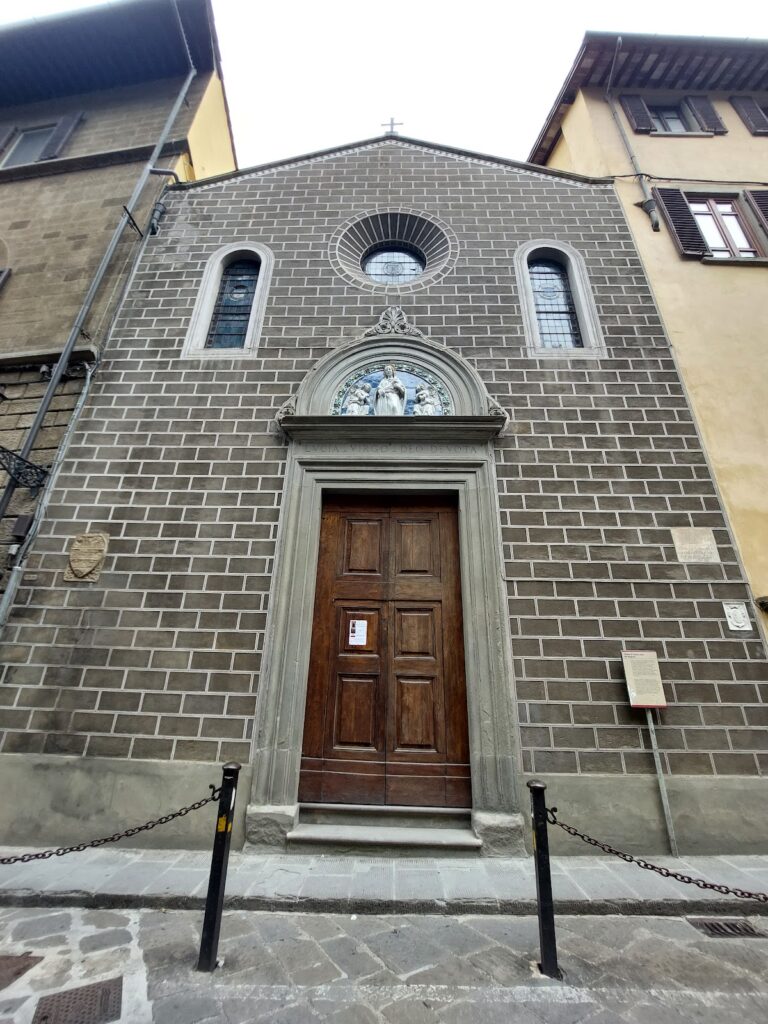
The exterior is simply plastered. Its gabled facade has a central sixteenth-century sandstone doorway with a pediment, a smaller architraved doorway on the left, and a large oculus above. A Quaratesi coat of arms is associated with the doorway. The facade plaque records the water levels reached in the floods of 1557 and 1966. A bell tower stands at the rear of the church.
Nave and side altars
Entrance wall
The interior has a single nave with exposed wooden roof trusses. At the first altar on the entrance wall is Alessandro Allori’s Sacrifice of Isaac, painted in 1583, beside a fresco of Saint Anthony Abbot attributed to the Master of Signa, a conventional name for an unidentified Florentine-area painter. On the opposite side, the Marzi Medici altar holds Francesco Curradi’s Miracle of Saint Nicholas Raising a Child, painted around 1625 to 1630. Beneath it is a fresco of Saint James and a posthumous miracle attributed to the Master of Signa.
Right-hand altars
Three sixteenth-century altars line the right side of the nave. The first contains Giovanni Battista Naldini’s Presentation of Jesus in the Temple, dated 1585. The second holds a polychrome wooden Crucifix attributed to Michelozzo and dated to about 1435. It was carved from a single piece of pear wood. At its base was a reliquary containing the bones of Blessed Manno, an Irish monk associated with the Bridgettine order, founded by Saint Bridget of Sweden. The Nasi family probably donated the relics after receiving them from the Bridgettine community at Paradiso in 1529.
Jacopo Coppi’s Pentecost, painted in 1572 and 1573, occupies the third right-hand altar. The chapel to the right of the high chapel contains Il Poppi’s Marriage of the Virgin. Andrea Banchi commissioned the work, which was installed in 1579 and restored in 1981 after flood damage. Its composition is strongly symmetrical, with the high priest forming its central vertical figure.
Left-hand altars
The three altars on the left include the Nasi family altar, whose coat of arms appears at the bases of its columns. It contains Il Poppi’s Christ Raising the Son of the Widow of Nain, made around 1584. The painting was severely damaged in the 1966 flood and returned to the church in the mid-1980s.
The Parenti family altar contains Alessandro Allori’s Saint Catherine of Alexandria and the Miracle of the Wheel, painted in 1587. The Paolini family altar has Jacopo da Empoli’s God the Father with Saints and Angels, painted around 1600 to 1610.
Transept chapels and sacristy
Uguccioni Chapel
The right transept chapel, associated with the Uguccioni family, contains a detached fresco of Saint Ansanus attributed to Francesco d’Antonio and dated to about 1425 to 1430. For centuries, Jacopo da Empoli’s altarpiece concealed the fresco, leaving only the saint’s face visible through an oval opening. The face was mistaken for the Virgin’s. The fresco was freed from the altarpiece in the late nineteenth century and detached in 1965. The process damaged its painted surface but protected it from the flood the following year.
Sacrament Chapel
The Sacrament Chapel in the left transept is associated with the Quaratesi family. It contains paintings formerly displayed on the church’s altars and stone tomb slabs bearing coats of arms, gathered there after the 1966 flood.
Quaratesi sacristy
The sacristy is a notable fifteenth-century room that began as a Quaratesi family chapel. Its present entrance is through the Uguccioni Chapel. A monumental stone aedicule, or small architectural shrine, is attributed to Michelozzo, and its lunette contains a fresco of the Madonna of the Girdle. The attribution of the fresco is disputed. Piero del Pollaiolo has also been proposed, although Alesso Baldovinetti is considered particularly likely.
The sacristy houses Gentile da Fabriano’s Intercession Polyptych, a multi-panel altarpiece. Its presence in the room is not known before the nineteenth century. It may have been made for the Banchi chapel, while other interpretations place its original commission at San Salvatore al Monte and its arrival at San Niccolò in the nineteenth century. The restored work is displayed in the sacristy.
Other works in the room include Giovanni dal Ponte’s Madonna of Humility Crowned by Two Angels, painted around 1405 to 1410; two paintings by Il Poppi; a silk antependium from the mid-seventeenth century; and a painting attributed to Jacopo da Empoli, Madonna and Child with Saints Sebastian, Margaret, Nicholas of Bari, and Raphael with Tobias, made around 1603. The last work came from Santa Margherita at Mangona in Barberino di Mugello.
Organ, former decorations, and monuments
Choir gallery and organ
The organ stands on the choir gallery beside the rear wall of the apse. Dionigi di Agostino Romani built it in 1581, Francesco Cappelletti restored it in 1683, and Antonio Tronci modified and enlarged it in 1769, rebuilding its case and windchest. The instrument has entirely mechanical action and seventeen stops. Its case has rich gilded carving, while the principal-pipe display is divided into several fields. A window console below has one keyboard and a pedalboard, and the stop controls are arranged in two horizontal rows. The stone balustrade of the choir gallery survives along the left longitudinal wall.
Works removed from the church
Gentile da Fabriano’s Quaratesi Polyptych, made for the Quaratesi chapel and completed in 1425, was dismantled in the early nineteenth century. Its panels are now divided between the Uffizi and other museums. Masolino’s Annunciation, painted around 1425 to 1430, is in the National Gallery of Art in Washington.
Gianni monument
The Gianni family chapel contains the cenotaph of Astorre Gianni, a monument commemorating a person whose remains are elsewhere. The Gianni family was the first owner of the nearby Gianni-Lucchesini-Vegni palace.