Chapel of the Hospital of St Mary Magdalene: A Medieval Hospital Chapel in Ripon
Site at a Glance
- Rating
- 4.9
- Popularity
- Very Low
- Country
- United Kingdom
- Primary era
- Medieval
- Eras represented
- Medieval
- Civilizations
- English
- Site type
- Religious
- Remains
- Chapel
On this page6 sections
History
The Chapel of the Hospital of St Mary Magdalene is a medieval Church of England chapel in Ripon, United Kingdom, founded in the twelfth century, probably around 1139–1140, at the behest of Archbishop Thurstan of York. Its surviving fabric combines Norman, Early English, an earlier Gothic style, and Perpendicular, a late-medieval English Gothic style marked by strong vertical lines. The chapel served the nearby Hospital of St Mary Magdalene and its leper community, making it one of the few surviving medieval remains associated with a leper hospital.
Foundation and medieval use
Thurstan is traditionally credited with founding the hospital between 1115 and 1139, although the chapel’s precise date and origin are uncertain. Inquisitions from the early fourteenth century recorded testimony that Thurstan paid for the hospital and intended it to serve all people with leprosy born within the Liberty of Ripon, the historic jurisdiction covering the city and its surrounding area. The chapel’s position in the countryside near the River Ure, roughly 0.75 mile northeast of Ripon Cathedral, reflects its original connection with a leper hospital rather than with the cathedral precinct.
The chapel initially served the hospital and its lepers. It later provided for blind clergy from the same geographical area. The east end was rebuilt after a destructive Scottish raid in 1321, and most of the present structure dates from the fifteenth century. The hospital’s function changed as leprosy became less prevalent. It was converted for brethren governed by a master, and after the Dissolution, the sixteenth-century suppression and confiscation of England’s religious houses, the canon of Ripon Cathedral became the hospital’s master. Marmaduke Bradley, the last abbot of Fountains Abbey, was among those who held that position.
Decline, restoration, and continuing use
The chapel was renovated during the fifteenth and seventeenth centuries, again in 1917, and between 1985 and 1990. It fell into disuse during the nineteenth century and was reportedly used as a pigsty. After the original building became unusable, a second chapel was erected opposite it during the 1860s. Reverend George Mason, the hospital trustee, paid for the new building after the hospital was reorganised in 1864.
A decorated rood screen, the partition between the chancel and nave, was recorded in the medieval chapel in 1875. By 1902 it had been removed, possibly for installation in Ripon Cathedral. The architect George Bland of Harrogate supervised restoration work in 1917. Renovation begun in 1985 led to the chapel’s rededication in 1989. It remains an active Church of England building dedicated to Mary Magdalene, a New Testament follower of Jesus who was associated in medieval belief with an outcast welcomed by Christ. The chapel forms part of Ripon Cathedral’s benefice, deanery, archdeaconry, and parish within the Diocese of Leeds. Since its rededication, its priest has also been responsible for St John the Baptist Chapel at Bondgate, another former medieval hospital chapel.
The building became a Grade I listed structure in 1949. It is regarded as the only surviving intact structure associated with Ripon’s medieval hospitals and as one of the few surviving remains of a medieval leper hospital. A tradition recorded by Sabine Baring-Gould tells of a dean selling the chapel bell during a period of financial difficulty. Parishioners protested and the bell was returned, but it was later found to be wooden and painted to resemble gun-metal. The original had been sent to a foundry and sold as scrap, and the chapel retains the wooden bell.
Remains
Layout, materials, and exterior
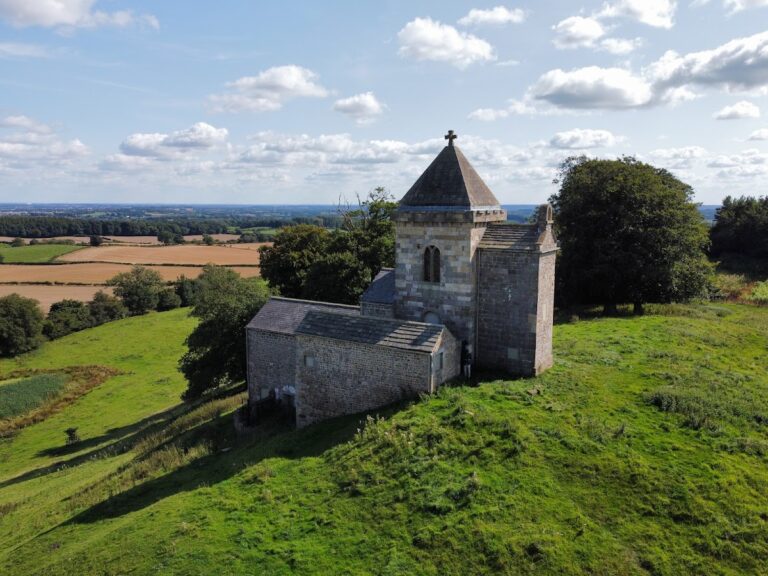
The chapel is an oblong parallelogram measuring approximately 14.6 metres in length, 5 metres in width, and 5.66 metres in height. It has no tower, aisles, porch, or vestry. Most of the current building is fifteenth-century hammer-dressed limestone. The earlier chapel was built of gritstone, while later work used magnesian limestone from Quarry Moor south of Ripon. The building stands beside the River Ure on the side of Magdalens Road opposite the former hospital grounds. The road was formerly known as Stammergate.
The west end is considered the surviving original part of the chapel. It has a single buttress and a bellcote above the doorway. A leper house once adjoined this end, but that building was later demolished, leaving the chapel standing alone. The west wall contains a single trefoiled Early English window, while the windows at the east end are Perpendicular. A small opening in the centre of the north wall is thought to have been a lychnoscope, a small church opening traditionally used to view the altar or service from outside or from a restricted area. It has since been adapted as an ordinary window.
Interior and archaeological evidence
The east end contains a tessellated floor beneath the altar. Its design has been linked to Roman-period buildings in the region, and part of the floor is thought to have been reused from a Roman structure. The chapel also retains a Norman font, which was once removed and used as a water trough before being returned. These elements preserve evidence of the building’s changing treatment and its long association with Christian worship.
Archaeological investigations in the 1980s showed that the historic floor level lay below the present one. They also found that many original boulders had been replaced with magnesian limestone during a building programme carried out by Richard Hooke in the second half of the seventeenth century. Skeletons were found during the same investigations, together with thirteenth-century pottery. None of the skeletons showed signs of leprosy, but the pottery placed them in the period when the hospital cared for people with the disease.