Old Synagogue in Sarajevo: A Historic Sephardic Synagogue and Jewish Museum


Site at a Glance
- Rating
- 4.6
- Popularity
- Low
- Country
- Bosnia and Herzegovina
- Primary era
- Early Modern
- External website
- Open
- Eras represented
- Early Modern, Modern
- Civilizations
- Austria-Hungary, Habsburg, Ottoman
- Site type
- Religious
- Remains
- Synagogue
On this page9 sections
History
The Old Synagogue in Sarajevo is Bosnia and Herzegovina’s oldest synagogue, established in 1581 for the city’s Sephardic Jewish community during the Ottoman period. Sephardim are Jews whose historical origins lie mainly in the Iberian Peninsula, many of whom dispersed after the expulsions from Spain and Portugal in the 1490s. The synagogue became the religious center of a community that helped shape Sarajevo’s history and later contributed to the development of Sephardic communities elsewhere in the country.
The formation of Sarajevo’s Jewish quarter
Jews were present in Sarajevo by the mid-sixteenth century. A legal dispute mentions them in 1557, while Jewish merchants appear in records from 1565. They may have arrived earlier, as the city expanded during the sixteenth century. In the later part of that century, Sijavuš Pasha, the Ottoman governor of Bosnia who subsequently served three times as grand vizier, arranged a permanent residential quarter for Sarajevo’s Jewish inhabitants.
The quarter was not a closed ghetto. It was a large building supported by a vakuf, an Islamic charitable endowment whose income could maintain residential, religious, educational, or public institutions. Resembling a caravanserai, it provided permanent accommodation for Jewish residents. The synagogue was established within this courtyard complex, known in Ladino as El Cortijo. Ladino was the traditional Sephardic language, historically based largely on medieval Spanish.
Sarajevo’s Jews were integrated into the city’s guilds, operated their own shops in the bazaar, and had designated spaces in the public baths. They also lived beyond the Jewish quarter, including in Ferhadija, Ćemaluša, and Bjelava. The community continued to grow despite periods of destruction. In 1779, Sarajevo had 214 Jewish households, and it maintained its own school. By 1740, its economic strength was reported to exceed that of Sarajevo’s Serbian population.
Fire, rebuilding, and expansion
The synagogue and the Jewish quarter suffered severe damage during the attack on Sarajevo led by Prince Eugene of Savoy in 1697. A further disaster came with the city fire of 1788, when the synagogue’s roof collapsed. The larger Sijavus Pasha han apparently survived until 1846 and perhaps until Sarajevo’s major fire of 1879, although the synagogue itself underwent repeated rebuilding before then.
Ottoman authorities approved reconstruction of the synagogue in 1794, despite legal restrictions governing the construction and renovation of non-Muslim houses of worship. The vault later collapsed again, and repairs were authorized in 1813. These works raised the building, and new vaults had been installed by 1821. An inscription indicates that the rebuilding was completed in 1827.
A major restoration followed in 1909, during the Austro-Hungarian period, with minor repairs carried out in 1924. The earlier work included plastering the building, fitting a new roof, adding a stairwell extension on the north side, constructing a conch probably intended for Torah storage, and installing a rose window on the southern side.
Wartime destruction and the Jewish community
During the Second World War, Sarajevo’s Jewish community endured systematic persecution under the fascist NDH state. Jews were dispossessed, excluded from professions, restricted in movement, and deported to Jasenovac and Stara Gradiška. Jasenovac was a concentration-camp complex operated by the fascist Independent State of Croatia, while Stara Gradiška was one of its major camps. Many prisoners were murdered there. A total of 7,092 Bosnian Jews are considered murdered or missing, and hundreds more died as Partisans. A few hundred escaped to Italian-occupied areas before later deportations to camps including Auschwitz, Bergen-Belsen, and Sajmište.
The Old Synagogue was heavily damaged, looted, and confiscated during this period. It was temporarily used as a detention facility, later became a warehouse, and was eventually abandoned. After the war, Sarajevo became the principal center of the country’s surviving Jewish population. The community grew from approximately 120 people in 1942 to about 2,000 before the Bosnian War. During that conflict, a Jewish relief organization evacuated approximately 1,500 Jews from Sarajevo, and only a small number returned. Emerik Blum, a Jewish industrialist and survivor of Jasenovac, served as Sarajevo’s mayor from 1981 to 1983.
Museum use and religious continuity
Restoration work began in 1957, and the building was converted into a museum. The Jewish Museum of Bosnia and Herzegovina opened there on 15 October 1966, in an event presented as marking 400 years since the first documented Jewish presence in Sarajevo. The museum later became part of the Museum of Sarajevo and presented Jewish life in Bosnia and Herzegovina across three levels, covering the Ottoman and Austro-Hungarian periods, the Second World War, the Holocaust, and the postwar era.
The museum closed during the Bosnian War, and the synagogue was subsequently repaired for war damage. It reopened in 2004 under the Historical Museum of Sarajevo, with a prayer room included in the building. The synagogue is now used for religious worship once a year, for the evening Maariv service on the first day of Rosh Hashanah, the Jewish New Year.
The Old Synagogue was declared a national monument of Bosnia and Herzegovina on 7 October 2003. It is regarded as one of the country’s most important Jewish monuments and as a rare surviving example of a sixteenth-century synagogue. Its history is closely tied to the origins of Sarajevo’s Jewish community, which became the oldest and largest Jewish community in Bosnia and Herzegovina. Sarajevo’s religious diversity and substantial Jewish population later helped give the city the name “European Jerusalem.”
Remains
Exterior and site setting
The synagogue stands at the northern edge of Sarajevo’s Baščaršija bazaar district, in the Stari Grad municipality. It faces a square-like courtyard now called Velika Avlija Laure Papo Bohoreta. The Novi Hram stands beside it on the same square, while Mula Mustafe Bašeskije Street runs north of the site, Gazi Husrev-begova lies to the east, and the southern exit leads toward Ferhadija.
The building is a three-storey brick structure with an irregular rectangular plan. Its west side measures 23.17 metres, the east side 20.87 metres, the south side 10.87 metres, and the north side 11.62 metres. The roof ridge reaches 12.17 metres. The facade facing the square has round-arched windows on the upper floors and rectangular windows at ground level. There are 26 windows and one portal. Its design combines Moorish and Christian architectural elements, a form also identified in synagogues in southwestern Europe and in archaeological excavations in Palestine.
Worship space and interior arrangement
Inside, the synagogue is organized around a central nave and two side aisles. Sermons were delivered in the central space, while the two-storey aisles separated male and female worshippers. Men prayed on the lower level and women on the upper level. The vaulted interior is formed by four large domes over the principal room and four smaller domes over the side aisles.
The main room has floors paved with stone slabs, while the other rooms have oak plank floors. Plastered walls carried geometric patterns, stylized plant ornaments, and Hebrew inscriptions. The historic interior now also functions as exhibition space, while a prayer room remains within the museum.
Courtyard and museum collections
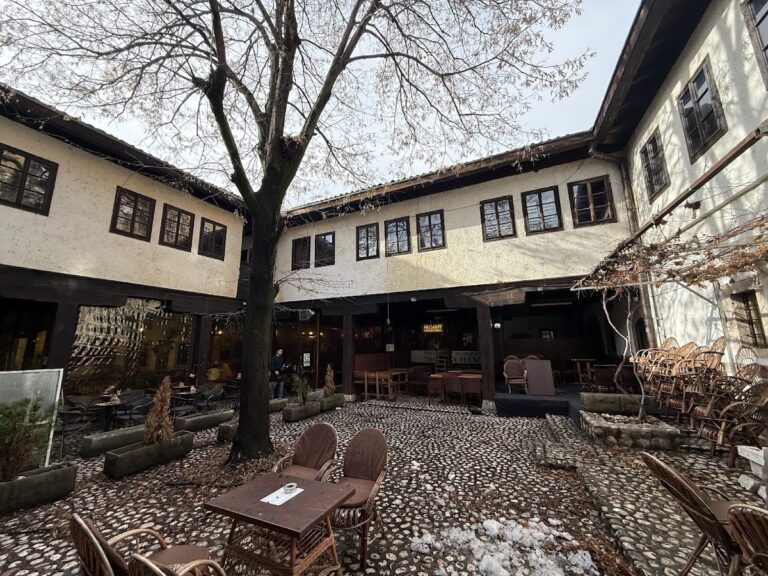
The enclosed courtyard is paved with cobblestones. Niches line the inner side of its surrounding wall, which has doors on the north, south, and west sides. The courtyard setting preserves the relationship between the synagogue and the residential complex in which it was established.
The Jewish Museum of Bosnia and Herzegovina preserves documents on Judaism in the country, material connected with Jewish citizens including Isak Samokovlija, a Jewish gravestone, religious objects, manuscripts, photographs, and traditional clothing from the eighteenth century. Its books include Ladino and other Jewish works, some printed approximately 200 to 300 years ago. The permanent exhibition also includes a model of the historic synagogue and a section on the Holocaust of Bosnia’s Jews.
The Sarajevo Haggadah is kept in the National Museum rather than in the synagogue, while the Jewish Museum displays a copy. A Haggadah is a Jewish ritual book used during the Passover seder, recounting the Exodus and setting out the order and texts of the ceremony. Together, the building and its collections present more than four centuries of Jewish history, culture, and heritage in Bosnia and Herzegovina.