Bergkirche Beucha: A Romanesque-Origin Evangelical-Lutheran Church in Germany


Site at a Glance
- Rating
- 4.7
- Popularity
- Low
- Country
- Germany
- Primary era
- Medieval
- Eras represented
- Medieval, Modern
- Civilizations
- German, Holy Roman Empire
- Site type
- Religious
- Remains
- Church
On this page14 sections
History
Bergkirche Beucha is a Romanesque-origin Evangelical-Lutheran church in Beucha, Germany, whose history began in the thirteenth century and whose nave was enlarged in 1848. The church belongs to the Evangelical-Lutheran Church of Saxony and stands on the Kirchberg, a hill shaped by centuries of granite porphyry quarrying.
Early church and medieval destruction
A Slavic cult site occupied the Kirchberg between approximately 1000 and 1200, before the region was Christianized. The fortified church at Beucha was first recorded in 1280. Its sacristy is considered the oldest surviving part, while red vine decoration in the tower also belongs to this early period.
In 1429, Hussite forces burned Beucha and its church. The Hussites followed the Bohemian religious reformer Jan Hus, and their military campaigns affected parts of central Europe during the early fifteenth century. Beucha and the church were rebuilt after the attack, and a small nave was added west of the tower.
Reformation and parish connections
The Reformation, the sixteenth-century movement that led to the establishment of Protestant churches in Europe, reached Beucha in 1529. That date is commemorated on one of the church’s two weather vanes. In the same year, Zweenfurth became a filial church of Beucha, meaning that its congregation depended on the larger neighboring parish rather than functioning independently.
Granite porphyry had been quarried on the Kirchberg since the fifteenth century. In the nineteenth century, proposals were made to demolish the church so that the quarry could be enlarged. Eduard Stephani, pastor of Beucha and its filial church Zweenfurth from 1811 to 1856, opposed repeated offers to purchase the Kirchberg. The old nave was nevertheless demolished in 1847–1848 and replaced with the present larger nave. The pulpit altar was installed during the same rebuilding.
War, damage, and modern conservation
During the Battle of Leipzig in 1813, the Kirchberg served as a lookout. Cossacks completely looted the parish during this period and took its communion vessels. Quarrying intensified during the last quarter of the nineteenth century, altering the hill around the church.
A bombing raid in 1945 severely damaged the roof and organ. Emergency repairs followed in 1946–1947. Serious structural deterioration led to the church’s closure in 1989, followed by extensive repairs that continued through 1997. The interior color scheme was based on the appearance around 1900, and the church was rededicated on Reformation Day in 1997.
The organ pipework was moved to the sacristy in 1989 to protect it while the building was repaired. After a seventeen-year interruption, the restored organ was returned in 2006. Since 1 January 2020, the Evangelical-Lutheran congregation of Beucha-Albrechtshain has belonged to a sister-church association with neighboring congregations. The United Evangelical-Lutheran Congregation Parthenaue-Borsdorf provides the shared pastoral positions and employs the clergy.
Bergkirche Beucha is legally protected as a historic monument. The adjoining quarry was designated a National Geotope in September 2019 for a ten-year period. A National Geotope is a formally recognized geological site valued for scientific, educational, or geohistorical importance. The quarry became the third National Geotope in the Porphyrland Geopark.
A burial place beside the church commemorates three generations of the Stephani family: pastor Friedrich Gotthold Stephani, his son and successor Eduard Stephani, and Eduard’s son Martin Eduard Stephani. Designs made in 1919 by the Leipzig painter Erich Gruner for an interior fresco survive, although the fresco was never executed.
Remains
Hilltop setting and churchyard entrance
The church stands on the 147-meter-high Beucha Kirchberg, which rises more than 20 meters above its surroundings. The hill is formed of granite porphyry and now projects as a spur surrounded on three sides by a 3.5-hectare lake. The lake occupies the quarry abandoned in 1958.
Approach to the churchyard passes through Beucha’s former water tower. The octagonal, four-story structure now serves as the entrance building to the churchyard, linking the former industrial landscape with the ecclesiastical enclosure.
Main building
Nave
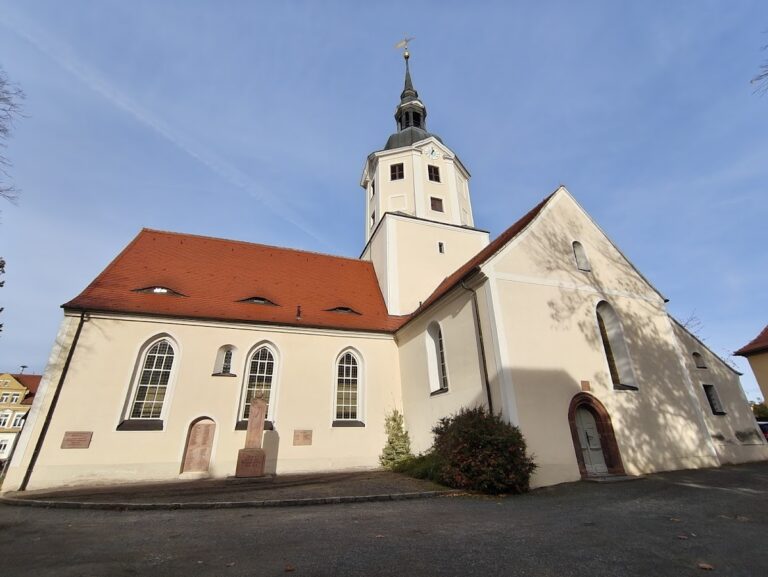
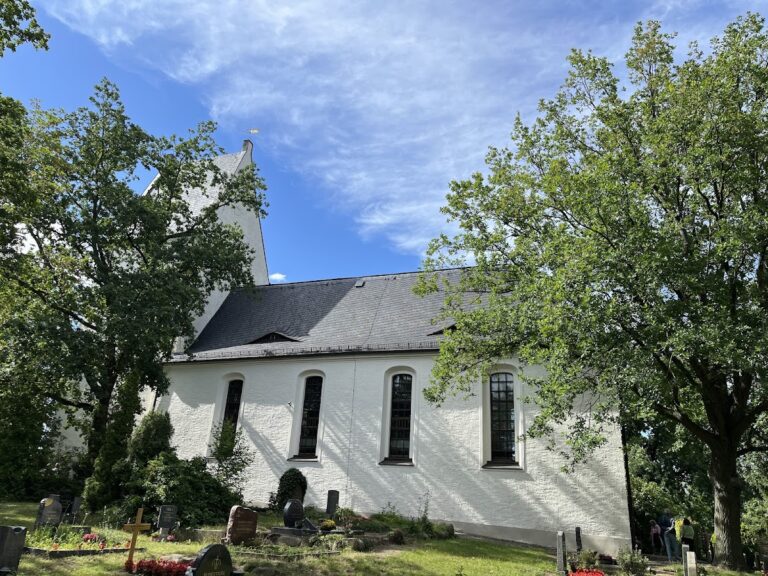
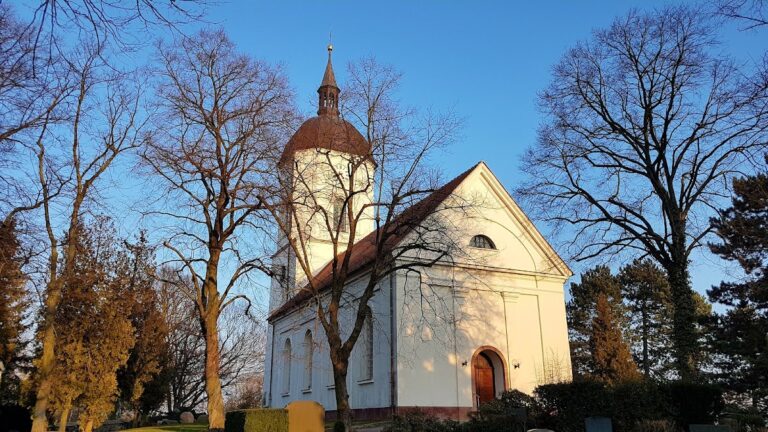
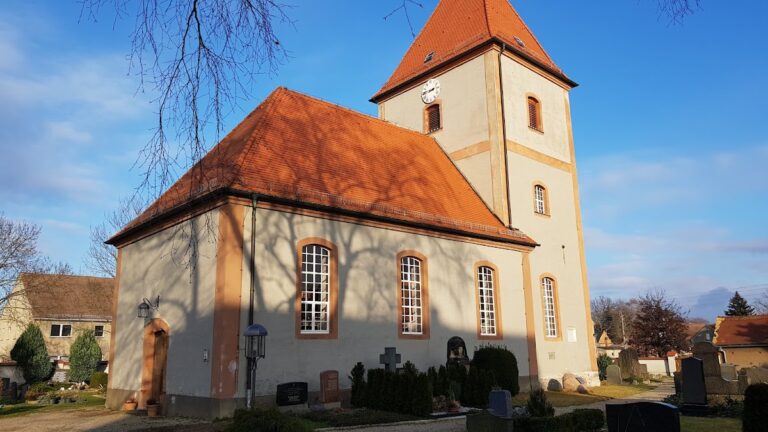
The present nave occupies the western part of the church. It has a gabled roof, five window bays, and tall round-arched windows. A small entrance hall projects in front of the two-windowed west gable and contains the stairs.
Tower and sacristy
The eastern tower rises above the choir, which now forms the tower hall. This arrangement makes the building a chortower church, a type in which the tower incorporates or rises above the choir. The tower is narrower than the nave, has small windows, and is covered by an east–west hipped roof with two weather vanes. A large round arch connects its interior with the nave.
Beyond the tower lies the narrower sacristy, a room used for storing liturgical objects and preparing clergy. It has a cross-vaulted ceiling, as does the tower hall. A wooden installation is attached to the sacristy gable, and a small mortuary hall adjoins it on the north.
Interior arrangement
The nave has a flat ceiling. Inside, smooth white walls contrast with gray-green furnishings. A gallery extends along three sides and has ornamented, inscribed panels edged in gold.
Altar and musical furnishings
Pulpit altar
The pulpit altar fills the opening between the nave and tower hall. Two steps rise to the altar table, behind which stands a crucifix. The pulpit projects slightly above the table and carries a round sounding board. Its side panels display ears of grain and vine motifs above their windows. Because of this arrangement, the tower hall primarily accommodates the staircase leading to the pulpit. A baptismal font, lectern, and Easter candle stand in the chancel, the part of the church around the main altar.
Organ
Between 1790 and 1792, Johann Gottlob Trampeli repaired and enlarged an existing organ without a pedal section. Wilhelm Hellermann of Lauchstädt overhauled it in 1847–1848. In 1929, the organist Karl Hoyer described its condition as a ruin.
In 1931, Alfred Schmeisser installed the 1863 Kreutzbach organ from the Martin Luther Church in Markkleeberg-Gautzsch within Hellermann’s case. Bomb damage led to its removal in 1945. Schmeisser reinstalled it in 1954 with a modified arrangement, including a coupling between the two manuals and a pedal coupling. The case was restored in 2005 by the restorer Ernst, and organ builder Georg Wünning of Großolbersdorf reinstalled the instrument in 2006.
Bells
The bell ensemble consists of three bronze bells. The oldest, sounding A-flat at three cents above pitch, was cast in the fifteenth century by an unknown founder. The large bell, sounding G at three cents below pitch, was cast in Leipzig by Georg Schesler in 1646. The small bell, sounding C at thirteen cents above pitch, was cast in 2008 at the Lauchhammer Art and Bell Foundry.