Abbaye Notre-Dame du Lys: A Royal Cistercian Nunnery in France


Site at a Glance
- Rating
- 4.3
- Popularity
- Low
- Country
- France
- Primary era
- Medieval
- Eras represented
- Medieval
- Civilizations
- French
- Site type
- Religious
- Remains
- Monastery
On this page11 sections
History
Foundation under Blanche of Castile and Louis IX
Abbaye Notre-Dame du Lys is a ruined Gothic Cistercian nunnery in Dammarie-les-Lys, France, founded in 1244 during the great medieval expansion of the Cistercian Order. The abbey stood about four kilometres downstream from Melun in Seine-et-Marne, within the Diocese of Sens-Meaux. It was a daughter house of Preuilly Abbey and belonged to the wider Cistercian lineage of Cîteaux, the reforming monastery from which the order developed.
The future site was chosen in March 1244, and building began that year. A land sale involving Guillaume de Sivry, a vassal of Persoys de Vaux-le-Vicomte, was recorded during the initial arrangements. In June, Guérin Lysenet transferred the vineyard plot on which the monastery was to be built. The nuns were established in the new convent by 1248, when the foundation charter was issued in June.
The roles of Blanche of Castile and her son Louis IX in founding the abbey are presented differently in contemporary royal documents. Louis’s June 1248 charter says that he founded and built the abbey at his own expense, without naming Blanche. A grant made the following month concerning rights in the Forest of Bière, however, identifies Blanche as founder. Later royal documents alternately attribute the foundation to Louis or Blanche.
Jean de Joinville’s account allows for a distinction between their contributions. Blanche may have initiated the foundation, while Louis supplied the resources that enabled it to function. Blanche was also acting as regent in her son’s name, a political arrangement that may explain why her role did not always appear formally in foundation documents. The abbey was intended to possess enough land, rents, and capital to sustain its community.
Alix de Vienne became the first abbess and played a leading part in establishing the new house. She had previously founded the Saint-Eloi priory in the same region and died on 23 August 1258. The conception of Notre-Dame du Lys closely resembled that of Maubuisson, another major Cistercian nunnery founded by Blanche of Castile, pointing to a shared royal initiative behind the two foundations.
A royal Cistercian community
Notre-Dame du Lys remained a community of Cistercian nuns until the French Revolution. Its succession of abbesses included Alix de Vienne, her niece Mahauld or Mathilde, who died in 1268, and Alips or Isabelle of Brabant, who died in 1275. Later abbesses included members of the houses of Melun, Griselles, Brabant, Dreux, Artois, Courtenay, Clèves, Evreux, Laval, Menou, Mailly, and Salm. The line continued through the sixteenth, seventeenth, and eighteenth centuries, with figures such as Claire-Cécile Colbert, the sister of Jean-Baptiste Colbert, and Marie-Anne de la Meilleraye de Mazarin.
The abbey possessed a strong connection with the French monarchy. Most French kings and queens visited it on pilgrimage, a tradition that continued until Louis XVI and Marie-Antoinette made the last royal pilgrimage. Blanche of Castile withdrew to Melun late in her life and died there in 1252 while Louis IX was on crusade. Although she was buried at Maubuisson, her heart was later transferred to Notre-Dame du Lys. The abbey also served as the place of confinement for Marie Mancini, the niece of Cardinal Mazarin.
The community encountered disputes as well as royal favour. In the sixteenth century, the nuns became involved in a conflict over their refusal to pay tithes, dues traditionally owed to support the church. The Parlement of Paris, the ancien régime’s highest court for the Paris region, handled the case on 27 June 1566. Over time, the abbey entered a gradual decline that was intensified by commendatory administration, a system in which a monastery’s revenues or governance could be assigned to a head who did not reside with the community.
Revolutionary dissolution and later ownership
The abbey’s final years as a religious community were marked by internal conflict and the revolutionary reorganization of religious property. On 2 August 1790, twenty-nine nuns remained, including seventeen professed nuns and twelve lay sisters. A lay sister, or converse, generally undertook practical or domestic work and did not possess the same choir and electoral status as a professed nun. The community opposed Abbess Élisabeth de Foissy, accusing her of violating monastic rules, and forcibly elected a new superior on 16 January 1791.
Élisabeth de Foissy left on 3 March 1791 with fifteen nuns. On 2 February 1792, Thérèse Boullet, known in religion as Sister Félicité, divided the community’s movable property and departed with three sisters. The remaining group consisted of two professed nuns, five lay sisters who could not take part in an election, and two nuns who were not affiliated with the order. No further abbess could be elected, and the last occupants were dispersed.
During the Revolution, the abbey was converted into what was called a Republican cattle enclosure. Germain Métier, a defrocked priest who led the Melun Jacobin Club, then ordered the demolition of the dovecote, commons, and guest pavilion because they were considered symbols of feudalism. The property became transferable as a national asset on 31 March 1792. Its valuation was completed on 1 October, and the community’s movable goods were sold between 15 June and 3 July 1793. The buildings were pillaged, tombs were broken, and lead was removed from the roofs.
Plans to reuse the complex as a military hospital with 600 beds or as a parish church were never carried out. On 24 June 1794, the Melun district administration stated that demolition was proceeding for public utility and could not be halted. The devastated abbey, its dependencies, and its mill were sold on 21 December 1796 to Samuel Legoux, a Swiss national, for 94,278 livres, 9 sous, and 6 deniers. The property later passed to William Temple Franklin, General de La Tour-Maubourg, Commander de Maisonneuve, and General Jehan de Noüe. In 1947, de Noüe transferred it to the municipality of Dammarie-les-Lys.
The ruins were classified as a Monument historique, a French legal heritage designation for sites judged to possess historic or architectural value, by an order dated 30 December 1930. The municipality subsequently incorporated them into a large park and maintained the abbey as an important part of the town’s heritage.
Remains
Church and conventual buildings
Abbey church
The surviving church remains include the apse, the choir, and the transept, together with ruined portions of the nave. In church architecture, the apse is the usually rounded or polygonal end of the choir, the choir is the area associated with the religious community’s liturgy, and the nave is the main longitudinal part of the building. The transept, which projects across the church’s main axis to form its cross-arm, remains visible beside the ruined longitudinal nave. These fragments preserve the principal arrangement of the Gothic abbey church.
Conventual buildings
Ruined sections of the conventual buildings survive beside the north transept. Their remains formed part of the wider complex that housed and supported the Cistercian community. The surviving church and conventual fragments now stand as a partially preserved architectural group within the park at Dammarie-les-Lys.
Outlying buildings and later setting
Estate buildings and mill
The abbey estate included a dovecote, commons, guest pavilion, other dependencies, and a mill. The dovecote, commons, and guest pavilion were demolished during the Revolutionary period. The mill was included with the abbey and its dependencies in the 1796 sale of the property, linking it to the estate’s later history.
Former abbey house
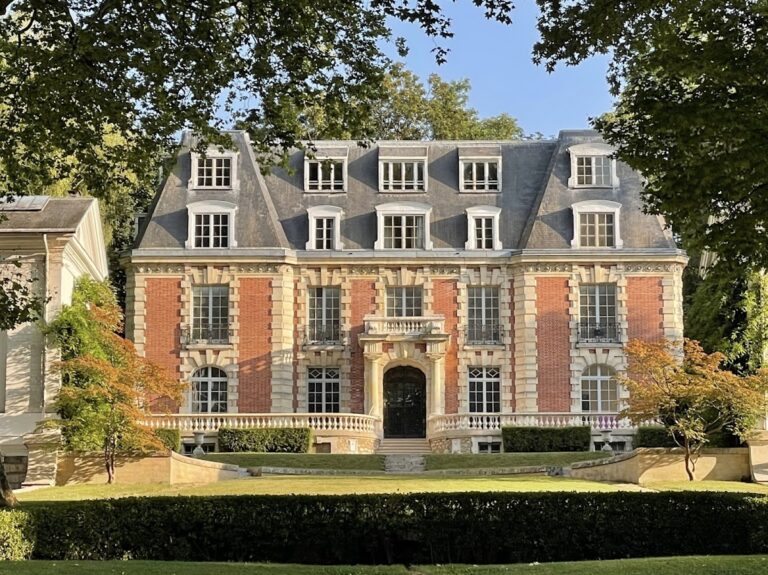
The former abbey house stands near the ruins. It now accommodates the Didier Lockwood Music Centre, named in honour of the violinist Didier Lockwood. Together with the surviving church and conventual fragments, it forms part of the preserved abbey setting within the large municipal park.
Nearby sites