Alekseyevsky Monastery in Uglich: A Historic Russian Orthodox Monastery


Site at a Glance
- Rating
- 4.7
- Popularity
- Low
- Country
- Russia
- Primary era
- Early Modern
- External website
- Open
- Eras represented
- Early Modern, Modern
- Civilizations
- Russian
- Site type
- Religious
- Remains
- Monastery
On this page10 sections
History
Alekseyevsky Monastery in Uglich, Russia, is an active women’s monastery of the Russian Orthodox Church founded in 1371 in medieval Muscovite Russia. The monk Adrian established it at the initiative of Alexis, the Metropolitan of Moscow, with the approval of Prince Dmitry Donskoy. The monastery occupies a hill beside the Stone Stream, historically known as Ogneva, where a pre-Slavic pagan sanctuary had existed before the foundation.
Foundation and Defensive Role
The monastery was first called the Dormition Monastery and took the name Alekseyevsky in 1439, in honor of Saint Alexis. Its early wooden walls defended the approaches to Uglich from the direction of the Yaroslavl Road. This defensive role connected the religious foundation with the protection of the town and its surrounding approaches.
The Siege of 1609
During the Time of Troubles, a period of dynastic conflict, foreign intervention, political crisis, and civil war in Russia during the late sixteenth and early seventeenth centuries, Polish-Lithuanian forces commanded by Jan Piotr Sapieha besieged the monastery in 1609. The defenders were eventually defeated, and all the monks were killed.
After the invaders were expelled, the Dormition Church was erected in 1628, probably as a memorial to the inhabitants of Uglich who had died. Its beauty gave it the popular name Divnaya, meaning “the Wonderful.” The church became the oldest surviving church in Uglich by construction date after the Soviet destruction of the city’s Pokrovsky Monastery.
Later Imperial History
In 1698, members of the streltsy, specialized Russian infantry units that also played an important political role in seventeenth-century Moscow, were imprisoned at the monastery after taking part in a revolt against Peter I. Peter’s government suppressed the uprising as part of the ruler’s effort to consolidate control over the Russian state.
The secularization reform of 1764 reduced the monastery to third-class status, an administrative classification applied to monasteries after the transfer of much church property to state control. The complex continued to develop during the nineteenth century. The Church of Saint Alexis was substantially rebuilt, and two stone chapels were added in 1898 and 1901. On 11 October 1907, Archbishop Tikhon of Yaroslavl and Rostov consecrated the Saint Nicholas chapel within that church.
The monastery’s property included 216 desyatinas and 803 square sazhen of land in the districts of Uglich and Myshkin, along with capital valued at 79,081 rubles. A desyatina and a square sazhen were pre-revolutionary Russian measures of land area whose exact values varied by period and local usage.
Soviet Closure and Reopening of the Past
During the Soviet period, the monastery was closed, and the Church of Saint Alexis was converted into an art gallery in the 1930s. Drawings made from life by Ivan Potekhin indicate that the church’s principal volume and apses survived until this conversion. In the early 2000s, an architectural and archaeological team from the Uglich Archaeological Expedition of the State Hermitage, directed by E. A. Turova, established that most of the sixteenth-century church remained within the later alterations. This discovery made future restoration possible.
Alekseyevsky Monastery is now a federally significant cultural-heritage monument of the peoples of the Russian Federation and continues to function as a women’s monastery.
Remains
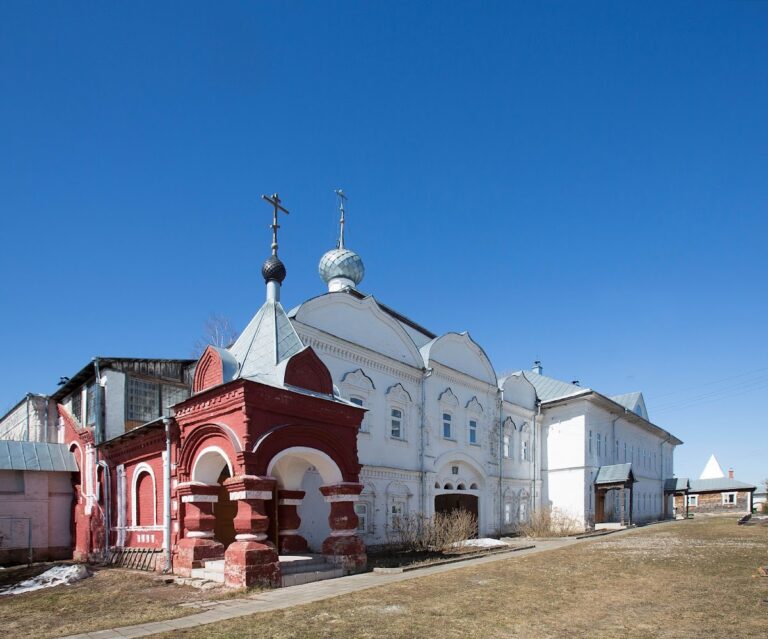
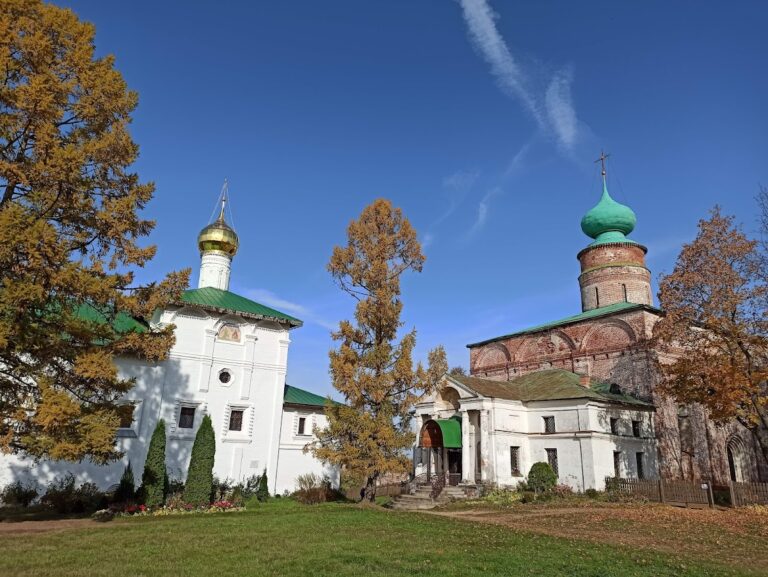
The monastery occupies elevated ground beside the Stone Stream on the hill historically called Ogneva. Its original enclosure consisted of wooden defensive walls facing the approaches from the Yaroslavl Road. The surviving complex includes churches from the sixteenth, seventeenth, and nineteenth centuries, together with chapels, a refectory, and associated monastic spaces.
Church of Saint Alexis
The Church of Saint Alexis was built of brick at the beginning of the sixteenth century. Its construction was funded by the governor Thomas Kolychev, also known as Saint Thomas of Uglich. The building is traditionally associated with the Rostov architect Grigory Borisov, perhaps with the participation of Italian masters working in Moscow. Its finely faceted apses have been compared with those of buildings by Borisov at the Borisoglebsky Monastery, constructed in 1522–1524, and at the Trinity-Danilov Monastery in Pereslavl-Zalessky, built in 1532.
The church was restored in 1629–1631 after the destruction associated with the Time of Troubles. During that work, a Chapel of the Epiphany was added on the south side. Nineteenth-century rebuilding gave the church a classical appearance, possibly through a design influenced by or developed with the Yaroslavl provincial architect Pyotr Pankov. A refectory, a dining hall or church space associated with communal meals, was added after 1829.
The later alterations concealed much of the earlier structure, but archaeological investigation showed that the sixteenth-century building remained almost entirely intact within the later construction, apart from its lost apses. The church’s main volume and apses had survived until its conversion into an art gallery in the 1930s, a change that also preserved evidence of its earlier form through Potekhin’s drawings.
Dormition Church, or Divnaya
The Dormition Church was built in 1628 as an important example of seventeenth-century Old Russian architecture. Its compact church section is crowned by three steep, tent-shaped roofs, each carrying a small cupola. Together, the roofs create a trident-like silhouette, while the building’s elevated position emphasizes the vertical character of the composition.
A refectory adjoins the church section. A massive central pillar supports its vaults, service rooms occupied the ground floor, and the superior’s cells were attached to the church. A formal porch formerly stood on the north side. The decoration is restrained, with individual details used to emphasize the building’s proportions. Three apses project from the eastern end.
The three-tent form made the Dormition Church an especially notable example of its type. Patriarch Nikon prohibited the construction of such churches in 1650, although the form continued in subsidiary buildings and in parts of northern Russia. The church houses the highly venerated Uglich Icon of the Mother of God, known as “The Gatekeeper” and also as “The Unquenchable Candle.”
The icon shows the Virgin as a nun holding a staff and prayer beads in her left hand and a candle in her right. It remained in the monastery’s storeroom until 23 June 1894, when a sick merchant from Saint Petersburg came to Uglich after dreaming that the Virgin directed him to the image and promised healing. The icon was solemnly transferred to the Dormition Church. After the merchant recovered, he presented it with a silver-gilt riza, a metal covering placed over an icon. Acts compiled by the Yaroslavl ecclesiastical consistory attributed more than forty miraculous healings to the image from 1894 onward.
Church of the Beheading of Saint John the Baptist
The small Church of the Beheading of Saint John the Baptist was built in 1681 and represents the Upper Volga architectural school. Nineteenth-century alterations changed its porch, which was also repainted, while the original decoration survives on the western side. The church is especially noted for its tile decoration, regarded as among the finest in Uglich.
Saint Nicholas Chapel and Icon
The Saint Nicholas chapel within the Church of Saint Alexis was associated with an Athonite icon of Saint Nicholas. Athonite refers to the monastic tradition and artistic production connected with Mount Athos. The icon was reportedly given from Mount Athos in the early twentieth century and was probably made for the newly arranged chapel through the efforts of Archimandrite Joseph, superior of the Saint Andrew Skete.
After the Soviet closure of the monastery, the expelled nun Catherine Bakalina took the icon into her care. It later passed to her godson, was sold to an antique shop in Moscow, and eventually reached the Krutitsy Metochion. On 24 August 2005, it returned to Alekseyevsky Monastery in exchange for an exact copy produced in Yaroslavl restoration workshops. An akathist, a devotional hymn or service of praise, is read before the icon each day, and monastic tradition associates it with healings.