Yazılıkaya: A Hittite Rock Sanctuary at Hattusa


Site at a Glance
- Rating
- 4.8
- Popularity
- Medium
- Country
- Turkey
- Primary era
- Bronze Age
- Eras represented
- Bronze Age
- Civilizations
- Hittite
- Site type
- Religious
- Remains
- Sanctuary
On this page16 sections
History
Yazılıkaya is a Hittite rock sanctuary at Hattusa in Türkiye, used from at least the late sixteenth century BCE and extensively developed in the thirteenth century BCE. The Hittites were a Bronze Age state centred in Anatolia, and Hattusa served as the capital and principal urban and religious centre of their empire. The sanctuary’s name means “Inscribed Rock” in Turkish. Its reliefs and buildings formed part of the religious landscape of the Hittite capital, although its ancient name and precise function remain unknown.
Early Use and Thirteenth-Century Development
Objects from the Early Bronze Age, including finds dating to the third millennium BCE, show activity in the area, but they do not demonstrate that it was already a place of worship. Hittite pottery and an enclosing wall indicate that gatherings of a religious community may have taken place from about the fifteenth century BCE. The sanctuary was transformed on a much larger scale in the thirteenth century BCE, probably during the reign of Great King Tudhaliya IV. Most of the rock reliefs belong to the reigns of Tudhaliya IV and his son Suppiluliuma II in the late thirteenth century BCE.
The sanctuary was probably associated with New Year and spring festivals. One interpretation identifies it as a New Year festival house and as the house of the Storm God, where the gods assembled each year. A procession may have linked the Great Temple at Hattusa with Yazılıkaya, while the king was ceremonially confirmed in office. These proposals remain interpretations because no direct Hittite text naming or describing the sanctuary has been found.
Religious and Funerary Interpretations
The site’s function has been understood in several ways. Chamber A has been associated with the itkalzi, a Hittite-Hurrian purification ceremony. Another interpretation sees Yazılıkaya as a huwaši sanctuary, a sacred place centred on a deity represented by a rock or stone, in this case probably the Storm God. The ordered groups of deities have also been compared with kaluti, formal sequences of gods used in Hittite-Hurrian rituals.
Burials show that the area also had funerary uses, although these may not have belonged to the sanctuary’s principal cult. Hittite-period burials were placed in fissures on the northern outer side and in a passage leading to Chamber B. A compressed group of three skeletons was found in a hollow. In Chamber D, a pig embryo was buried in a bowl secured with nails, a practice interpreted as evidence of purification rites.
Chamber B may have served as a memorial or funerary monument for Tudhaliya IV and possibly as his burial place. His name cartouche, an enclosing frame around a royal name and titles, and his depiction with the protective deity Šarruma support a connection with the king. Suppiluliuma II may have commissioned a rock sanctuary and statue for his father’s dead spirit. Since no comparable Hittite royal tomb has been found, this funerary interpretation remains speculative.
Cosmic Imagery and Religious Traditions
A 2019 theory proposed that the sanctuary also had a calendrical or time-keeping role. In that interpretation, the twelve underworld gods represent the lunar months, the thirty male deities represent the days of a lunar month, and the nineteen female deities represent the nineteen-year Metonic cycle, when lunar months and the solar year approximately realign. Another interpretation presents the sanctuary as an image of the cosmos, including earth, sky, and underworld, together with cycles of day and night, lunar phases, and the seasons. These ideas remain scholarly proposals rather than established explanations.
The imagery reflects the incorporation of Anatolian, Hurrian, and Mesopotamian traditions into the Hittite pantheon. Teššub, a major Hurrian storm god, was identified with or incorporated into Hittite storm-god traditions. Hebat, a major Hurrian goddess, appears with the supreme divine couple and was later associated with the Hattic Sun Goddess of Arinna; Šarruma was their son and a protective deity. Ea, a Mesopotamian god associated with wisdom, appears in the male procession. Šauška, a Hittite-Hurrian form of Ishtar associated with love, sexuality, and warfare, is represented in male form.
Rediscovery and Archaeological Investigation
Charles Texier documented Yazılıkaya in 1834 but mistakenly identified it as Pteria. Heinrich Barth exposed the reliefs in Chamber B in 1858, and Ernest Chantre cleared them in 1893. A French expedition led by Georges Perrot produced detailed drawings in 1861. Edmond Guillaume made architectural and relief drawings, Jules Delbet took the first photographs, and Carl Humann made casts of important reliefs in 1882. The casts are now held by Berlin’s Vorderasiatisches Museum.
After Hugo Winckler identified Hattusa as the Hittite capital in 1906, Yazılıkaya could be securely connected with the Hittites. Kurt Bittel began systematic investigation in 1935. Work was interrupted by the Second World War in 1939 and resumed from 1966 to 1972. Later investigations by the German Archaeological Institute and the German Oriental Society included work led by Kurt Bittel, Peter Neve, and Jürgen Seeher, while smaller-scale excavations continued from 2001. Yazılıkaya and Hattusa were inscribed together on the UNESCO World Heritage List in 1986, and the sanctuary lies within Boğazköy-Alacahöyük National Park.
Remains
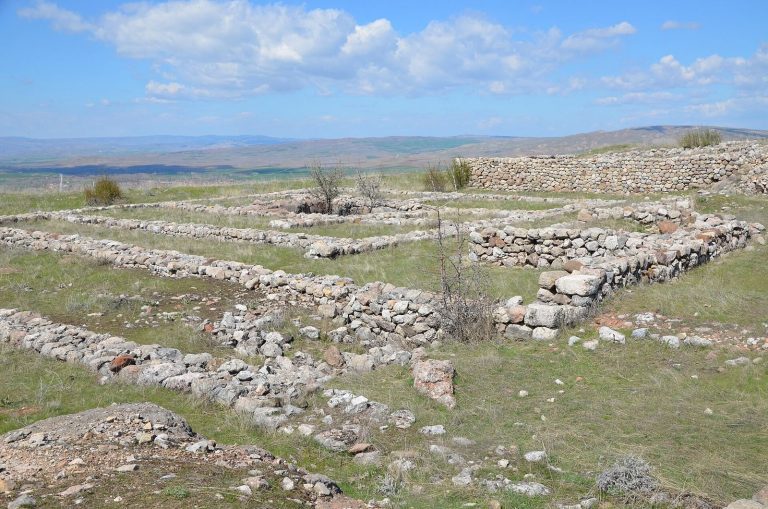
Yazılıkaya consists of two roofless natural limestone chambers, A and B, set among a group of rock outcrops. Their walls rise between approximately 2 and 12 metres, and both chambers contain rock-cut reliefs. Buildings stood directly before the chambers and controlled access. An exterior wall was replaced during the thirteenth-century redevelopment by a temple-like complex with stone foundations, timber framing, and mudbrick walls. The buildings now survive mainly as low stone foundations.
Entrance Complex and Processional Setting
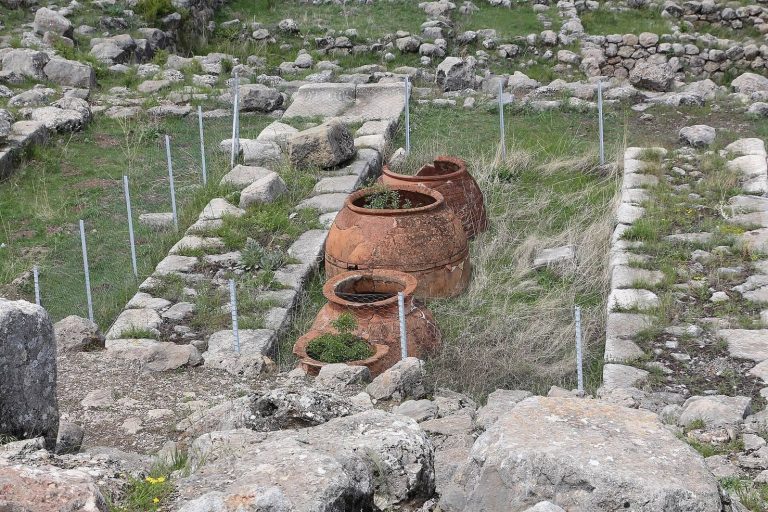
A free-standing gate structure and stairs led into the sanctuary. Further stairs reached a central courtyard surrounded by rooms that may have served as storerooms, service areas, or places where preliminary rituals were prepared and conducted. An altar in the courtyard may have been used for purification and other initial actions. Additional stairs continued toward the open area before Chamber A, while a narrow passage on the right led toward Chamber B.
A processional route probably connected the Great Temple at Hattusa with Yazılıkaya. Although the route itself no longer survives, its course can be reconstructed from the terrain. It crossed the Büyükkaya Deresi stream, followed a depression beside the city wall, passed the rock group of Osmankayası and a Hittite burial place near a spring, and continued over gently rising ground toward the sanctuary. Surface and geophysical investigations indicate that settlement extended up the eastern slope.
Chamber A
Form and Processions
Chamber A is about 30 metres long and initially about 20 metres wide before narrowing toward the rear. Its floor was originally paved with stone slabs, interrupted by a step and then raised slightly toward the rear wall. The paving has disappeared, but sockets cut into the rock preserve the former level, which was approximately 50 to 60 centimetres higher than the present floor. This placed the reliefs near eye level. Almost the entire limestone surface is covered by processions. Rock-cut and stone-built ledges beneath the figures probably supported votive offerings, while three rectangular depressions below figures 25 to 33 may have held cult objects or been used for burning incense.
The northwestern wall carries male deities moving toward the central scene, while the opposite wall carries female deities approaching it. The chamber contains 63 deity figures, numbered 1 to 63, together with a separate image of Tudhaliya IV. The figures are shown in profile with walking legs, while male torsos generally turn toward the viewer, a convention characteristic of Hittite relief sculpture. Luwian hieroglyphs, a writing system used in Anatolia, identify many of the figures, although several inscriptions are damaged or only partly deciphered.
Male Deities and Attendants
Figures 1 to 12 are nearly identical underworld gods carrying sickle-swords. Figures 13 to 15 and 16a to 17 are mountain gods, whose long scaled garments symbolize mountains and springs. Figures 25 to 27 carry long swords and include the probably identified Iršappa, Pišaishapḫi, and Nergal. Figures 28 and 29 are bull-human beings, possibly the celestial bulls Šeri and Ḫurri, standing on the sign for earth and holding a crescent moon above their heads.
Figures 30 to 35 include the possible war god Ḫešui, the possibly winged deity Pirinkir, an unidentified protective deity perhaps represented as the deer god Karzi, Aštabi, the heavenly Sun God Šimige, and the Moon God Kušuḫ. Šimige carries a crook and sword and is accompanied by a winged solar disk. Kušuḫ has wings at his shoulders and a crescent moon above his horned cap. Figures 36 and 37 are Ninatta and Kulitta, attendants of Šauška. Their lower reliefs may have replaced earlier carvings damaged by natural forces or deliberate destruction.
Central Divine Scene
Figure 38 represents Šauška in male form, wearing wings, a short skirt, an overgarment, and a cloak. Figure 39 is probably Ea, shown with a beard, horned cap, short skirt, cloak, and club. Figures 40 to 46 form the central divine scene. Figure 40 is probably Kumarbi, standing on two mountain forms. Figure 41 is probably the Storm God of Hatti or alternatively Tašmišu. Teššub, figure 42, stands on two mountain gods, probably Namni and Ḫazzi, and carries a sword and club. A bull associated with Teššub appears behind his legs.
Hebat, figure 43, stands on a leopard supported by four mountain forms and begins the female procession. A bull appears behind her. Šarruma, figure 44, is the only male figure in that procession. He stands on a feline animal, holds it by a leash, and carries a sword and battle-axe. Figures 45 and 46 are probably Hebat’s daughter Allanzu and granddaughter Kunzišalli, standing on a double-headed eagle. Later figures include Ḫudena, Ḫudellura, Allatu, Nabarbi, Šaluš-Bitinhi, Tapkina, Nikkal, and several uncertain or unidentified goddesses. A niche damaged Allatu’s head and was later filled with a stone block.
Tudhaliya IV and Chamber D
The sanctuary’s largest relief, figure 64, shows Great King Tudhaliya IV opposite the central divine scene. He wears a long cloak, pointed shoes, and a rounded cap, holds a curved staff, and carries a sword whose hilt is partly visible. He stands on two scaled mountain forms beneath a winged solar disk. His name and titles are carved above his outstretched arm. A natural limestone deposit helped preserve the image, which receives direct sunlight for only a short period on afternoons around the summer solstice in June.
Figures 65 and 66 stand near the entrance to Chamber D. They show a male and female figure seated opposite one another across what may be a table or altar. Only the divine hieroglyph remains clear enough to permit identification, and the figures may represent Tenu and Tipatu. Walls that once closed Chamber D on its western and southern sides have been identified, although their function is unknown. A female relief found at Yekbas, now Evren, in 1945 may have belonged to a gap in Chamber A. Its inscription identifies Šauška, and the block is preserved in the local museum at Boğazkale.
Chamber B
Entrance Passage
Chamber B is approximately 18 metres long and between about 2 and 4 metres wide, narrowing toward one end. Its side walls retain their natural form rather than being fully dressed. A narrow entrance passage is about 80 centimetres wide and 10 metres long, rising approximately 4 metres. Hittite stonecutters widened it artificially, leaving hammer marks in the rock. The paved floor was formerly 30 to 40 centimetres higher than today, and clay pipes beneath it drained water from Chamber C. Two lion-headed, winged demons flank the entrance as guardians.
Chamber B may originally have had another entrance from the south and a passage through Chamber C to the east. The southern entrance was probably blocked by a fallen rock in antiquity, while the passage to Chamber C is now sealed. A limestone slab at the broader modern entrance matches a statue base found in a neighbouring village in 1981 and may have supported a statue of Tudhaliya IV.
Royal and Underworld Reliefs
The reliefs in Chamber B are better preserved than those in Chamber A because debris partly filled the chamber until the mid-nineteenth century. Its principal image is Nergal, the underworld or sword god, represented by a sword driven into the ground whose upper part becomes a human figure. Lions form the figure’s shoulders and sword hilt, with additional lions arranged vertically below it. A podium may once have stood beside the rock.
Beside Nergal, Tudhaliya IV appears in the embrace of Šarruma. The god holds the king by his raised right wrist and seems to accompany him, possibly toward the afterlife. Tudhaliya wears a long cloak, rounded cap, and pointed shoes, and carries the same curved staff shown in Chamber A. Both figures carry swords whose hilts appear behind their cloaks. A second cartouche gives Tudhaliya’s name and titles, including labarna, a Hittite royal title, and “Great King,” together with a mountain-god sign or figure and a winged solar disk. Its repetition may have identified a cult statue of the king once installed in the chamber.
The opposite wall carries twelve nearly identical underworld gods, numbered 69 to 80. They march in step with sickle-swords over their shoulders and wear short skirts, pointed shoes, broad belts, and horned pointed caps. Their sequence repeats the beginning of the male procession in Chamber A, where the carvings are less well preserved.
Rock-Cut Technique and Preservation
The reliefs were carved directly into the limestone as relatively shallow panels. The freshly dressed surfaces may originally have appeared much lighter and may have been painted in vivid colours, although surviving pigment traces do not confirm this. Chamber B preserves portions of the original rock surface more clearly than Chamber A.