Yanmen Pass: A Strategic Frontier and Great Wall Defense in China
Site at a Glance
- Country
- China
- Primary era
- Medieval
- Eras represented
- Classical, Medieval
- Civilizations
- Ming
- Site type
- Military
- Remains
- Wall
On this page12 sections
History
Yanmen Pass is a mountain pass and historic military route in China, where the Ming rebuilt the defenses in 1374. It controlled movement between the valleys of central Shanxi and the Eurasian Steppe, and saw conflict from ancient times through World War II. The names Yanmenguan and Xixingguan are also used for the pass, whose name is associated with wild geese migrating through the area.
The Zhao frontier and Han expansion
During the Warring States period, an era of competing Chinese kingdoms, King Wuling of Zhao conquered territory in northern Shanxi between 306 and 304 BC. He organized it into the commanderies of Yunzhong, Yanmen, and Dai, administrative districts of the state. Around 300 BC, he began building earthen defenses against steppe peoples along the northern edge of his territory. These defenses did not cross the pass.
During the reign of Qin Shi Huang, the first Qin emperor, the Chu noble Ban Yi fled north to the Loufan area near Yanmen. By the early Han dynasty, Ban Yi’s clan had become wealthy by herding and trading thousands of cattle and horses. Their success helped encourage further Chinese settlement along the frontier. The clan later left amid regional instability, and members subsequently gained prominence among Eastern Han officials.
Conflict between Han forces and the Xiongnu, a powerful confederation of steppe peoples, repeatedly affected the frontier. In autumn 129 BC, 40,000 Han cavalrymen massacred Xiongnu traders at frontier markets. Han commanders Li Guang and Gongsun Ao suffered serious defeats near Yanmen. They avoided execution by paying large fines, but both lost their status and became commoners.
Soon afterward, Wei Qing led 30,000 men north from Yanmen, defeated Xiongnu forces, and took control of the Ordos Loop. The Han then sent 100,000 Chinese settlers to the region. In 127 BC, after Xiongnu forces defeated and killed the governor of Liaoxi, Han Anguo tried to stop them at Yanmen with 700 men. He was defeated and withdrew to Yuyang. Wei Qing and Li Xi later returned with a larger force, captured some Xiongnu, and drove the rest beyond the frontier.
Great Wall defenses under successive dynasties
In 557, the Northern Qi built a section of the Great Wall through the pass as part of a major defense project ordered by its ruler, Gao Yang, against the rival Northern Zhou. More than 1.8 million laborers took part in the project. The wall formed an inner defensive line and was repaired and extended in 565. After the Northern Zhou absorbed the Northern Qi in the late 570s, retired emperor Yuwen Chan, acting for his young successor Yuwen Yun, strengthened the wall between Yanmen and Jieshi in 579 against the Göktürks, a Turkic steppe power, and the Khitans, who later founded the Liao dynasty.
After Yuwen Chan died in 580, his father-in-law Yang Jian seized power and later established the Sui dynasty. Sui rulers ordered seven large-scale Great Wall repairs. The Tang dynasty’s expansion northward reduced the wall’s defensive importance, and it fell into disuse and decay.
Song and Liao conflict
After the Later Tang and Later Han collapsed, much of Shanxi came under the control of Northern Han, a regional kingdom ruled from Taiyuan by Liu Chong. Zhao Kuangyin had unified most of China before his death in 976. His younger brother and successor, Zhao Jiong, invaded Northern Han in 978 and conquered it the following year.
In 980, about 100,000 Khitan horsemen of the Liao Empire, led by Li Chonghui, invaded Shanxi to support their defeated allies. Near Yanmen, Song generals Yang Ye and Pan Mei encircled and decisively defeated them at Baicao Lingkou. The battle killed Xiao Chuoli, the Liao emperor’s brother-in-law, and brought the Song many horses and military supplies. The victory helped secure the northern border and the Song’s recent conquests.
Yuan, Ming, and Qing periods
Under the Yuan, a Mongol-led dynasty, the Great Khan nominally ruled peoples on both sides of the wall, and its fortifications deteriorated. The Ming rebuilt Yanmen’s defenses in 1374 as part of the Inner Great Wall. The pass was traditionally counted first among the ‘Nine Passes under Heaven.’ Yanmen, Ningwu, and Pian, also called Piantou, formed part of the wall’s inner defensive line. In Ming and Qing classifications, however, they were called the ‘Outer Three Passes,’ in contrast to the ‘Inner Three Passes’ nearer Beijing.
Twentieth-century conflict and memory
During the Second Sino-Japanese War, China’s war against Japan, Yanmen became a battlefield in the 1937 Battle of Xinkou. On 18 October, He Bingyan led the 716th Regiment of the 358th Brigade in an ambush on Japanese forces. The regiment belonged to He Long’s 120th Division of the Eighth Route Army, a Communist-led force fighting Japan. It reported killing or wounding more than 300 Japanese troops and destroying over 20 vehicles, while suffering 112 casualties. The regiment sought to disrupt Japanese supply and communications as the advance toward Taiyuan continued.
A skirmish followed on the night of 20 October, and the next day the regiment attacked another supply column. The attack was credited with killing around 200 Japanese troops and destroying hundreds of vehicles. Japanese air attacks and the arrival of the Ushiromiya Division then forced He Bingyan’s men farther north.
After the war, authorities treated Yanmen Pass as part of the boundary of China’s ‘Third Front,’ a strategic framework used to guide infrastructure investment and military defense. The Battle of Yanmen Pass also became a subject of legends, folktales, and plays about the Yang family generals.
Remains
The pass lies in the Gouzhu, or Yanmen, Mountains, a western extension of the Hengshan Range between the Sanggan and Hutuo River basins. The mountains form a climatic boundary: the milder Hutuo Valley supports rice cultivation, while the colder, drier Sanggan basin has more saline soil and is less suited to agriculture. The surviving defensive complex includes a hill fort associated with the Zhao period and a stone-built Ming wall with gatehouses and nearby religious and trade features.
Defensive remains
Zhao-period hill fort
During the Zhao period, a fort and garrison on a local hill defended the pass. This separate defense complemented the earthen wall system built along the northern edge of Zhao territory.
Ming wall and gatehouses
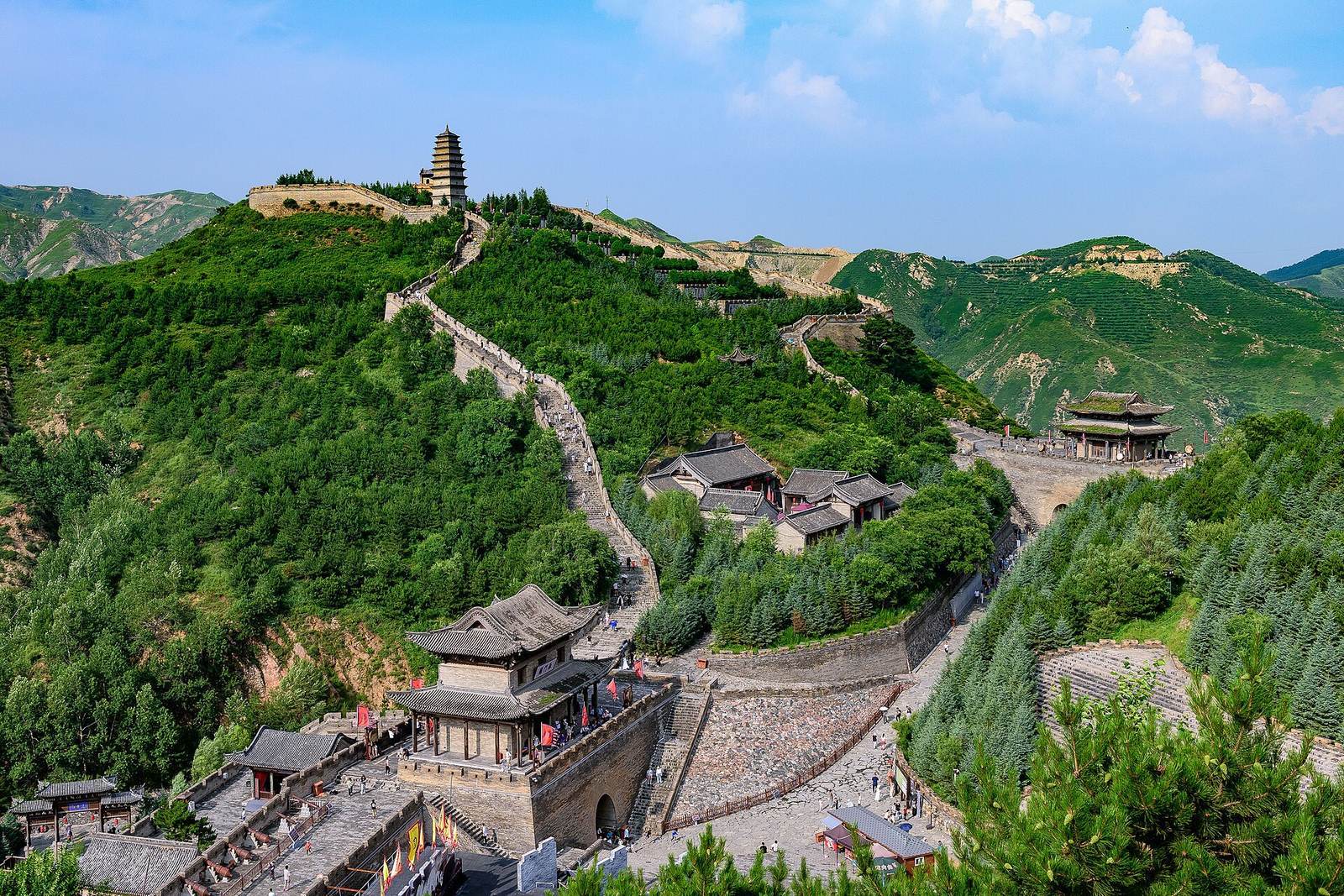
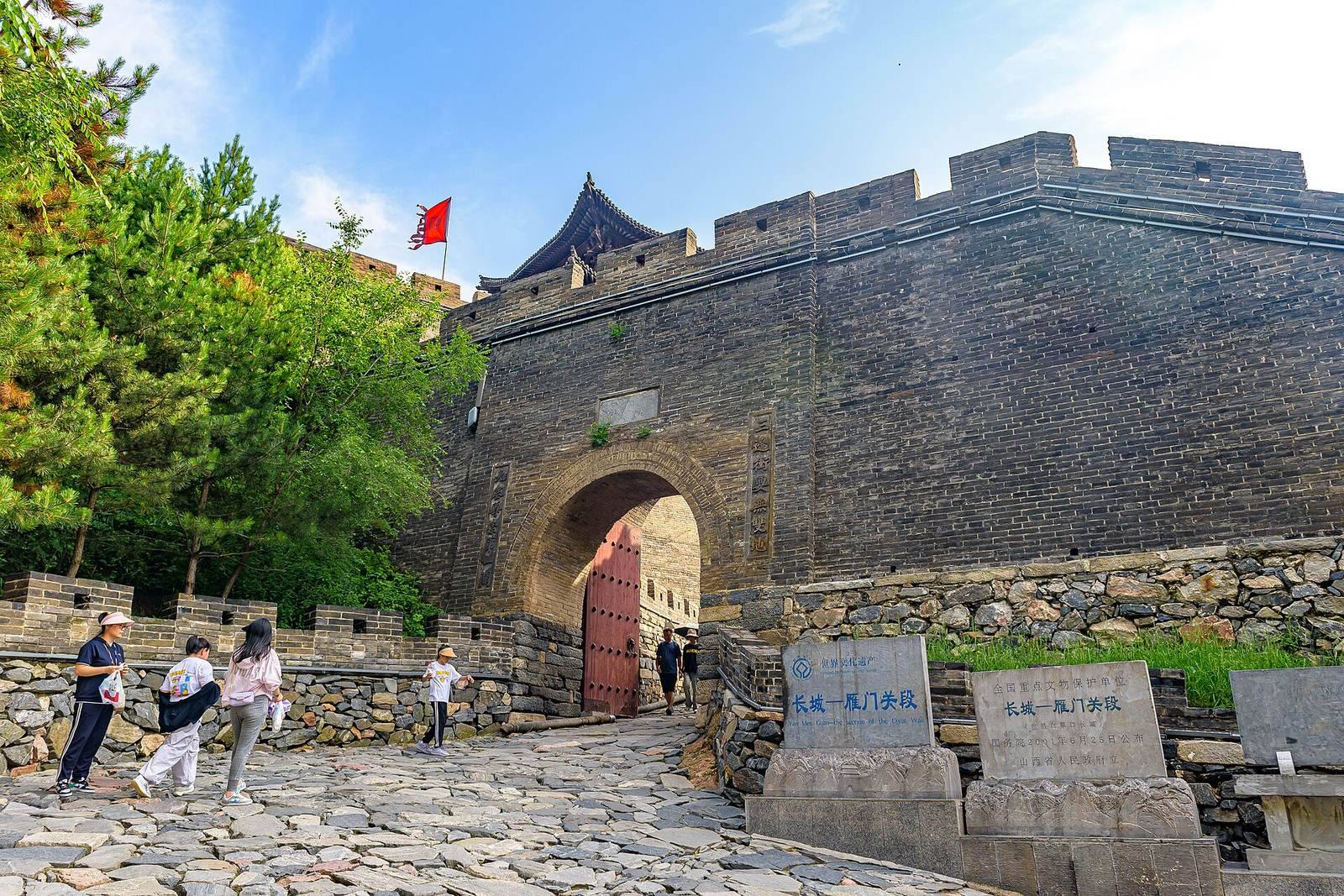
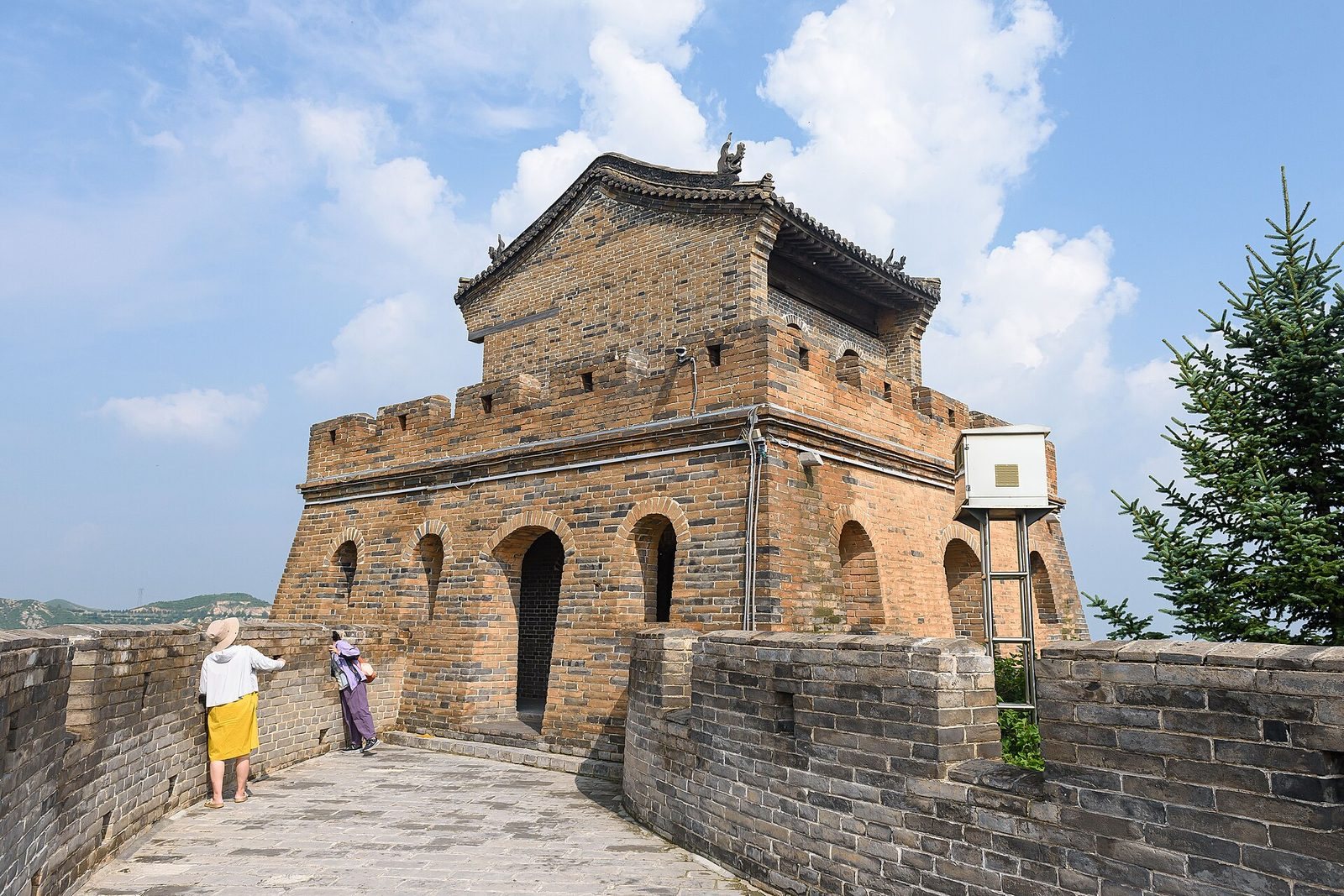
The preserved Ming fortifications extend for about one kilometer and stand roughly four meters high. They are built of stone, a material uncommon among surviving sections of the Great Wall in Shanxi. Three gatehouses are incorporated into the defenses: Dili Gate, meaning ‘Chosen Battleground,’ to the west; Yanmen Gate in the center; and Tianxian Gate, meaning ‘Impregnable Fortress,’ to the east. A pagoda overlooks the Great Wall at the pass.
Temples and commemorative features
Zhenbian Hall stands beside Tianxian Gate and is dedicated to Li Mu, the celebrated Zhao general. The monk Shan Quan began holding Buddhist services there in 1856. Beside Dili Gate, a temple is dedicated to Guan Yu, a historical Chinese general later revered as a deity of war. Statues of the Yang family generals stand along one of the site’s pathways.
Market and trade route
A frontier market lay between Yanmenguan Village and Dili Gate. A flagstone path known as Frontier Trade Street runs through the area and is lined with hostels and shops.