Woljeongsa: A Historic Buddhist Temple on Odaesan
Site at a Glance
- Rating
- 4.4
- Popularity
- Medium
- Country
- South Korea
- Primary era
- Medieval
- External website
- Open
- Eras represented
- Medieval, Early Modern
- Civilizations
- Goryeo, Joseon
- Site type
- Religious
- Remains
- Monastery
On this page16 sections
History
Woljeongsa is a Buddhist temple on the slopes of Odaesan in Pyeongchang County, South Korea, founded by the Silla monk Jajang Yulsa in 643 during the reign of Queen Seondeok. The temple belongs to the Jogye Order, Korea’s dominant meditation-centered Buddhist order, and serves as the head temple of its fourth parish, which supervises 60 affiliated temples. Woljeongsa is also regarded as a sacred place of Manjushri, the Mahayana Buddhist bodhisattva associated with wisdom.
Foundation and early development
The name Woljeong, meaning “Moon Abiding,” was associated with the exceptionally bright full moon rising over Dongdaesan. Foundation tradition relates that Jajang met Manjushri in China and returned to Silla with Buddhist relics, robes, and an alms bowl. When he later went to Odaesan hoping to meet Manjushri again, severe weather continued for three days and prevented the encounter. Jajang then built a temporary hut, which became the earliest predecessor of the temple.
The site was later occupied by the lay practitioner Sinhyo, traditionally regarded as an incarnation of Yudong Bodhisattva. Shinui, a disciple of the national preceptor Beomil, built a small hermitage on the location of Jajang’s hut. After Shinui’s death, the hermitage fell into ruin. The monk Yuyeon of Sudasa subsequently rebuilt it, and the institution developed into a proper temple.
Rebuilding and monastic importance
Fire destroyed Woljeongsa completely in 1307, after which the monk I-il rebuilt it. Another fire struck in 1833, and monks including Yeongdam and Jeongam reconstructed the temple in 1844. During the Joseon dynasty, which ruled Korea from 1392 to 1910, Woljeongsa was responsible for protecting the Odaesansago historical archives. By the nineteenth century, it had become a substantial monastic center where more than 100 monks practiced.
Woljeongsa was associated with prominent Korean Buddhist monks including Bang Hanam and Tanheo. It was also the last monastery where Gyeongheo Seongu stayed before withdrawing from public life in 1903. The temple’s religious identity remained closely connected with Jajang’s foundation tradition, Buddhist relics, and the Manjushri cult at Odaesan. It is traditionally counted among Korea’s five Jeokmyeolbogung sanctuaries, Buddhist relic sites understood as enshrining the Buddha’s presence without a conventional principal image.
Wartime destruction and modern reconstruction
During the Korean War, fears that North Korean forces might occupy the temples on Odaesan led Walton Walker, commander of the United States Eighth Army, and Korean Army general Kim Baek-il to order their destruction for strategic reasons. Woljeongsa’s buildings, including Chilbulbogeon, were burned. The Octagonal Nine-Story Stone Pagoda survived as the only major structure left standing.
Tanheo rebuilt Jeokgwangjeon in 1964, and the monk Manhwa continued the reconstruction of the complex. Much of the temple seen today therefore consists of buildings rebuilt after the Korean War. The Seongbo Museum opened in 1999 and manages cultural properties belonging to the 60 temples of the Jogye Order’s fourth parish. Woljeongsa also maintains temple-stay programs and the traditional practice of circling the pagoda, known as Woljeongsa tapdori.
Remains
Woljeongsa lies within a dense fir forest on the slopes of Odaesan. Its subsidiary buildings are arranged beside the central pagoda rather than along the straight axial plan commonly associated with Silla temples. The complex includes Iljumun, Sacheonwangmun, Jeokgwangjeon, Sugwangjeon, Samseonggak, and buildings used for temple-stay programs. Eight hermitages are also associated with the wider complex, whose surviving buildings and objects reflect repeated reconstruction and the continuing importance of the site as a Buddhist center.
Central pagoda area
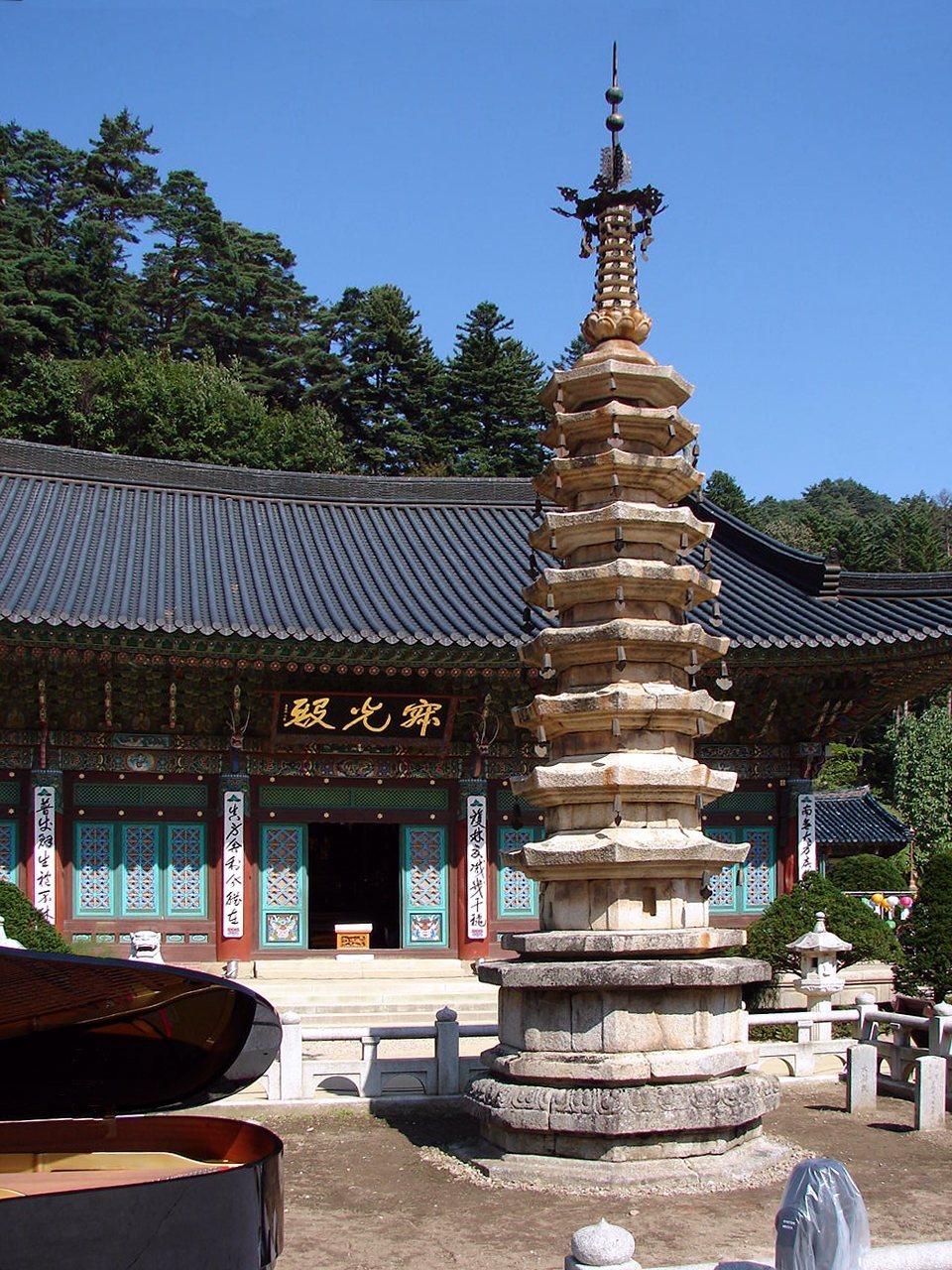
Octagonal Nine-Story Stone Pagoda
The Octagonal Nine-Story Stone Pagoda is an early Goryeo monument dating to approximately the twelfth century. Rising about 15.2 meters, it has an octagonal plan and represents an important form of early Goryeo pagoda design, particularly in northern Korea. Lotus designs are carved on the upper stone of its lower foundation. Its roof stones use two-tiered supports that combine angular and rounded forms instead of the more usual tiered arrangement.
When the pagoda was dismantled and restored in 1970, workers discovered a reliquary ensemble consisting of 12 pieces in nine types. Most of the objects date from the tenth or eleventh century, and the group includes a gilt-silver standing Buddha. Preserved in the Seongbo Museum, the ensemble provides evidence for the study of early Goryeo metalwork, Buddhist ideas, and cultural exchange.
Stone Seated Bodhisattva
A Stone Seated Bodhisattva is positioned before the southern side of the pagoda and faces north. The approximately 1.8-meter-high image dates to the eleventh century and kneels as if making an offering to an unidentified figure. Its identity remains uncertain, although it has been considered possibly a Medicine Buddha. Tradition holds that the statue was found at Diamond Pond south of the temple.
The image now placed before the pagoda is a replica made in 2008, while the original is preserved in the Seongbo Museum. The statue belongs to an early Goryeo tradition of placing Bodhisattva images before pagodas, a practice particularly represented in the Gangwon region.
Relic sanctuary and forest monuments
Jeokmyeolbogung
Jeokmyeolbogung is a one-story sanctuary measuring three bays across the front and two bays along the side. A Jeokmyeolbogung is associated with Buddhist relics and is traditionally understood as a place where the Buddha’s presence is enshrined without a conventional principal image. The building has an elaborate hipped-and-gabled roof, central double plank doors, and side bays with plank walls below lattice windows. Its establishment is traditionally connected with Jajang’s return from China after receiving a revelation from Manjushri.
Woljeongsa Stupa Group
The Woljeongsa Stupa Group stands in the fir forest about 700 meters along the route from Woljeongsa toward Sangwonsa. It contains 22 stupas, including examples associated with Ungong Seonggwan and Geumseongdang. Most are bell-shaped stone structures measuring about one to two meters high. Others take the form of round towers with double bases and roof stones. The group is generally attributed to the period after the middle of the Joseon dynasty.
Sculptures and hermitage objects
Gounam Hermitage sculptures
The Seongbo Museum preserves a Wooden Seated Shakyamuni Buddha from Gounam Hermitage at North Terrace. Gwangseup and two other sculptors made the image in 1710. A written votive text and a ritual container found inside the statue establish its date and production. The same hermitage also produced a Wooden Seated Maitreya Bodhisattva in 1710. Its internal materials identify its date and maker, and the image remains in good condition as an important example of eighteenth-century Buddhist sculpture.
Six-armed Avalokitesvara
The six-armed Avalokitesvara is a gilt-bronze Bodhisattva from the Joseon period. It has three arms on each shoulder and wears a three-faced floral crown. A seated transformation Buddha appears on the front of the crown, above which rises an ushnisha, the raised crown-like feature on the head of a Buddha or bodhisattva. Avalokitesvara is associated with compassion.
Sajaam Hermitage Vairocana Buddha
The Wooden Seated Vairocana Buddha from Sajaam Hermitage at Central Terrace is a late Joseon sculpture made in 1894. Materials placed inside the statue identify both its date and its maker. The image is preserved in the Seongbo Museum. Vairocana is the cosmic Buddha associated with the universal and illuminating aspect of Buddhahood.
Jijangam Hermitage shrine
The Wooden Ksitigarbha Triad Shrine from Jijangam Hermitage at South Terrace displays characteristic features of seventeenth- and eighteenth-century Buddhist sculpture. Shrines depicting Ksitigarbha in a triad arrangement are uncommon, and this work represents the sculptural style of the late Joseon period. Ksitigarbha is associated especially with beings in the underworld and with protection of the dead.