Joyangdong Prehistoric Heritage in Sokcho: A Bronze Age Archaeological Site
Site at a Glance
- Rating
- 4
- Popularity
- Very Low
- Country
- South Korea
- Primary era
- Bronze Age
- Eras represented
- Bronze Age
- Civilizations
- Unclassified
- Site type
- Domestic
- Remains
- House
On this page6 sections
History
Joyangdong prehistoric heritage in Sokcho is a Bronze Age archaeological site near Cheongcho Lake in Sokcho, South Korea, preserving habitation and burial remains from around the eighth century BCE. The site reflects the activities of prehistoric communities on Korea’s east coast and includes pit houses and dolmens associated with the Bronze Age.
Prehistoric settlement and exchange
The settlement occupied low hilltops near the lake. Its material includes both Neolithic and Bronze Age traditions, indicating activity across more than one prehistoric cultural phase. A pedestal-handled vessel resembles pottery from the late Neolithic Hogu-dong site at Musan in North Hamgyong. Its discovery at a southern Korean site has been interpreted as evidence of exchange between northeastern Korea and the central east coast.
A fan-shaped bronze axe recovered from one of the dolmens was especially important for regional research. Axes of this type were known from South Hamgyong, but this was the first example found in the coastal area of Gangwon.
Discovery and heritage protection
In 1990, the Korea Land Development Corporation designated approximately 130,000 pyeong, a traditional Korean area measure of about 3.3 square meters per pyeong, in Joyangdong for housing development. Because the land was to be altered, the Gangneung University Museum carried out a surface survey in late 1991. Excavation followed for about 70 days from mid-May to late July 1992 and identified seven pit-house sites and two dolmens.
The remains were sufficiently well preserved in their original form for the site to be designated Historic Site No. 376 on October 10, 1992. A Historic Site is an officially designated category of cultural heritage in South Korea. The protected area covers 24,295 square meters. Excavated artifacts are displayed at the Sokcho Municipal Museum.
In 2014, restrictions on the height of nearby buildings were relaxed after a complaint from a housing developer. The Cultural Heritage Committee’s Historic Sites Subcommittee allowed the change on the condition that later ordinance amendments or development plans would be discussed with national heritage authorities. Developers have also continued to seek cancellation of the designation and additional development.
Remains
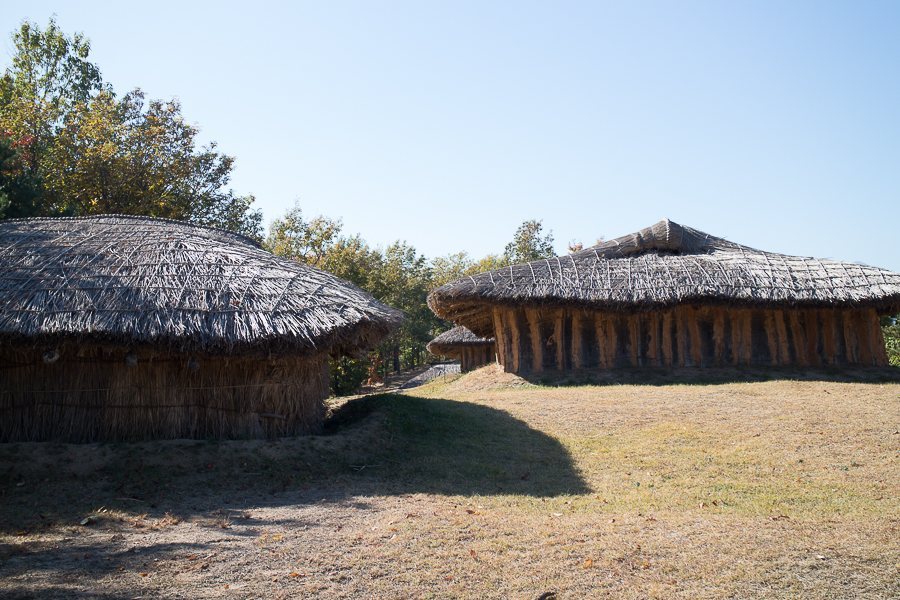
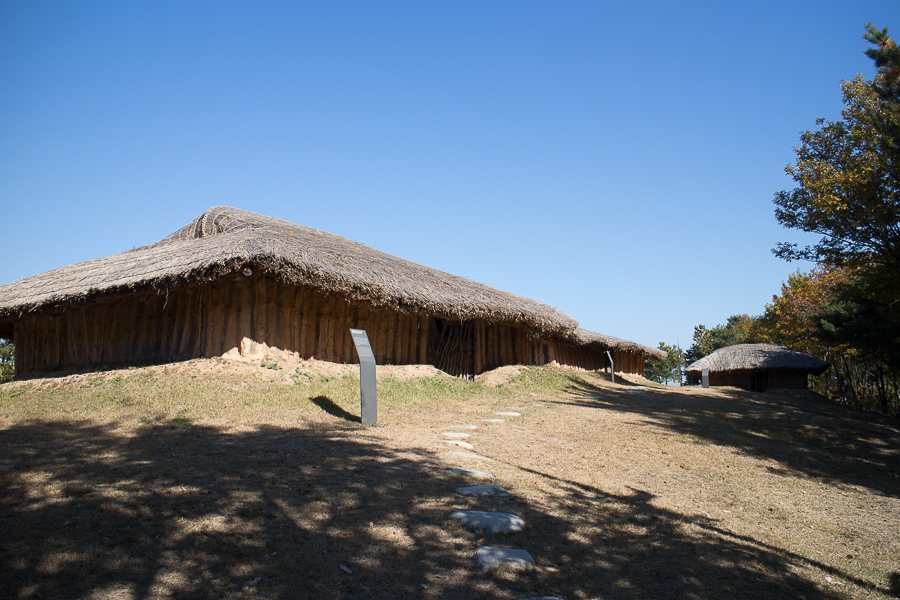
The site contains seven pit houses and two dolmens arranged across the tops of low hills. The dwellings faced south and were elongated rectangles aligned east to west. Their excavated areas ranged from approximately 23 to 76 square meters. Five house remains have been restored, while two were covered again after excavation. A reconstructed pit-house model also stands at the site.
Pit houses
A pit house is a dwelling partly set below the surrounding ground surface. At Joyangdong, each house was cut approximately 40 to 60 centimeters into naturally weathered bedrock, with a thin layer of fine clay laid over the floor. The surviving remains preserve the form of Bronze Age domestic structures and show how the settlement was established on the low hilltops.
Dolmens and excavated objects
A dolmen is a prehistoric stone burial monument generally formed from supports and a large capstone. The two dolmens at Joyangdong yielded the fan-shaped bronze axe, as well as pottery and stone-tool assemblages. The finds include Neolithic comb-pattern pottery sherds, double-rim pottery, perforated-pattern pottery, grooved-rim pottery, red-burnished pottery, and pedestal-handled vessels.
Stone objects from the excavation include axes, daggers, half-moon-shaped knives, spindle whorls, net sinkers, and arrowheads. Together with the pottery and bronze axe, these objects provide evidence for the settlement’s domestic activities, burial practices, and connections with prehistoric communities beyond the east coast.