West Point Foundry: An American Ironworking and Machine-Shop Complex
Site at a Glance
- Rating
- 4.7
- Popularity
- Low
- Country
- United States
- Primary era
- Modern
- External website
- Open
- Eras represented
- Modern
- Civilizations
- Unclassified
- Site type
- Economic
- Remains
- Production Complex
On this page9 sections
History
West Point Foundry was a major American ironworking and machine-shop complex in Cold Spring, New York, United States, established in 1817 and operating from 1818 until about 1911. Its creation followed the War of 1812, the 1812–1815 conflict with Britain that exposed the need for stronger domestic arms production. President James Madison encouraged American artillery manufacture, and Gouverneur Kemble incorporated the West Point Foundry Association in 1817.
Founding and industrial expansion
The site was chosen for its combination of natural resources and transport advantages. Nearby iron mines supplied raw material, while abundant timber provided charcoal. Margaret’s Brook supplied water power for machinery, and the Hudson River offered a route for moving finished products. The United States Military Academy across the river also provided protection. The foundry manufactured artillery and other munitions, but its output extended into civilian industry, including iron pipe for New York City’s water system and equipment sent to sugar mills in the West Indies.
The company also built several early locomotives, including the Best Friend of Charleston, the West Point, the DeWitt Clinton, Phoenix, and Experiment. In 1843, it manufactured the USS Spencer, the first iron ship built in the United States. These products demonstrate the range of work carried out alongside military production.
Robert Parker Parrott and weapons development
Captain Robert Parker Parrott became the United States Army’s ordnance inspector at the foundry in 1835. He left the army in 1836 and became superintendent on October 31 of that year. Under his direction, the foundry prospered and undertook extensive experiments with artillery and projectiles. Around 1860, this work produced the Parrott rifle cannon, a rifled artillery weapon associated with Parrott and widely used during the American Civil War.
The Civil War, fought from 1861 to 1865 between the Union and the Confederacy, brought exceptionally heavy military orders. The foundry employed 1,400 people and produced 2,000 cannon and three million shells. Parrott also developed an incendiary shell for the 8-inch Parrott rifle cannon known as the “Swamp Angel,” which bombarded Charleston. President Abraham Lincoln visited and inspected the works in June 1862, reflecting the foundry’s importance to the Union war effort. Its reputation even led Jules Verne to choose it as the contractor for the Columbiad in his novel From the Earth to the Moon.
Decline and archaeological recognition
Parrott resigned as superintendent in 1867 but continued experimenting with artillery designs until his death in 1877. Around 1870, the foundry stopped using charcoal and began purchasing coal from Pennsylvania. Competition from newer iron- and steel-production methods then weakened its business. The company entered receivership in 1884, a court-administered condition for a financially distressed organization, went bankrupt in 1889, and was sold to the Cornell brothers in 1897. Operations ended in 1911.
A major archaeological study took place from 2002 to 2008, supported by Scenic Hudson and conducted by Michigan Tech. The foundry itself was listed in the National Register of Historic Places in 1973. The West Point Foundry Archeological Site was added to the National Register in 2010 and designated a National Historic Landmark in 2021, a federal recognition reserved for properties judged to possess exceptional national importance.
Remains
The surviving industrial landscape lies beside the Hudson River, with Margaret’s Brook supplying the water power once used by the machinery. The preserved and investigated area includes ruins of the former foundry complex, buried industrial features, the intact central office building, and an artillery-proofing platform. An 87-acre preserve owned by Scenic Hudson forms part of the historic property, while the archaeological site is associated with a 100-acre designated area and the broader historic district is described as covering 93 acres.
Buildings and industrial remains
Central office building
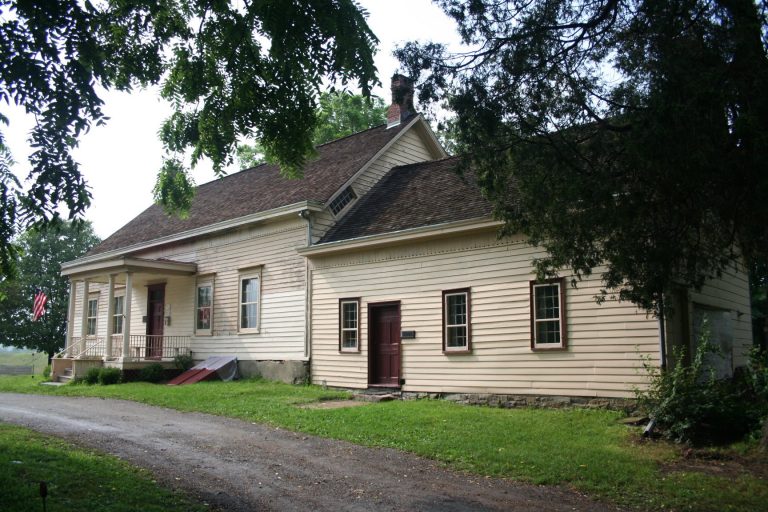
The central office is the only foundry building that remains intact. It survives within a landscape where the rest of the former industrial buildings appear as ruins, preserving the relationship between an administrative structure and the wider manufacturing complex.
Foundry ruins
The ruins and buried industrial features represent the former works that produced cannon, shells, iron pipe, civilian iron fittings, locomotives, and the iron revenue cutter USS Spencer. Their surviving fabric forms part of the archaeological site and reflects the range of manufacturing carried out at West Point Foundry.
Artillery-proofing platform
Artillery was tested through proof firing, the controlled discharge of a weapon to test its strength and safety. Guns were fired across the Hudson toward the then-desolate slopes of Storm King Mountain, the prominent mountain opposite the foundry. The platform used to mount artillery during this testing was uncovered during federal Superfund investigation and cleanup work in the early 1990s.