Volterraio Fortress: A Coastal Fortification on Elba Island


Site at a Glance
- Rating
- 4.6
- Popularity
- Low
- Country
- Italy
- Primary era
- Medieval
- External website
- Open
- Eras represented
- Bronze Age, Iron Age, Classical, Medieval
- Civilizations
- Etruscan, Holy Roman Empire, Republic of Pisa, Roman
- Site type
- Military
- Remains
- Castle
On this page7 sections
History
Volterraio Fortress is a coastal fortification in Italy, on Elba Island within the municipality of Portoferraio. Built around AD 1000, probably over an earlier Etruscan structure, it occupied a strategic position above the island’s northern coast and the sea beyond it. Thirteenth-century documents called the site Monte Veltraio.
Medieval Reconstruction
The fortress was renovated in the late thirteenth century, probably following a design by Vanni di Gerardo Rau. A Pisan document from 1298 describes the works as necessary for the defense of Elba, indicating the importance of the stronghold within the island’s defensive system.
In the mid-fifteenth century, Jacopo III Appiano, lord of Piombino, ordered the strengthening of Elba’s defenses. During this phase, Volterraio Fortress was enlarged and acquired the configuration that largely defines the surviving complex.
Ottoman Attacks and Later Military Use
The fortress was briefly besieged by Khayr al-Din, an Ottoman admiral and corsair also known as Barbarossa, in 1544. Dragut, an Ottoman naval commander and privateer, attacked it in 1553. The stronghold continued to serve as a station for long-range surveillance of northern Elba and the adjacent sea into the eighteenth century.
Toward the end of the eighteenth century, the fortress became a garrison for troops belonging to Napoleon I, the French emperor and military ruler. An uprising against the French forces in 1798 caused partial destruction of the complex, after which the fortress was permanently abandoned.
Archaeology and Conservation
Restoration work carried out from 2013 onward recovered surviving parts of the historic fortification. The remains are now owned by the Tuscan Archipelago National Park, preserving the site as a record of Elba’s long defensive history.
Remains
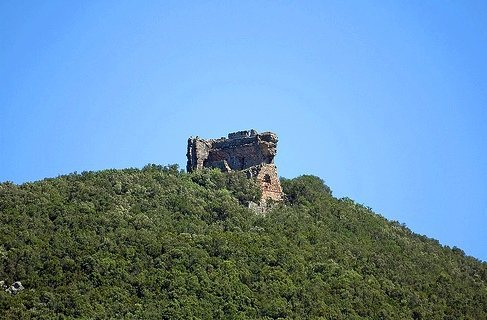
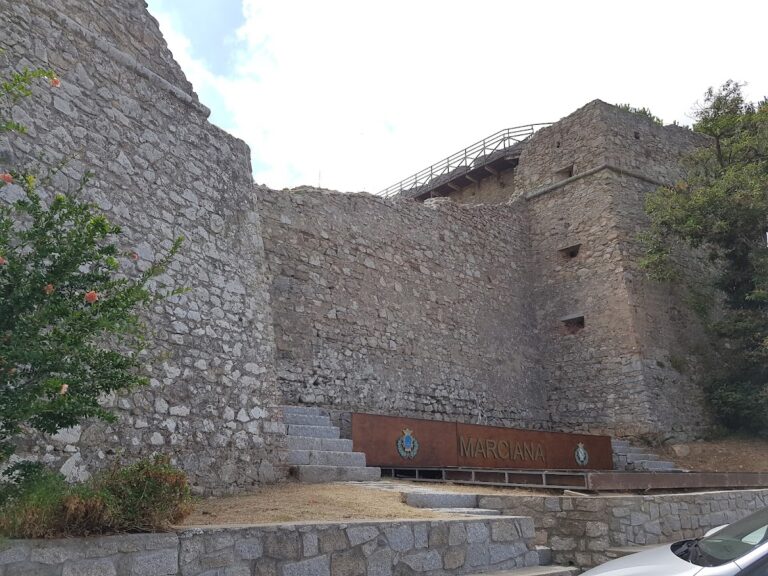
Volterraio Fortress stands at an elevation of 394 metres on the summit of the hill that bears its name. The surviving complex has a hexagonal plan, and its masonry structures are faced entirely with stone. Although ruined and partly restored, the fortress retains much of the imposing appearance associated with its original defensive purpose.
Fortress Structure
Traces of older Etruscan and Roman walls remain visible in places at the base of the fortress. These earlier masonry remains lie beneath and around the medieval stronghold, linking its visible ruins with the earlier occupation of the hill.
Earlier Settlement and Finds
Below the fortress are the remains of a Bronze Age settlement associated with the Subappennine culture, a cultural tradition of Bronze Age Italy, and connected directly with the settlement at Cima del Monte. A small rock-cut necropolis, meaning a cemetery formed by cutting burial spaces into natural rock, is also present.
Material recovered near the site includes a bronze coin from Volterra minted between the fourth and third centuries BC, lead sling bullets, fragments of figured bronze objects, and pieces of bucchero, a distinctive black, burnished Etruscan pottery. Together, these finds provide evidence of activity at the hill before the medieval fortress took its final form.