Château de Saint-Jean-d’Angle: A Fortified Castle Protecting the Salt Marshes


Site at a Glance
- Rating
- 4.7
- Popularity
- Medium
- Country
- France
- Primary era
- Medieval
- External website
- Open
- Eras represented
- Medieval, Early Modern
- Civilizations
- French
- Site type
- Military
- Remains
- Castle
On this page8 sections
History
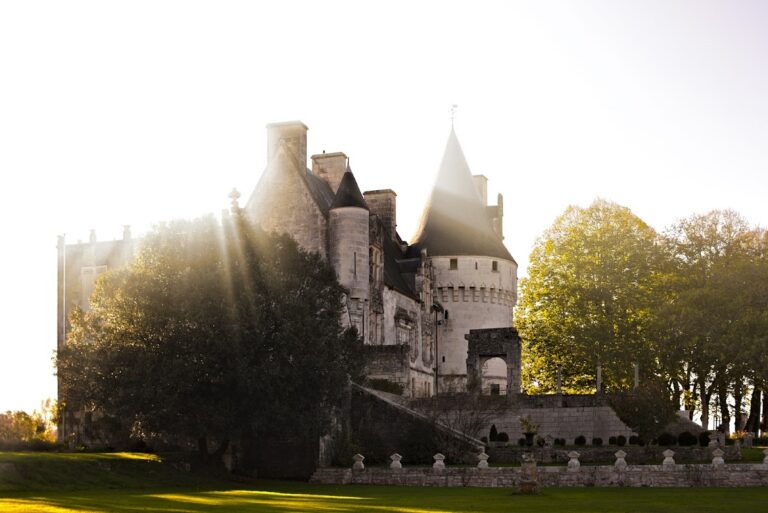
Château de Saint-Jean-d’Angle is a fortified castle in France, standing near the village of Saint-Jean-d’Angle. Construction began in the twelfth century in the form of a shell keep, a medieval fortress whose buildings were arranged against a strong enclosing wall around a central courtyard. The castle protected the nearby salt marshes, whose economic value was paramount, and took its name from the commune where it stands.
Medieval foundations and noble ownership
The fief of Saint-Jean-d’Angle appears in records from the early twelfth century, when it was associated with Foucher de Saint-Jean-d’Angle. Guillaume de Lusignan and Denise d’Angle are identified as the castle’s initial owners. On 15 January 1310, the knight Johan Rémont was connected with the first logis noble, a noble residence within a feudal estate. Raymond de Lobet later acquired this residence.
In 1406, Yolande Bouchard brought the domain to her marriage with Charles de Saint-Gelais as her dowry. The property remained in the Saint-Gelais family for six generations, preserving its place within a long-lived line of local lordship.
Seventeenth-century rebuilding and later transfers
During the seventeenth century, Charlotte de Saint-Gelais-Lusignan brought the castle to her husband, Guy-Philippe de Salins de La Fin. In 1624, she ordered repairs and enlargements to the main residence and other buildings. After her death on 4 April 1652, the domain passed among several co-lords, including Jacques Dupuy de Tournon, who died in 1715.
Jacques Dupuy de Tournon’s daughter, Louise de Pontevès, sold the castle on 24 August 1729 to Pierre de Verthamon for 56,000 livres, a pre-decimal French monetary unit. Jean-Baptiste de Verthamon later sold it for 127,000 livres to Jean-Jacques Isle de Ballode, the king’s cartographer and the last lord of Saint-Jean-d’Angle. The same transaction included the town of Saint-Symphorien.
The castle then passed to Isle de Ballode’s nephew, Louis-Henry Isle de Beaucheine, lord of Malvillars and husband of Marie-Pauline Aubert de Boumois. On 8 January 1818, he sold the castle and its surrounding 48 hectares of land to Pierre Beau for 30,000 francs. Pierre Beau died in 1848, after which the domain passed through the Herbout, de Lestrange, Latreuille, Fougère, and Lacour families.
Restoration and protected status
The property was eventually transferred to Alain Rousselot, who undertook a major restoration of the buildings. The quality of this work brought the castle the Grand Prix des Vieilles maisons françaises, a French heritage award, and the Europa Nostra Prize, awarded by a European heritage organization. Château de Saint-Jean-d’Angle has been classified as a French historic monument since 21 March 1994, a legal designation that provides heritage protection. It remains privately owned, with Chantal Rousselot as its current owner, and is used privately.
Remains
Château de Saint-Jean-d’Angle survives as a fortified castle organized according to the shell-keep model. Its buildings are set against the inside of a strong enclosing wall, leaving a central courtyard rather than filling the defensive core with a massive solid tower. The castle stands approximately 250 metres west of the village centre in Saint-Jean-d’Angle, in the Charente-Maritime department.
Residential buildings and seventeenth-century alterations
The noble residence
The logis noble associated with Johan Rémont in 1310 is identified as Saint-Jean-d’Angle’s first noble residence. It forms part of the castle’s residential history, which continued when Charlotte de Saint-Gelais-Lusignan had the main residence and other buildings repaired and enlarged in 1624.
The latrine bretèche
A date-bearing inscription on a latrine bretèche, a projecting enclosed structure incorporating a toilet facility, records Charlotte de Saint-Gelais-Lusignan’s rebuilding work: “LANMDCXXIIII CHARLOTTE DE St. GELAIS DE LUSIGNAN A REFAIT FAIRE CECI.” The inscription is positioned near her coat of arms, which appears beneath a depiction of Mélusine, a legendary European water spirit commonly shown as a siren or a serpent-tailed woman.