Velké náměstí 1: The Renaissance Town Hall of Kroměříž
Site at a Glance
- Rating
- 4.5
- Popularity
- Low
- Country
- Czechia
- Primary era
- Early Modern
- External website
- Open
- Eras represented
- Early Modern, Modern
- Civilizations
- Habsburg, Holy Roman Empire
- Site type
- Civic
- Remains
- Town Hall
On this page8 sections
History
Velké náměstí 1 is the Renaissance town hall of Kroměříž in Czechia, probably established by around 1550 and already taking its present form by 1593. Renaissance architecture revived classical forms in Europe between approximately the fifteenth and seventeenth centuries. The building stands at the southern part of the main square and has served as a civic and administrative centre through successive periods of the town’s history.
Renaissance town hall
The town hall is first mentioned in the 1570s. In 1611, it was renovated with financial assistance from Cardinal František von Dietrichstein, a senior Catholic Church dignitary who was also Bishop of Olomouc. The building’s jail had already held the Uničov priest Saint John Sarkander in 1610. Sarkander was later venerated as a saint, and his imprisonment forms part of the town hall’s historical record.
Destruction and rebuilding
Swedish forces burned the town hall during the invasion of 1643 led by General Torstensson. The town archive was destroyed in the same fire. Repairs were completed by 1654, after which the building underwent further alterations, particularly under Bishop Karel II of Liechtenstein-Kastelkorn. Additional repairs followed in 1686, 1730, and 1787.
A heraldic plaque installed in the building’s vestibule contains a chronogram, an inscription whose selected letters encode a date. Its encoded year is 1668, and the text honours Bishop Karel II as a pious prince to whom the people of Kroměříž dedicated the plaque.
Nineteenth-century administration
In 1850, the municipal council moved to the Generálhaus on the square, while the district administration and court took over the town hall. The changes made for this new use included inserting a third storey into the attic, removing the staircase that had been relocated, and modifying the facades. That year also brought the abolition of the stone standards for the ell and fathom, which had been mounted on the town-hall wall.
The tower watchman used the 40-metre-high gallery to sound the hours and also helped guard the town against fire. He last performed this duty during the Prussian invasion of 1866. After 1945, a major reconstruction restored an older appearance. A memorial plaque in the entrance vestibule lists Kroměříž citizens who died in the Second World War. It is registered as a war grave and commemorative site.
Twentieth-century reconstruction and present use
The general reconstruction completed in 1963, during celebrations of Kroměříž’s seven-hundredth anniversary, rebuilt the two-flight staircase and reopened the arcaded passage on the ground floor. Small shops that had occupied the passage for centuries were removed, and the municipal national committee returned from the Generálhaus to the town hall. The building now houses Kroměříž Municipal Office, including the municipal council, the mayor, deputy mayors, and several departments. Weddings and other social events are also held there.
Remains
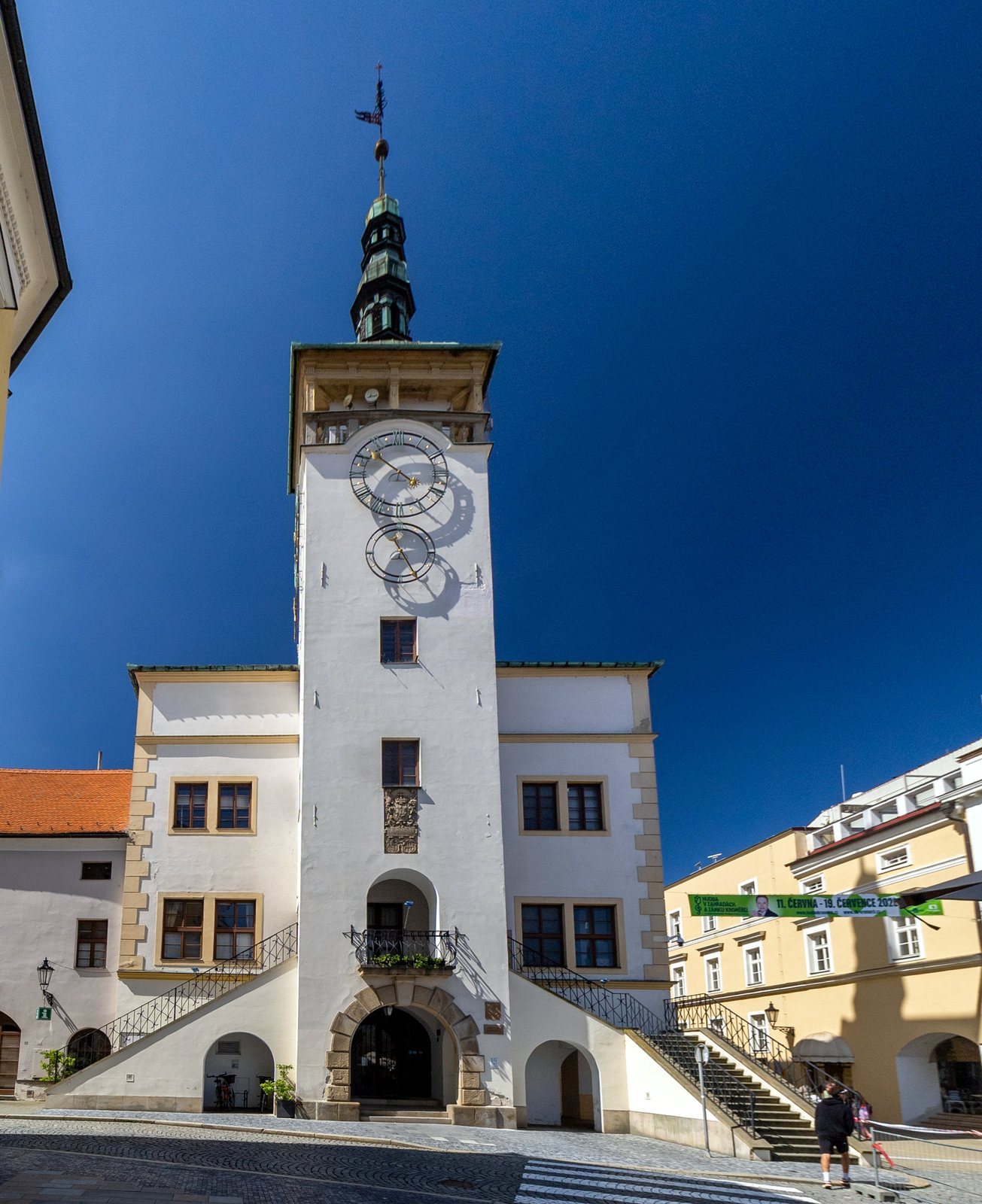
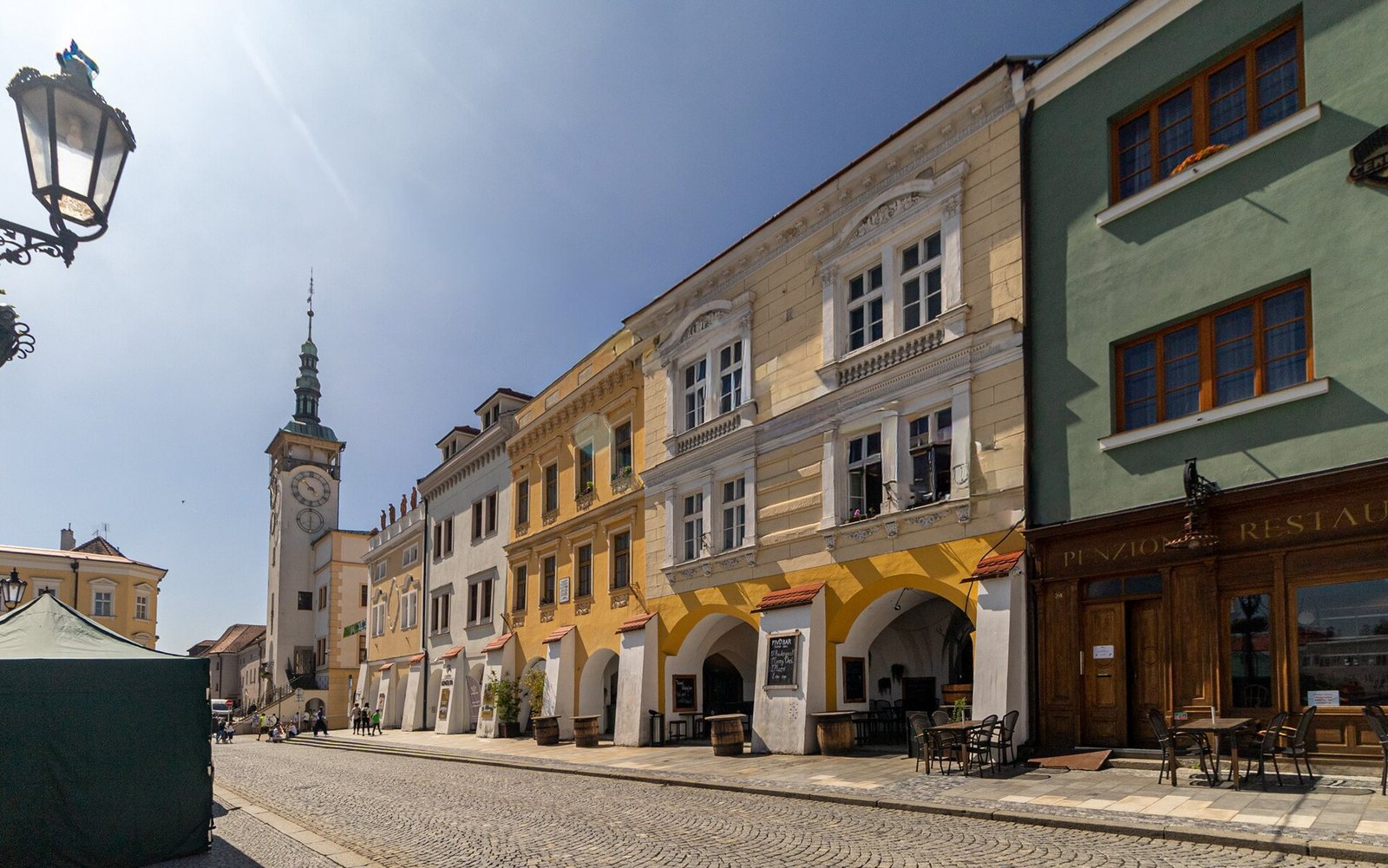
Velké náměstí 1 is a Renaissance corner building at the southern end of Velké náměstí, set between Kovářská and Prusinovského streets and adjoining the former burgher brewery. Its principal mass is organized around a square-plan tower projecting approximately half its depth beyond the front wall. The tower stands on the axis of the facade facing the square, while arcaded passageways extend beside it and along the Kovářská Street side.
Town-hall tower
The square tower rises 40 metres and ends in a stone gallery, above which is a dome or cupola carrying a slender, two-level lantern. Its upper storey and the decorative balcony on the front date from the alterations of the mid-nineteenth century. The tower originally had two clock faces. The large faces beneath the gallery date from the seventeenth century, and the upper face now indicates hours while the lower one shows minutes. In 1691, the clocks were verified as displaying two kinds of time, corresponding to full-hour and half-hour clocks.
The tower also contained accommodation for the watchman and his assistants, who guarded the town against fire. Its bell, called the pirglok, gave the daily signal for the closing of the drinking houses. A heraldic plaque bears the arms of Cardinal František von Dietrichstein, Kroměříž, and the Archdiocese of Olomouc. A Latin inscription expresses the citizens’ gratitude to Dietrichstein and commemorates him for posterity, while the city arms on the plaque are dated 1611.
Arcades and civic interior
The arcaded passageways form a defining part of the ground-floor arrangement, running beside the tower and along Kovářská Street. The passage was reopened during the 1963 reconstruction after the removal of the small shops that had occupied it for centuries. The entrance vestibule contains the Second World War memorial plaque, linking the surviving civic interior with the town’s twentieth-century commemorative history.