Vanse Church: A Medieval Parish Church in Norway
Site at a Glance
- Rating
- 4.7
- Popularity
- Very Low
- Country
- Norway
- Primary era
- Medieval
- Eras represented
- Medieval, Modern
- Civilizations
- Norwegian
- Site type
- Religious
- Remains
- Church
On this page8 sections
History
Vanse Church is a historic stone parish church in Norway, serving Lista Parish in Farsund Municipality. Traditionally dated to around 1037, it may represent an early medieval Romanesque church, although other interpretations place the beginning of construction around 1200 and date the oldest surviving sections to the thirteenth century. The church belongs to the Church of Norway, the country’s national Lutheran church, and was formerly a Catholic church before the Reformation.
Medieval origins and rebuilding
The traditional early date is linked to the former population of Lista and to the belief that the builders belonged to the same teams responsible for churches at Oddernes. A wooden church may have preceded the stone building. The medieval church was rebuilt and enlarged during the twelfth century, while its surviving pointed arches indicate Early Gothic work, a later medieval style associated with pointed arches and a more vertically oriented design. These features suggest that the church developed through several construction phases.
Election church and nineteenth-century transformation
In 1814, Vanse Church served as an election church and polling station during the first national elections in Norway. Those elections selected electors for the Norwegian Constituent Assembly at Eidsvoll Manor, which produced Norway’s constitution.
A major rebuilding took place in 1848 after panic in a crowded church caused an accident that killed eight people and injured several others. The medieval choir and east wall were demolished and replaced by a large cross-shaped extension, substantially enlarging the building.
Fire, restoration, and continued use
Lightning struck the church in 1872, starting a fire that damaged the roof. The roof was subsequently rebuilt. Later restoration work preserved the church as an active parish building, and it is protected under Norwegian cultural-heritage legislation by the Norwegian Directorate for Cultural Heritage. Vanse Church remains an automatically protected cultural-heritage site.
Remains
Medieval stone church
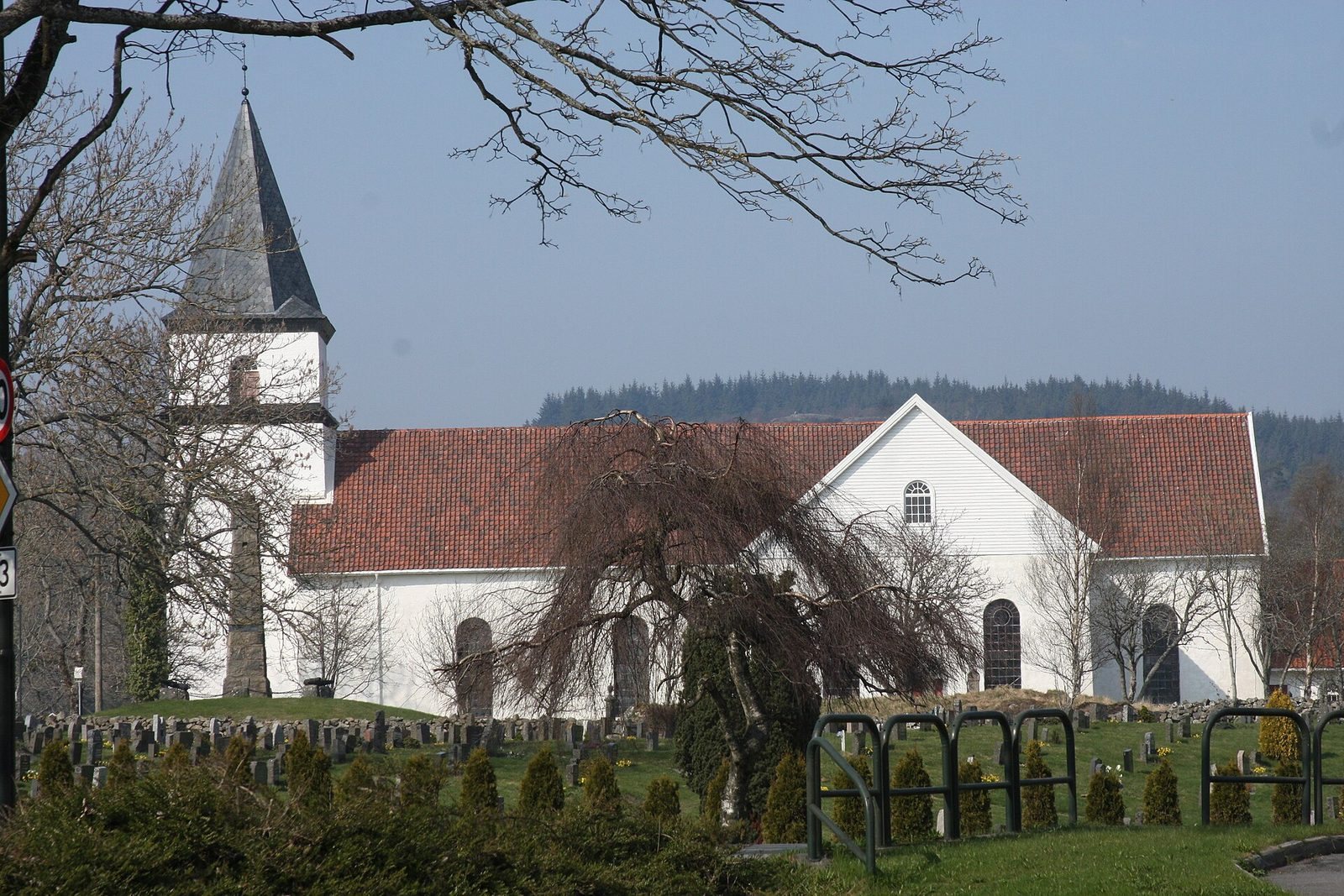
Vanse Church is a white stone building whose western nave is the oldest surviving part. The original stone church may have followed Romanesque principles, with massive masonry and generally rounded arches, while the pointed arches that survive belong to the Early Gothic phase. The early building had two high windows in its south wall and two windows in the choir wall, reflecting a medieval arrangement later altered by rebuilding.
Cross-shaped nineteenth-century extension
The present church has a cruciform plan and seating for approximately 850 people. Its large cross-shaped extension dates from the 1848 rebuilding and occupies the area where the medieval choir and east wall once stood. The building is whitewashed stone, and its architect is unknown.
Finds beneath the former altar
During the 1848 work, a small lead box containing a piece of cloth was found beneath the floor immediately in front of the former altar. Limestone and a piece of bone attributed to an unidentified saint were also recovered there. The bone may have been associated with Saint Olaf, the medieval Norwegian king also known as Olaf II, who was venerated as a Christian saint.