Unorozh: A Multiperiod Archaeological Settlement in Russia
Site at a Glance
- Popularity
- Low
- Country
- Russia
- Primary era
- Medieval
- Eras represented
- Iron Age, Medieval, Modern
- Civilizations
- Russian
- Site type
- City
On this page14 sections
History
Unorozh is a multi-period archaeological site on the southern edge of Unorozh village in Kostroma Oblast, Russia. Its history includes Mesolithic visits, an early Iron Age settlement, and successive medieval communities; its early medieval settlement is interpreted as a regional centre, although the identity of its inhabitants remains uncertain.
Prehistoric and Iron Age activity
People visited Unorozh between the ninth and fifth millennia BC, during the Mesolithic, a period of hunter-gatherer societies between the Palaeolithic and Neolithic. These visits were probably temporary and connected with hunting or other subsistence activities. A later settlement developed in the early Iron Age, around the eighth to sixth centuries BC, when iron tools and weapons were widely used. Its inhabitants used net-pattern pottery and, at another stage, comb-and-cord pottery associated with the Ananyino cultural-historical area, an archaeological grouping of eastern forest communities. The site helps researchers examine interaction between western and eastern Finnic-speaking communities.
Early medieval settlement
Unorozh’s most substantial early medieval occupation dates from the ninth to eleventh centuries. It is traditionally associated with the Merya, a historical Finnic people, but similarities with finds from the Krutik settlement leave open whether the inhabitants were Merya or Ves, another Finnic people. The settlement may have served as a tribal centre for communities around Lake Galich and as a regional hub for the fur trade. Finds point to connections extending from the Baltic region to the Kama.
The ninth-century population was replaced by a different Finnic-speaking community by the beginning of the tenth century, when the settlement was already involved in international trade. Archaeologist E. A. Ryabinin proposed that Unorozh may have served as a base for Novgorod’s expansion during the first half of the eleventh century. A layer associated with a major fire in the eastern part of the settlement may relate to the replacement of Novgorodian administration by Suzdal. In the twelfth century, the growth of Galich Mersky, the historical name for Galich in Kostroma Region, may have reflected Suzdal princes’ efforts to establish a new administrative and military centre in the region.
Medieval and later use
A settlement belonging to medieval Rus, the political and cultural world of the East Slavic principalities, occupied the site in the twelfth and thirteenth centuries. A men’s Annunciation monastery was established there from the fourteenth century. Its name refers to the Christian feast commemorating the angel Gabriel’s announcement to Mary that she would bear Jesus. The monastery ended during Catherine II’s secularization reforms of the 1760s, which transferred church and monastic property to state control. A tradition regarded as plausible holds that Jonah, later a metropolitan (a senior bishop overseeing a major church territory) and a saint of the Russian Church, became a monk there. Local tradition also linked Unorozh with the princes of Galich.
A brick Annunciation Church was built on the former monastery grounds in 1814 and became the parish centre for nearby villages. The site was mentioned in the Kostroma Provincial Gazette in 1888. V. N. Glazov excavated a feature known locally as the Zhuravets Mound in 1908 and took the first photographs of Unorozh. Later surveys were carried out by V. I. Smirnov in 1927, M. I. Matasov in 1956 and 1958, and K. I. Komarov in 1983.
E. A. Ryabinin excavated 96 square metres in the eastern part of the site in 1988–1989. From 2013, the Kostroma Archaeological Expedition, led by A. V. Novikov, conducted annual investigations, including work on more than 100 square metres in the northwest. These investigations established the site’s early Iron Age and Mesolithic activity and strengthened the case for an early medieval beginning in the ninth century. Research in 2016 supported interpreting Unorozh as a proto-urban settlement, one with some features of a town but not a fully developed urban centre, and the earliest such centre in the Trans-Volga area of Kostroma Region. Finds in 2017 confirmed that early medieval occupation began in the ninth century. Unorozh is designated a cultural heritage site of federal significance in Russia.
Remains
Setting and layout
The site occupies an irregular platform approaching a pentagon on a remnant of the first terrace above the floodplain, on the right bank of the Veksa River. The Veksa flows from Lake Galich and joins the Kostroma River. The Toiga, a right-bank tributary of the Veksa, curves around the site’s northern and eastern sides, separating the terrace remnant from the main terrace. The platform measures about 185 metres from north to south and 70 to 145 metres from west to east, narrowing toward the south; its slopes rise about nine metres above the floodplain. An oval rise lies at the northwest corner, the principal part of the site available for archaeological investigation.
Archaeological deposits and features
Northwest defensive remains
Excavations on the oval rise identified remains of defensive works. This area includes the feature locally called the Zhuravets Mound, which Glazov investigated in 1908.
Prehistoric and Iron Age deposits
Mesolithic finds include flint tools and waste from making them, while net-pattern pottery occurs among the site’s finds. Early Iron Age deposits survive in separate areas, and a storage pit from this period was recorded in 2014. Soil analysis indicates that people had ploughed land at Unorozh by the early Iron Age.
Workshops and street surfaces
Excavations identified four buildings that may have formed a street used by craftspeople. A paved area of dark stone, with a large stone slab, may have been part of a production facility. A bronze-casting workshop from the tenth or early eleventh century contained numerous crucibles, heat-resistant vessels for melting metal. Part of an adjoining street from the same period had a surface of wood chips.
Early medieval finds
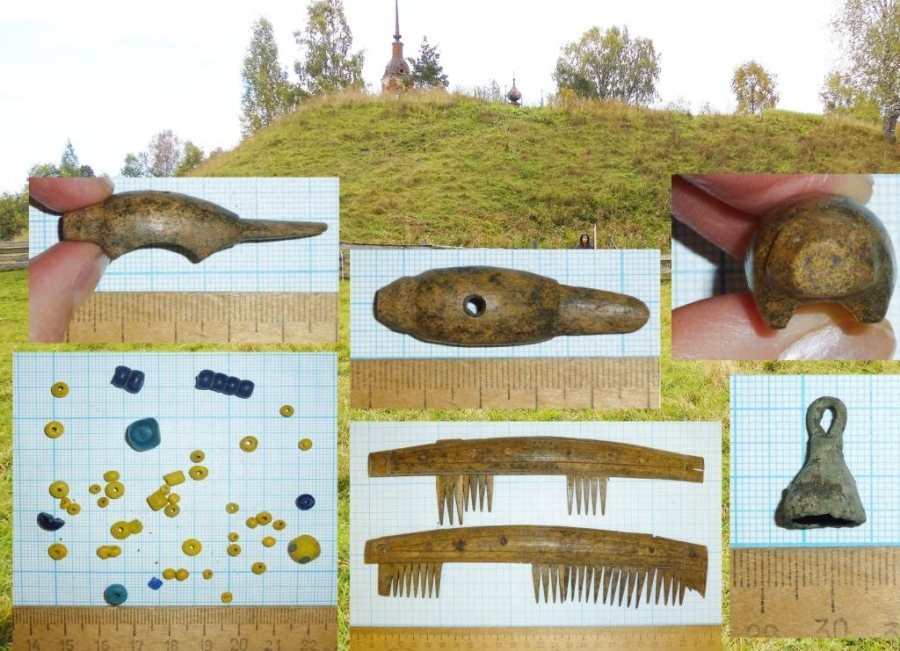
Objects from the early medieval settlement include imports, many beads and glass beads, and Samanid dirhams, silver coins associated with a dynasty that ruled parts of Central Asia and Iran in the ninth and tenth centuries. Beaver bones greatly outnumber those of other animals in the assemblage. A small figurine carved from a beaver ankle bone has a nearly complete parallel at the Krutik settlement in the Sheksna basin. Excavations also recovered an animal-shaped early medieval comb.
Medieval and later remains
Burial ground
A ground cemetery, meaning a burial ground without burial mounds, is associated with the twelfth- to thirteenth-century settlement. One recorded burial dates to the late thirteenth or first half of the fourteenth century.
Church and parish cemetery
The brick Annunciation Church stands on the former monastery grounds. A parish cemetery occupies a substantial part of the site and remains in use by people from nearby settlements.