University of Sassari: A Historic University in Sardinia
Site at a Glance
- Country
- Italy
- Primary era
- Early Modern
- Eras represented
- Early Modern, Modern
- Civilizations
- Crown of Aragon, Italian, Kingdom of Sardinia, Spanish
- Site type
- Civic
- Remains
- University
On this page14 sections
History
The University of Sassari is a university in Piazza Università, Sassari, Italy, whose history began with a Jesuit college that opened its first classes in 1562. Alessio Fontana, a member of Emperor Charles V’s Imperial Chancellery, left his property to the municipality in 1558 to establish the college, which was entrusted to the Society of Jesus, the Catholic religious order commonly known as the Jesuits and long associated with education.
Jesuit foundations and royal recognition
A papal bull in 1612 authorized the Jesuits to grant degrees in philosophy and theology. On 9 February 1617, King Philip III, the Habsburg king of Spain, granted those faculties university status under royal law, following petitions from the Jesuits, the municipality, and Archbishop Antonio Canopolo. Considered a second founder, Canopolo contributed funds for classrooms and the Aula Magna, the university’s main ceremonial and assembly hall, as well as making substantial donations.
Construction of the principal Jesuit building began in 1611. Classrooms financed by Canopolo were completed in 1618, and the building was subsequently raised. Work on a chapel dedicated to Saint Joseph began in 1625, followed by the Jesuits’ living quarters in 1634. Much of the accommodation, including the library, could be used by 1636, and the complex was completed in 1643. A royal charter in 1632 had meanwhile authorized degrees in law and medicine.
The college library grew through donations in the sixteenth and seventeenth centuries. Archbishop Andrea Bacallar gave it books on scholastic philosophy in 1612. An inventory excerpt records a bequest of 1,400 Sardinian lire and a booklet intended to track books lent, exchanged, sold, or purchased. The collection focused on Christian education and sacred texts, following a model associated with Jesuit writer Antonio Possevino and the teachings of the Council of Trent, the Catholic council held from 1545 to 1563 during the Church’s response to the Reformation.
Medical teaching began after the university gained degree-granting privileges in 1632. Modeled initially on Spanish universities, the course had three teaching chairs, or designated academic posts, for morning lectures, afternoon lectures, and the Institutes. Its first professors were Quirico del Rio, Andrea Vico Guidoni, and Gavino Farina. Del Rio also served as senior medical official for Sassari and Logudoro, a historic region of Sardinia.
The curriculum likely included readings from Hippocrates, Galen, and Avicenna. During the winter term, professors probably alternated between medical theory and practical anatomy, including cadaver dissection and readings from Johann Vesling’s Syntagma anatomicum. The academic year ended on the eve of the 24 June feast of Saint John the Baptist. Students seeking final examinations and degrees had to deposit money for the degree seal, gratuities, and the collegians’ gloves. Since medicine was introduced later than theology and law, it initially held a lower academic standing.
Reform and library development
In 1765 the university was restored under reforms of the Savoy government, whose ruling dynasty was the House of Savoy. Its regulations recognized four faculties: Philosophy and Arts, Theology, Law, and Medicine. Faculty members were recruited from Piedmont, broadening the university’s scholarly outlook and encouraging scientific research. The reforms also promoted investigation into Sardinia’s cultural and economic conditions. That year, Savoy minister Giovanni Battista Bogino asked the municipality to renovate the building as part of the wider educational reform. Work began in July under the direct supervision of Archbishop Viancini, the university’s chancellor from 1765 to 1772, and focused largely on restoring five classrooms facing the square.
After the reform, the university library became a royal library. Following the suppression of the Jesuit order in 1773, the college’s books were transferred to it. The library was enlarged under a plan drawn up in 1785 and in a later project. In the nineteenth century its first location consisted of two rooms, one for displaying books and the other for reading. A roof collapse closed the library in May 1837. Repairs took about five years, and it reopened in June 1842. An alphabetical catalog remained the sole means of finding books until a definitive inventory and the first subject-classified catalog were prepared in 1862.
Renewal and modern faculties
In 1877 the university was placed on a footing comparable to secondary institutions, beginning another period of renewal. Positivism, an intellectual movement emphasizing observation and scientific methods, gained influence in medicine, science, and law in the early twentieth century. Under the national university system, faculties of Pharmacy and Veterinary Medicine were established during the century’s opening years.
The Faculty of Agriculture was established in 1950. It developed proposals for agrarian reform later implemented by the Autonomous Region of Sardinia, the island’s regional government, and was associated with Sardinia’s economic and social renewal. In 1927 the building’s façade facing the square was demolished and rebuilt as part of a broader interior renovation.
Remains
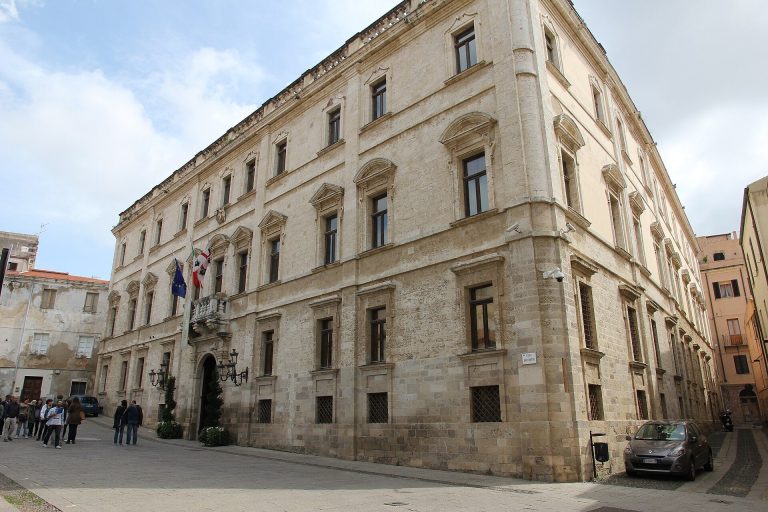
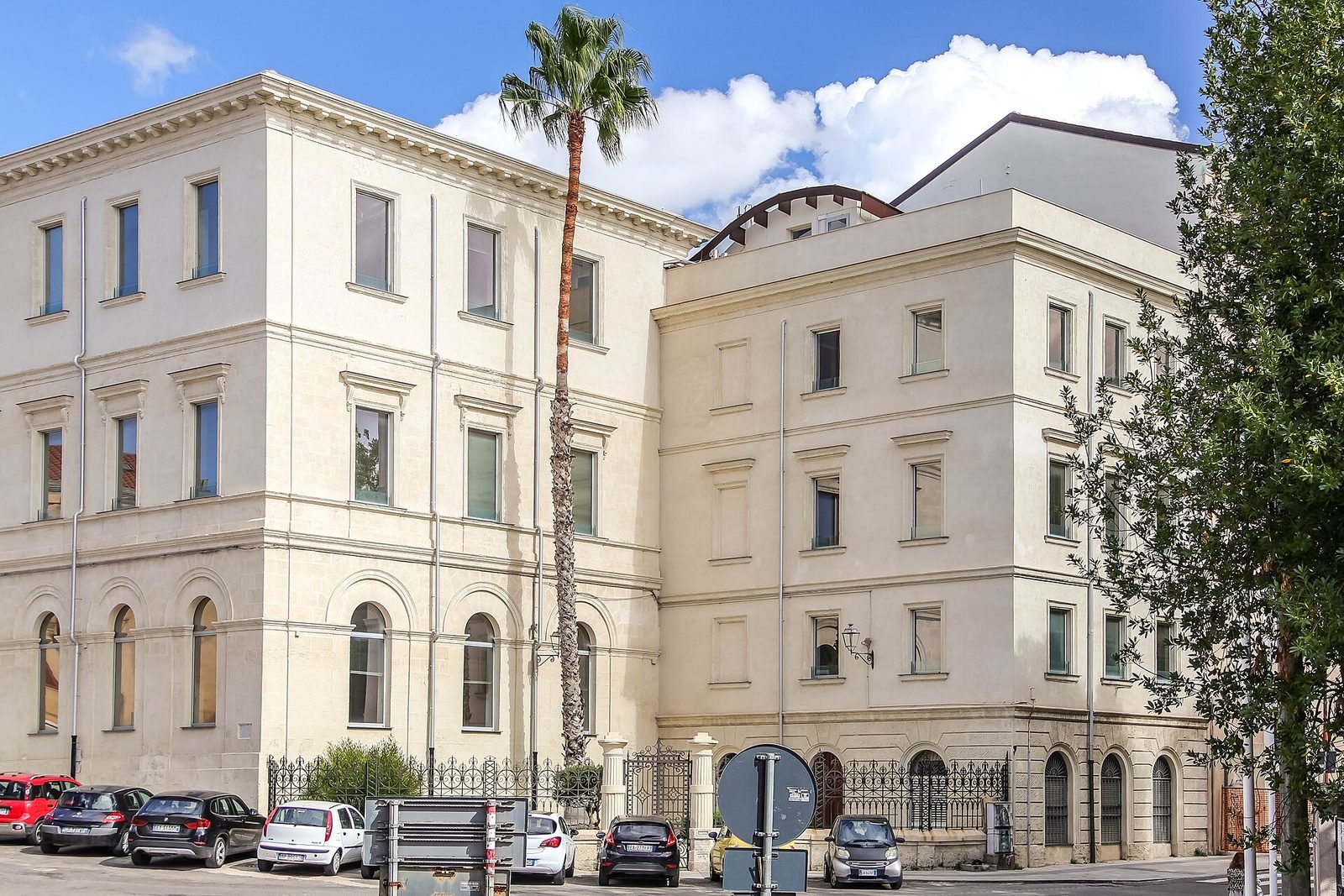
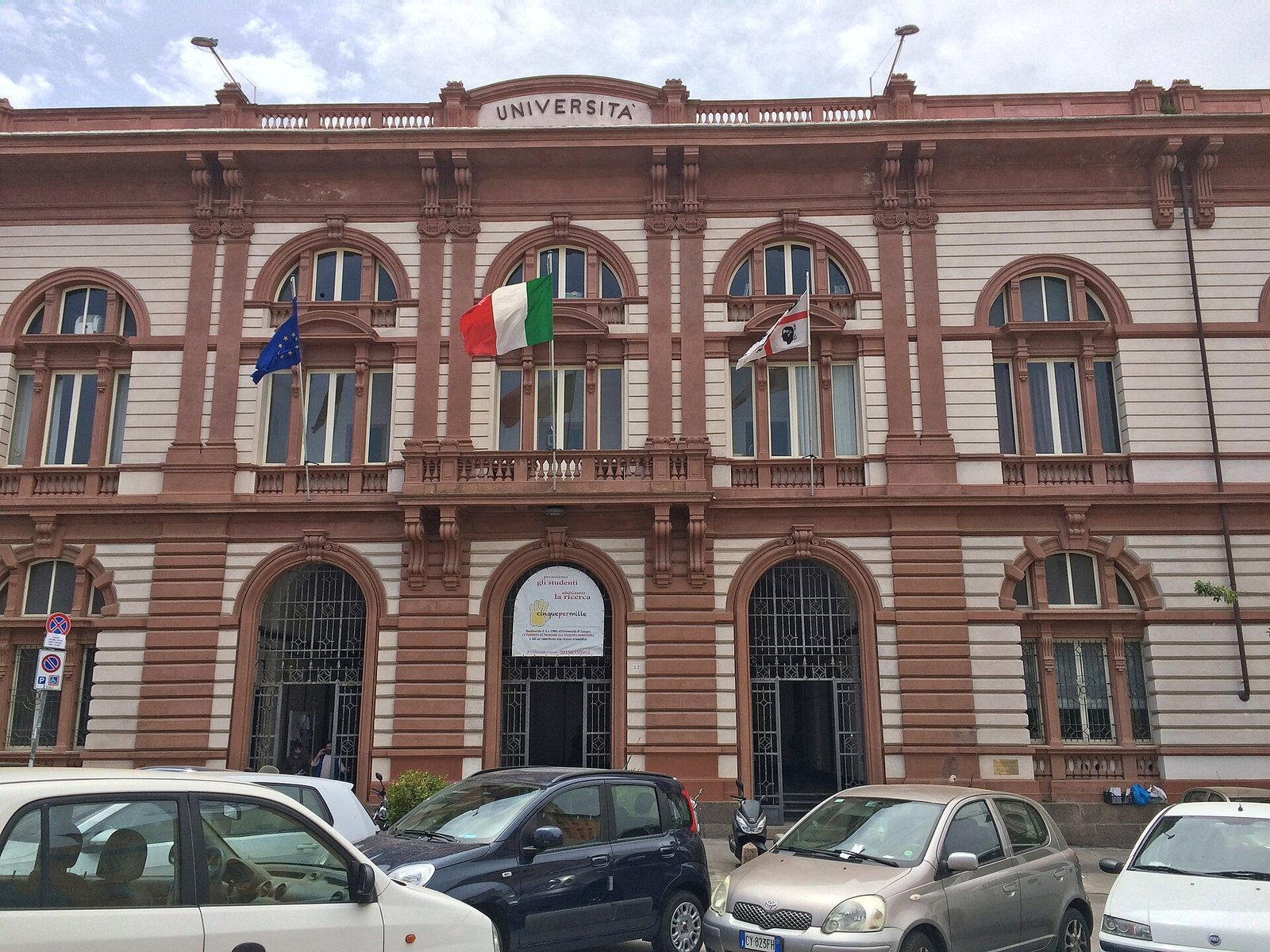
The historic Palazzo dell’Università is the university’s central building and houses its historical library. It retains parts of the Jesuit complex amid later renovations, while its unified reinforced-concrete front carries late Renaissance-style ornament. The university also has a botanical garden.
Plan and exterior
Courtyards and original arrangement
The building retains two courtyards. One lies within the first classroom block and was used by students; it was later given a covered walkway. The other, beside the church and the Jesuits’ apartments, has no such walkway. The garden-facing side appears to preserve an original arrangement of two separate building sections, in a design that recalls other buildings by Jesuit architects.
Original square façade
The former façade facing the square had two projecting side sections, bounded by supporting wall projections, and a narrow central section. Two thin horizontal bands divided the central front. It had three flat-topped entrances, with the middle one emphasized, and three framed square windows. A triangular upper feature contained a further square window. This arrangement followed a pattern common in Spanish convents of the period.
Rebuilt façade
The rebuilt front brings the façade together as a single reinforced-concrete composition. Its central section is marked by three arched doorways with brackets and projecting wedge-shaped stones at the tops of the arches. Above them, windows have arched decorative crowns, railings made of small columns, and brackets. The covered walkway was completed with decoration corresponding to the façade.
Entrance and interior spaces
The present entrance hall occupies the site of the former chapel. Canopolo’s coat of arms is visible there, and the main staircase has a railing formed by small columns. Classroom spaces were enlarged during the interior renovation.
The Aula Magna and its decoration
Paintings and lectern
The hall has simple stucco, a decorative plaster finish, and a monumental lectern beneath its largest painting. The lectern’s placement was planned with examples at the universities of Perugia and Padua in mind. Mario Delitala’s The Anatomy School of the Municipality of Sassari depicts a closed, dimly lit anatomy classroom. Its contrasts of light and shadow recall the sixteenth-century Venetian painter Tintoretto, while the light also emphasizes the arrangement of color. The Founder of the First College of Studies shows Fontana seated beside a table with four other figures; a Jesuit identified as the executor of his will sits opposite him as Fontana explains his wishes. The composition contrasts yellows, blues, violets, and reds. The Municipality of Sassari Obtains the Royal Charter from the Royal Chancery of Madrid presents a formal scene within a deep architectural setting, with the main figures at the foot of a monumental staircase and others arranged on either side. Broad contrasting strokes and luminous color define the composition.
Ceiling, portraits, and memorial door
The ceiling painting represents the university’s four faculties at the time: Law, Veterinary Medicine, Medicine, and Pharmacy. Two male and two female nude figures, rendered in sculptural form, hold blue, green, red, and lilac ribbons that extend around the university’s coat of arms. Round portraits between the pillars show Sardinian historian Giovanni Francesco Fara, anatomist Luigi Rolando, historian and statesman Giuseppe Manno, jurist Domenico Alberto Azuni, historian Pasquale Tola, Jesuit scholar Father F. Gemelli, and Jesuit naturalist Father F. Cetti. Delitala also designed the hall door, with plaster strips shaped like columns, a horizontal upper frame, and a triangular crown. Marble panels bear carved names of people who died in the First World War, 1915–1918.
Historical library rooms
In 1872 the library was assigned space in the building’s upper southern wing. Its new location comprised three large rooms decorated with stucco, royal and municipal symbols, provincial emblems, and likenesses of notable Sardinians.