Umm El Dabadib Spring: An Ancient Egyptian Fortress and Settlement in Egypt


Site at a Glance
- Rating
- 4.5
- Popularity
- Very Low
- Country
- Egypt
- Eras represented
- Classical
- Civilizations
- Roman
- Site type
- Military
- Remains
- Fort
History
Umm El Dabadib Spring was established by the ancient Egyptians and later saw continued use through the transition from pagan to Christian periods.
The earliest evidence of human presence at Umm El Dabadib dates back to prehistoric times, indicating long-term occupation of the area. During the period of Egyptian control, the site developed into a small fortress town that played a role in regional connectivity, situated along the ancient Darb Ain Amur route linking the Kharga and Dakhla oases. This route facilitated trade and communication across the Western Desert.
Scholars suggest that the fortress and its surrounding settlement were constructed later than other fortifications in the Kharga Oasis, as indicated by the distinctive rectangular corner towers. The design of the irrigation system, which includes underground aqueducts resembling Persian qanats, points to possible influences or developments during the Persian occupation of the region. This suggests that the site may have been adapted or expanded under Persian rule.
In the Christian period, the site continued to be inhabited, as shown by the presence of a church adjacent to the fortress. This church contains inscriptions and prayers in Greek, Coptic, and Arabic, reflecting the religious and cultural changes that took place over time. The cemeteries around Umm El Dabadib also reveal a transition in burial practices, with tombs ranging from rock-cut chambers to mudbrick-lined graves, some containing mummified remains.
Despite its long history, the site experienced damage in recent times due to looting, which has affected some of its key structures. Nevertheless, archaeological surveys have documented its layout and features, preserving knowledge of its historical development.
Remains
The site of Umm El Dabadib Spring is centered around a fortress covering roughly 100 meters on each side, enclosed by thick mudbrick walls. Unlike other fortresses in the Kharga Oasis, this one features four large rectangular towers at its corners. The southwestern tower is the tallest, rising to about 15 meters and containing remnants of a spiral staircase. The fortress’s main entrance is located on the southern wall, with smaller buildings arranged along the southern and western sides. Inside, much of the structure has collapsed, but several vaulted chambers on the ground floor remain intact.
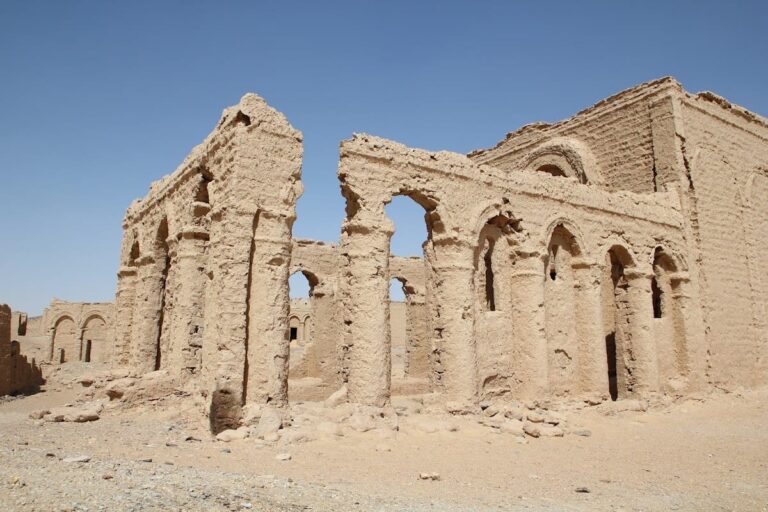
To the east of the fortress lies a Christian church characterized by arches and pillars. Traces of original red plaster survive on its walls, alongside inscriptions in Greek, Coptic, and Arabic. This church suffered significant damage from looters using heavy machinery, yet its architectural elements still reveal its religious function and period of use.
The settlement extends primarily to the north of the fortress and includes hundreds of small buildings that served as homes and shops. Among these are some multi-storey houses reaching up to three stories, indicating a degree of wealth or status within the community. In the northeastern section of the fortified area stands an Egyptian-style temple with walls that slope inward, located near a spring or well. Recent discoveries near the temple include a possible mill and a small hermitage, suggesting diverse activities within the settlement.
A notable feature of Umm El Dabadib is its sophisticated irrigation system. At least five underground aqueducts run northward from the town toward the nearby escarpment. These tunnels include regularly spaced vertical shafts, likely used for ventilation and maintenance, and are more advanced than Roman qanats found elsewhere in the Kharga Oasis. This system would have been essential for sustaining the settlement in the desert environment.
The site also contains ten identified cemetery areas. Some tombs are rock-cut into a rocky spur east of one aqueduct, while others are lined with mudbrick and feature façades. Many of these burial sites have been disturbed, with scattered mummified remains found within. The cemeteries reflect the long span of occupation and changing funerary customs at Umm El Dabadib.
Umm El Dabadib lies within a broad, flat wadi crossed by several ancient tracks. These routes connect the site to other important locations in the region, such as the el-Labekha fortress, Ain Amur, and the Hibis Temple, underscoring its strategic position along desert pathways.