Twyfelfontein: Namibia’s Prehistoric Rock-Art Site
Site at a Glance
- Country
- Namibia
- Primary era
- Stone Age
- Eras represented
- Stone Age, Bronze Age, Iron Age, Classical, Medieval, Early Modern
- Civilizations
- Unclassified
- Site type
- Civic
- Remains
- Rock Art
On this page12 sections
History
Prehistoric occupation and rock art
Twyfelfontein is a prehistoric rock-art site in the Huab valley of Namibia, used by hunter-gatherers and later Khoikhoi herders over thousands of years. People have inhabited the area for about 6,000 years. The earliest residents belonged to the Wilton cultural group, a Stone Age archaeological tradition of southern Africa. Khoikhoi pastoralists, Indigenous people historically related to the San, occupied the valley about 2,000 to 2,500 years ago. Both communities used the area for worship and shamanistic rites, religious practices involving ritual specialists and spiritual experience.
The oldest engravings may be as much as 10,000 years old. Regional stylistic estimates place much of the rock art between about 6,000 and 1,000 years ago, although some images may be more recent. Radiocarbon results range from roughly 5,850 to 180 years before present. How these dates relate to the periods when different communities lived or worshipped here remains uncertain. Hunter-gatherers made most of the engravings and probably all the paintings; Khoikhoi herders also created rock art, including geometric designs distinct from the older engraved images. Rock-art production probably ended around AD 1000 with the arrival of pastoral groups.
Rediscovery and investigation
Topographer Reinhard Maack reported engravings in the area in 1921. David Levin revisited the valley in 1947 while assessing its potential for farming and rediscovered the spring. Its water supply proved difficult to rely on for his family and livestock. He bought the land and registered a farm in 1948, naming it Twyfelfontein after a friend joked about his doubts concerning the spring. The Afrikaans name is often translated as “doubtful spring,” though “uncertain spring” or “questionable spring” is closer to its meaning.
Scientific study of the rock art began in 1950, when Ernst Rudolph Scherz described more than 2,500 engravings on 212 sandstone slabs. His early survey distinguished 14 smaller art localities; in 1975, he described the archaeological site as divided into 15. The estimated total has since risen to more than 5,000 depictions.
Settlement, protection, and World Heritage status
After the Second World War, severe drought brought Afrikaans-speaking white farmers to the area. The apartheid government later acquired the farm under the Odendaal Plan, a policy that created designated homelands, or bantustans, for Black communities in Namibia. The land became part of Damaraland, and the white settlers left in 1965.
Twyfelfontein was declared a National Monument on 15 August 1952, but remained without guards until it became a nature reserve in 1986. During that period, people damaged or removed many engravings and added graffiti to the sandstone. The site is now protected under Section 54 of Namibia’s National Heritage Act. In 2007, UNESCO inscribed it as Namibia’s first World Heritage Site, recognizing its extensive evidence of hunter-gatherer ritual practices over at least two millennia and the apparent relationship between ritual, economic practices, and land beside an aquifer. The listed core covers about 57.4 hectares, within a buffer zone of about 9,194.5 hectares.
Remains
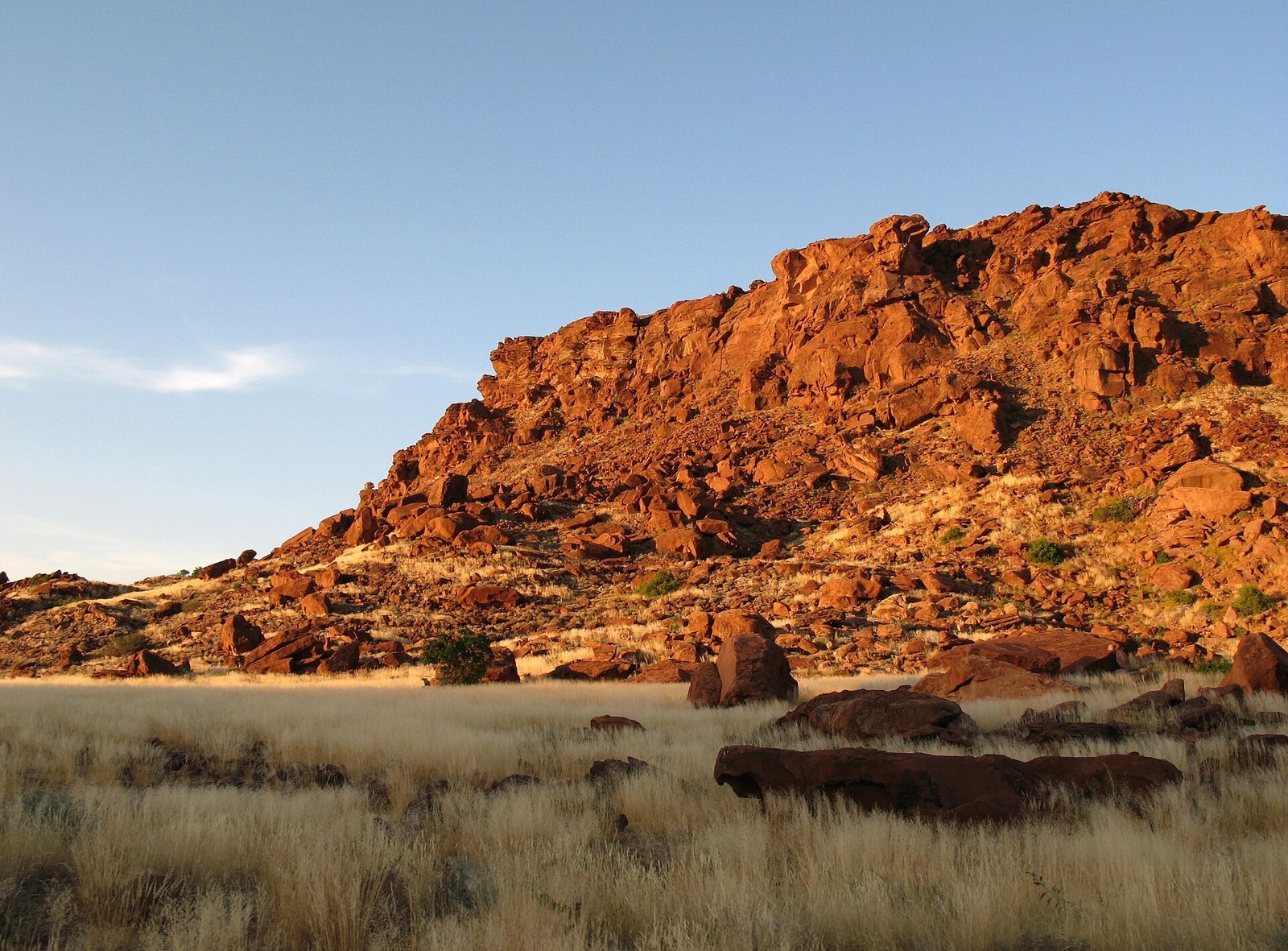
The rock-art area occupies a valley on the banks of the Aba Huab River, between the slopes of a sandstone table mountain in the Mount Etjo formation. It lies about 550 metres above sea level in a transition zone of semidesert, savanna, and shrubland, where annual rainfall is below 150 millimetres. An underground water-bearing layer above fine-grained shale feeds the spring. Across the valley’s sandstone surfaces, more than 5,000 individual depictions are distributed among 15 smaller localities. The rock is coated with dark mineral varnish; artists pecked or chiselled through it to reveal the lighter stone beneath.
Engravings
Animals, people, and tracks
Engravings show animals, people, fantastic creatures, and the tracks of humans and animals. Rhinoceroses, elephants, ostriches, and giraffes are among the subjects. The Lion Man depicts a lion with a long, kinked rectangular tail ending in a six-toed paw print. It and other figures appear to show people changing into animals. Together with images that place animals beside their tracks, these scenes support the interpretation that some engravings relate to shamanistic rites, rather than simply depicting efforts to secure food. This interpretation remains a proposal, not a certainty.
Some indistinct images were once identified as sea lions, penguins, and possibly flamingos, leading to suggestions that the artists travelled to the coast, more than 100 kilometres away. A later survey led by Sven Ouzman questioned those identifications: unclear figures might instead be rough renderings of animals from the region, possibly giraffes. Other recorded images include rare handprints, human figures in varied poses, a four-toed human footprint, and a grouping of an adult and child. In one case, animal figures lie beneath circles pecked onto the same surface, indicating that the animals were carved earlier.
Geometric designs and carved hollows
Geometric images include pecked circles and rows of dots. Khoikhoi imagery includes geometric designs that may represent groups of herders, as well as hollows used for grinding and board games. Small rounded pits, known as cupules, occur in several clusters. Some stones bear marks consistent with use as gong stones, which produce unusual resonant sounds when struck.
Panels and recorded localities
Named panels preserve a range of subjects. The Lion Slab bears the Lion Man; the Monkey Slab includes a human figure with pecked infill; and the Half-Moon Slab has a seated giraffe. Carsten’s Slab carries several pecked animal images. Other recorded features include two large giraffes filled with fine pecking, a seated giraffe on a giant slab, a pecked ostrich connected by a line to a horse-family animal, a dancing kudu, and a giraffe with three wavy lines attached to its head. A spoor rock bears several animal tracks and a seven-toed feline, while another engraved cluster combines tracks and cupules. Recorded groups vary in size, including localities with 150 to 250 engravings and others combining engravings, paintings, and geometric images.
Paintings and excavated remains
Paintings
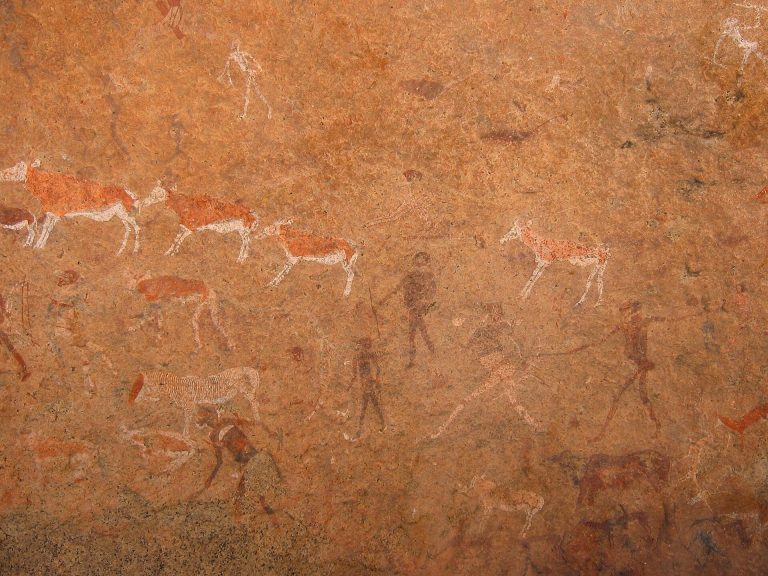
Paintings occur at 13 localities. Red-ochre human figures appear in six rock shelters, and the valley includes both painted and engraved images, a rare combination. Recorded examples include a cave with paintings, red-pigment images, and some of the valley’s best-preserved paintings.
Tools, ornaments, and food remains
Excavated stone tools were made mostly from quartzite. Their forms indicate work on rock, while the wider tool evidence points to woodworking and leatherworking as common activities. Pendants and beads made from ostrich eggshell fragments were found at several locations. Excavated remains also include charcoal, bone fragments, and undecorated pottery sherds. The pottery may belong to early farmers rather than the Stone Age communities responsible for the rock art. Food remains include bones of small antelope, rock hyraxes, and lizards, in contrast to the large animals frequently depicted on the rock surfaces.