Tron Theatre: A Performing Arts Venue in Glasgow
Site at a Glance
- Rating
- 4.7
- Popularity
- High
- Country
- United Kingdom
- Primary era
- Early Modern
- Eras represented
- Early Modern, Modern
- Civilizations
- British, Kingdom of Scotland
- Site type
- Religious
- Remains
- Church
On this page12 sections
History
The Tron Theatre is a performing arts venue in Glasgow, Scotland, United Kingdom, housed in the former Tron Kirk. A collegiate church, served by a community of clergy rather than necessarily by monks, was built on the site in 1484. Its bell tower was completed between 1630 and 1636. A fire devastated the church in 1793 but left the tower standing, and a new church was built on the site in 1795 for the Presbyterian Church of Scotland, to a design by Scottish architect James Adam.
Church site and early theatre clubs
An earlier Tron Theatre Club, organized by R. F. Pollock, operated from 1929 to 1932. Pollock sought to develop a distinctively Scottish approach to acting, drawing on ideas associated with Russian actor and theatre practitioner Konstantin Stanislavski. The club staged Henrik Ibsen’s The Master Builder, and actor Duncan Macrae began his career there. When the amateur company disbanded in 1932, it split into three groups, including the Curtain Theatre and Dumbarton People’s Theatre.
A separate Glasgow Theatre Club was founded in 1978 by Joe Gerber, Tom Laurie, Tom McGrath and Linda Haase. It was the predecessor of the present Tron Theatre Company. The group had performed at the Close Theatre, part of the Citizens’ Theatre in the Gorbals, until a fire destroyed that venue. In 1980, it took over the nearly derelict Tron Kirk, the Scots name for the church.
The church was converted into a theatre in 1981 by the architectural practice McGurn, Logan and Duncan. The Tron opened on 10 May, and its first season of short plays began two days later with Eine Kleine Nacht Musik, directed by Ida Schuster-Berkeley.
Company leadership and productions, 1984–2005
Faynia Williams became the company’s first artistic director in 1984. With her husband, dramaturg Richard Crane, who helped shape the development of theatrical work, she wrote the company’s first script, Burke and Hare. Michael Boyd led the company from 1986 to 1996. Performers Alan Cumming, Forbes Masson, Peter Mullan, Craig Ferguson and Siobhan Redmond, as well as musician Craig Armstrong, emerged from the company during his tenure. Irina Brown was artistic director from 1996 to 1999.
In 2000, the company presented the world premieres of Douglas Maxwell’s Our Bad Magnet and Zinnie Harris’s Further than the Furthest Thing. The latter was directed by Brown and co-produced with the Royal National Theatre. It premiered at the Edinburgh International Fringe Festival, won four awards, then played at the National Theatre and Tricycle Theatre in London before touring South Africa.
Neil Murray became director in 2002 and served as the company’s artistic producer. Productions under his leadership included Iain Heggie’s Love Freaks, John Mighton’s Possible Worlds, Forbes Masson’s Jack and the Beanstalk and Cinderella, and Chris Hannan’s Shining Souls. Possible Worlds was the centrepiece of the Canadian Six Stages Festival. Shining Souls, co-produced with v.amp productions, was named Best Production at the 2003 Critics’ Awards for Theatre in Scotland.
The 2004 programme included David Greig’s world premiere of San Diego at the Edinburgh International Festival, and Anthony Neilson’s The Wonderful World of Dissocia, created with the festival and Theatre Royal, Plymouth. The latter won five of its ten nominations at the 2005 Critics’ Awards for Theatre in Scotland. A 2007 revival with the National Theatre of Scotland toured the United Kingdom and played at London’s Royal Court Theatre.
Changing artistic leadership, 2005–2023
Murray left in 2005 to become Executive Director of the National Theatre of Scotland. Ali Curran, formerly of the Peacock Theatre at Dublin’s Abbey Theatre, directed the Tron from May 2005 to May 2006. Her period included Ubu the King, adapted by David Greig and directed by Dominic Hill in a co-production with Dundee Repertory Theatre, the Barbican, the Old Vic and Bite:05. The company also presented the European premiere of John Mighton’s Half Life, co-produced with Perth Theatre and Canada-based Necessary Angel, and Forbes Masson’s Christmas pantomime Weans in the Wood, a comic stage entertainment traditionally associated with the Christmas season.
Gregory Thompson was artistic director from 2006 to 2008. Productions during his leadership included Grae Cleugh’s The Patriot, Antigone and D. C. Jackson’s The Wall, co-produced with Borderline Theatre Company. Andy Arnold, founder of the Arches Theatre Company, took over as director in April 2008 and left the post in 2023. His productions included The Drawer Boy; Monaciallo at the Naples Theatre Festival; David Harrower’s A Slow Air in London and New York; Abigail Docherty’s Sea and Land and Sky; Liz Lochhead’s Edwin Morgan’s Dreams and Other Nightmares; and John Byrne’s adaptation of Three Sisters.
Arnold’s tenure also included Dermot Bolger’s adaptation of James Joyce’s Ulysses, the first UK and Irish stage production of that adaptation. It toured Belfast, Dublin and Cork and was named the best production of 2012 by The List. Jemima Levick succeeded Arnold in 2023.
The Tron Theatre Company produces contemporary theatre and presents visiting theatre, comedy and music from Scotland, elsewhere in the United Kingdom and abroad. Its education and outreach work includes drama workshops for children and young people, creative writing for adults, and professional development for theatre students and practitioners. The former Tron Kirk and the separate Tron Steeple were designated Category A listed buildings in 1970, the highest category for historic buildings in Scotland.
Remains
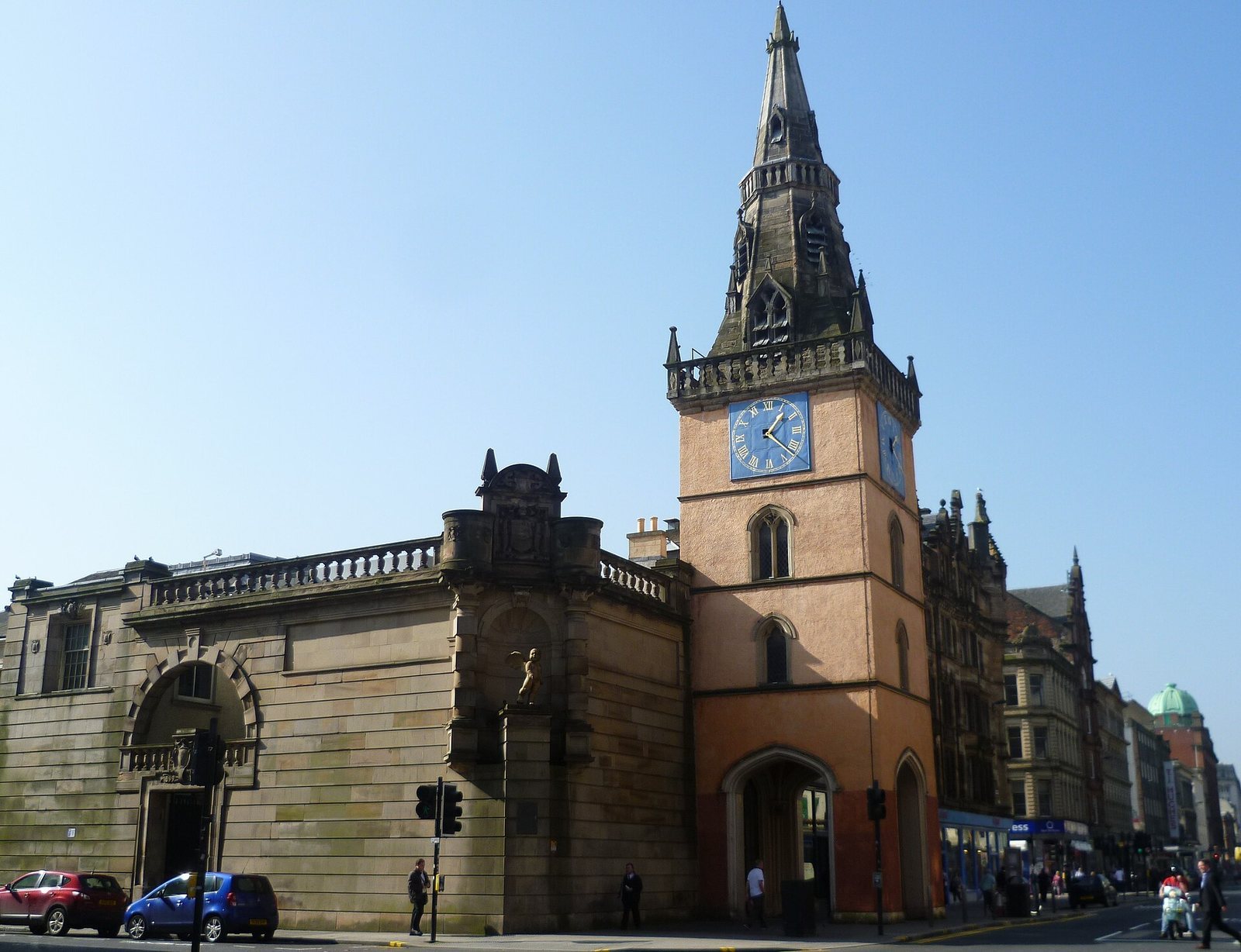
The theatre occupies the former church at the corner of Trongate and Chisholm Street, southeast of Glasgow city centre. The complex includes the church, a courtyard formed behind a projecting neo-Baroque screen wall, and the nearby steeple, which stands separately beside the street. The church’s north-facing front is partly obscured from the street by the screen wall and a building in front of it. The exteriors are finished in harling, a rough plaster or mortar coating applied to masonry.
Church and street frontage
Church facade
The church facade is divided into seven vertical sections and has a relatively plain appearance. Its central entrance projects from the wall beneath a shallow-curved arch. The doorway has a decorative frame, a horizontal window above it and a decorative pediment, a shaped feature crowning the entrance. Stair towers flank the facade, each with a semicircular rear end.
Screen wall and courtyard
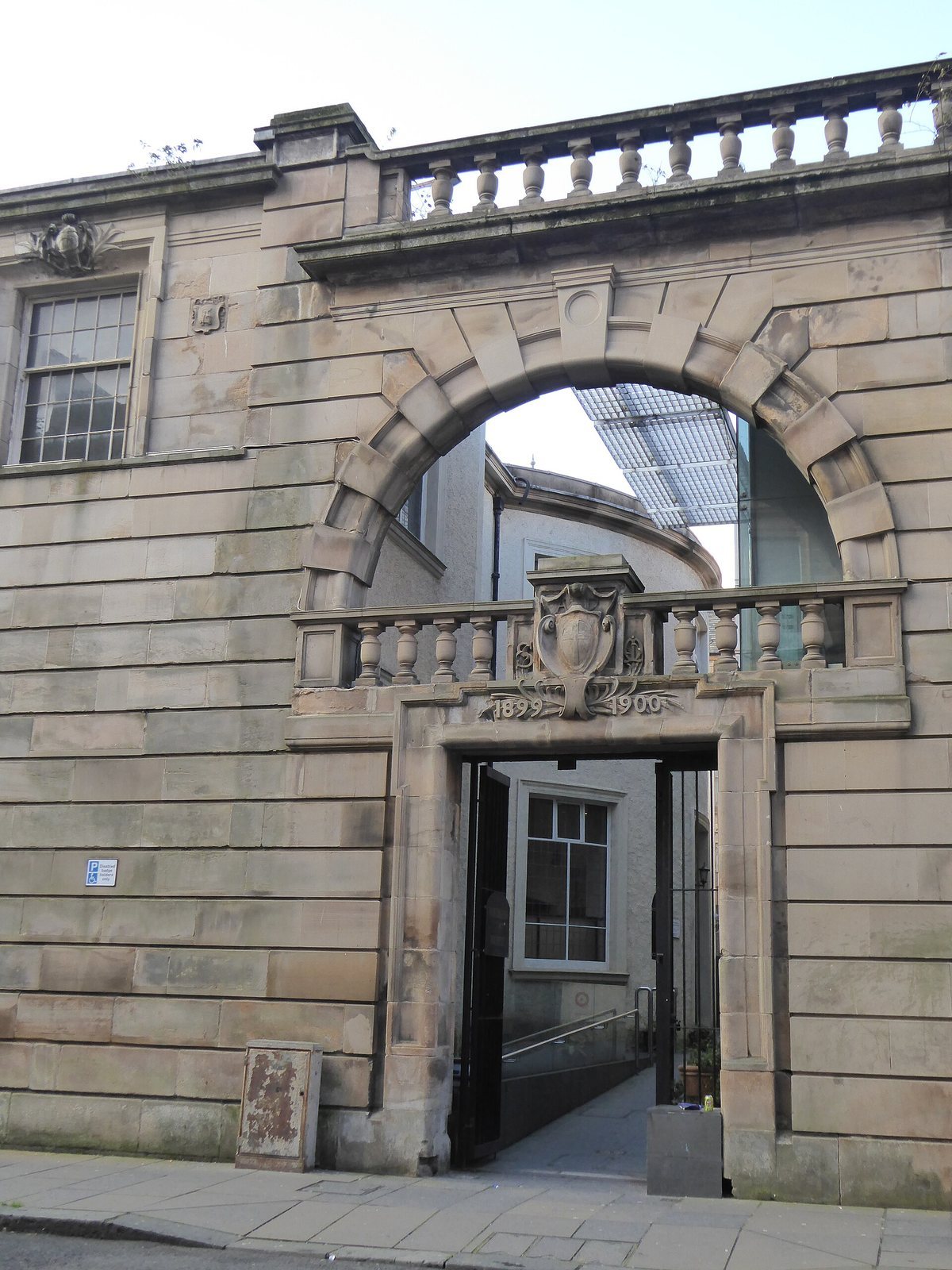
Architect John James Burnet added the neo-Baroque screen wall in 1899, when the courtyard was formed. Neo-Baroque describes a later revival of Baroque design. The wall projects in front of the church and partly screens its facade from the street.
Tron Steeple
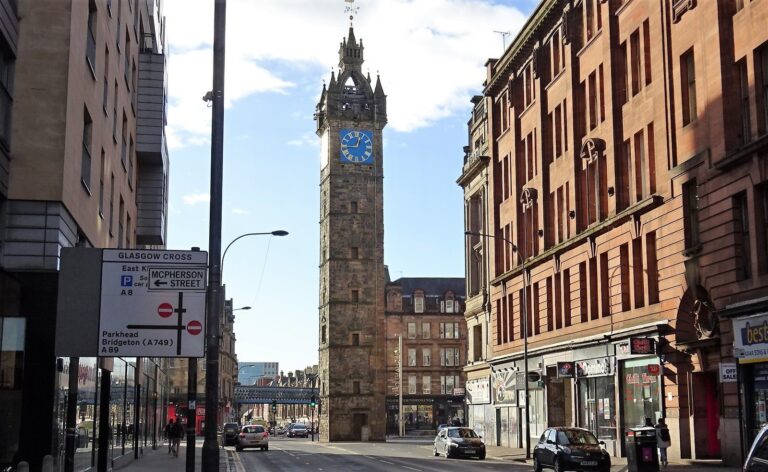
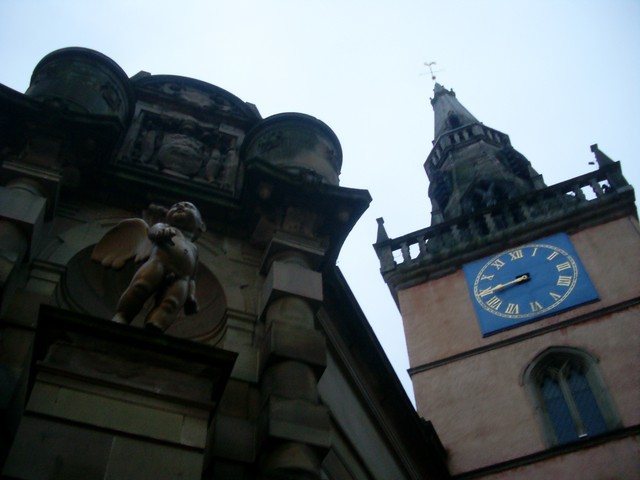
The Tron Steeple is a four-storey tower on a square plan, with harled faces. Pedestrian passages pass through its base beneath Tudor-style arches and a ceiling made from intersecting vaults. John Carrick created these passages in 1855. Clocks occupy the uppermost storey on all sides except the south. Above them is a stone railing with corner pinnacles, while the spire has dormer windows decorated with ornamental stone patterns.
Theatre spaces and exterior additions
Performance spaces
Much of the former church interior was lost during its conversion into a theatre. The Main Auditorium has a capacity of 230, while the Changing House Studio Theatre holds 50. The stated end-on arrangement places the audience on one side of the performance area, facing it. The Victorian Bar is also used as a performance space.
Exterior sculptures
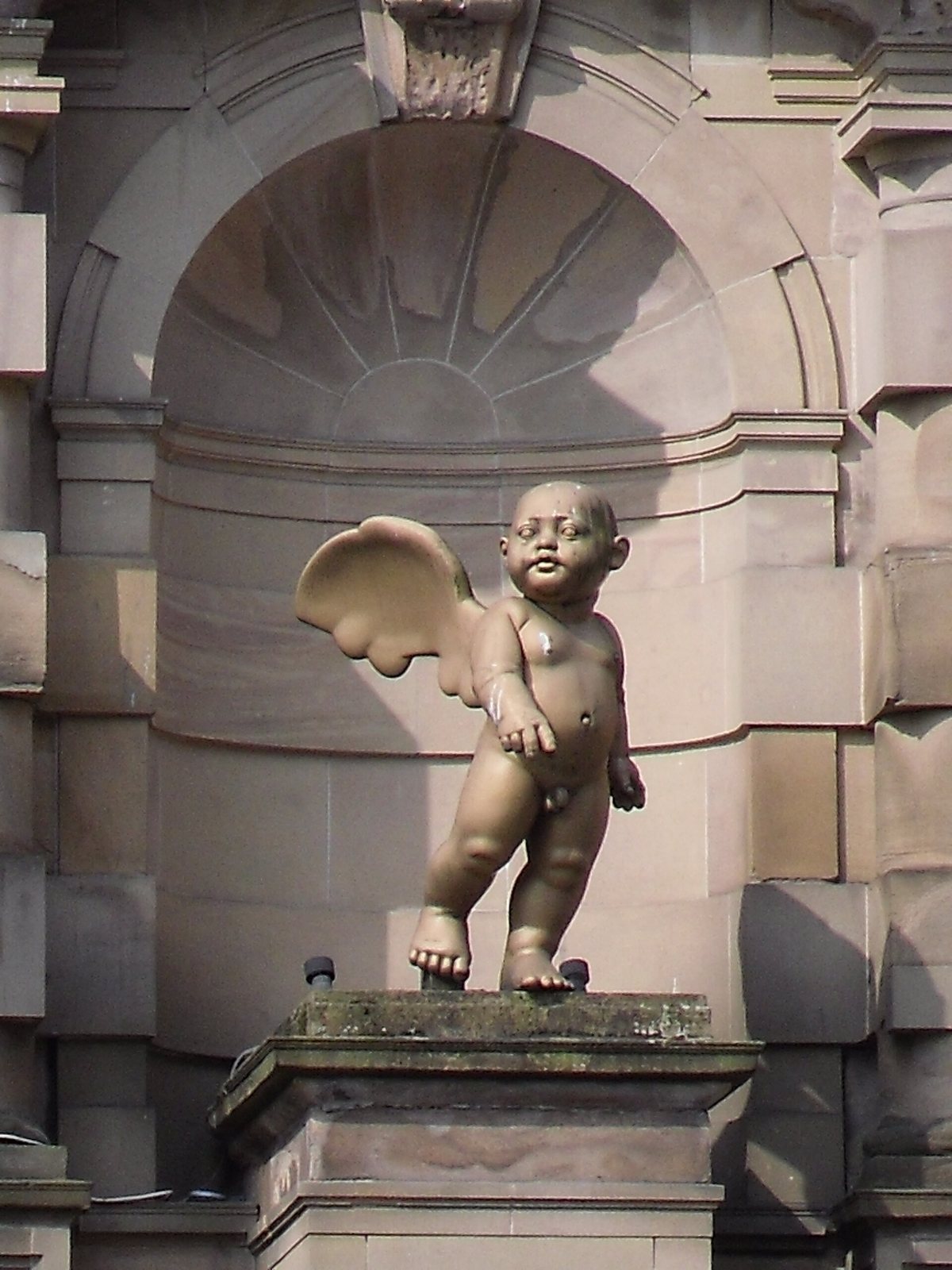
Two sculptures by Kenny Hunter were added to the exterior during a refurbishment in 1999. The works are a large golden cherub and a skull.