Troarn Abbey: A Medieval Benedictine Monastery in France
Site at a Glance
- Rating
- 3.5
- Popularity
- Very Low
- Country
- France
- Primary era
- Medieval
- Eras represented
- Medieval
- Civilizations
- French
- Site type
- Religious
- Remains
- Monastery
On this page16 sections
History
Troarn Abbey was a Benedictine monastery at Troarn, France, made autonomous around 1050 by the Norman lord Roger II of Montgomery after earlier religious communities had occupied the site. Its history began in the eleventh century, and its dominant architectural style was Gothic, represented by thirteenth-century work. The abbey became the second most important in the diocese of Bayeux, a territory overseen by a bishop, after Saint-Étienne at Caen.
From dependent community to autonomous abbey
A community of canons, clerics organized around service in a church, preceded the monastery. In 1022, Roger I of Montgomery established twelve monks from Fécamp Abbey at Troarn as a dependent house. Around 1050, Roger II replaced this community with an independent Benedictine monastery. Its monks came from Conches, and they followed the Rule of Saint Benedict, a guide to monastic life. The first church was dedicated in 1059. Durand, the first abbot, came from the Abbey of the Holy Trinity at Fécamp and later rebuilt the church.
The Montgomery family provided the foundation for the abbey’s wealth. Roger II granted it land around Troarn, including marshes and churches. His wife, Mabille of Bellême, gave it churches in the diocese of Séez, while William the Conqueror granted the abbey what Mabille held from him in England. Around 1100, further estates came through a charter from William of Évreux and his wife, Helvise of Nevers. Between the Norman Conquest of England and 1086, Troarn also received Horsley Priory in Gloucestershire as a dependent house. It retained Horsley until 1260, when it exchanged the priory with Bruton Priory in Somerset for Norman lands.
Estates and regional influence
By the thirteenth century, about forty monks lived at Troarn. For roughly seven centuries, the community helped drain and reclaim the Dives marshes, expand pasture in the Auge valley, and develop vineyards in the countryside around Caen. Its estate grew through gifts, purchases, rents, and lending. The abbot led the community and also held lordly and baronial authority, including judicial powers over people and property within the abbey’s lands.
The abbey collected tithes, church dues traditionally taken from produce or income, in Troarn and numerous surrounding settlements. It held a weekly market, two annual fairs, mills, ovens, presses, dovecotes, fishing rights, a ferry at Troarn, and the right to appoint or support clergy at churches. Its resources also included half the peat-bearing ground in the Dives marshes, fisheries, saltworks at Robehomme, Varaville, and Sallenelles, woods, houses, and other lands. One house in Caen had been granted by William the Conqueror.
Eight priories, religious houses often dependent on an abbey, served as outlying economic and religious centers. Roger of Montgomery founded Le Goulet near Écouché; its income supported the abbey’s chamberlain, who supplied clothing to the monks. Cagny had four members of its religious community, while Dives had two monks. The Colombières family founded Tailleville before the Crusades. Other foundations included a hospital at Sainte-Marie-Madeleine-de-Saulx and a priory at Fresney-le-Puceux. The prior of Le Désert held authority over three parishes, the barony of Saint-Sauveur-de-Chaulieu, and local tithes. Troarn also held rights at about fifty churches in six dioceses, often including a share of their tithes.
Medieval leadership and conflict
In 1147–49, Abbot Richard obtained papal confirmation of the abbey’s donations. Around 1250, Pope granted Abbot Durand permission to ease the strictness of monastic life. King Louis IX spent several days at Troarn in 1269.
During the Hundred Years’ War, a prolonged conflict between the English and French crowns, the abbey’s property and authority were caught up in military and political change. Around 1410, Abbot Louis de Chantemerle secured royal confirmation of the right to guard the abbey’s fortresses, although his administration was poor. Henry V of England confiscated the monastery’s revenues in 1417, then confirmed the abbot’s possession of its property in 1419. In 1444, Guillaume de Silly became the first commendatory abbot, a titleholder whose control of the abbey’s revenues could be separate from daily monastic leadership. Robert, the last regular abbot, obtained letters patent from the English king in 1448. English forces captured the abbey by assault in June 1450, and its abbot swore allegiance to Charles VII of France. Royal troops occupied Troarn in 1467 and 1468 while campaigning against Bretons who had entered Normandy.
Destruction and final suppression
In 1504, commendatory abbot Louis Rodin met the residence requirement and formally acknowledged his feudal obligations to the king. Charles IX and Catherine de’ Medici also stayed at the abbey. In 1562, Protestant forces under Admiral Gaspard de Coligny burned it; Protestants and abbey vassals also pillaged the complex. The following year, Coligny’s forces, led by judge François de Malherbe and Gilles de Benneville, destroyed the cloister. For several years the monastery remained in ruins and was nearly deserted.
From 1618 to 1748, the abbey was held in succession by Jacques de Bouscher de Sourches and his nephew, Jean-Louis du Bouchet de Sourches. Its decline under their tenure could not be reversed, and financial administrators were appointed. A proposal to unite the abbey with Caen’s collegiate church of the Holy Sepulchre, a church served by a chapter of clergy, was considered between the 1760s and 1780s. In 1786, Louis XVI converted the conventual endowment into a regular chapter of noblewomen and canonesses, women religious living in a chapter, attached to the Royal House of Saint-Louis at Saint-Cyr. The chapter’s abbess, Emmanuelle-Henriette de Crécy, received a royal patent on 4 March 1786.
A law of 15 February 1790 dispersed the remaining monks. The revolutionary government put the abbey up for sale in 1792, after which its church and cloister were demolished. The surviving remains were classified as historic monuments in 1921; the relocated fourteenth-century entrance portal received the same status in 1928.
Remains
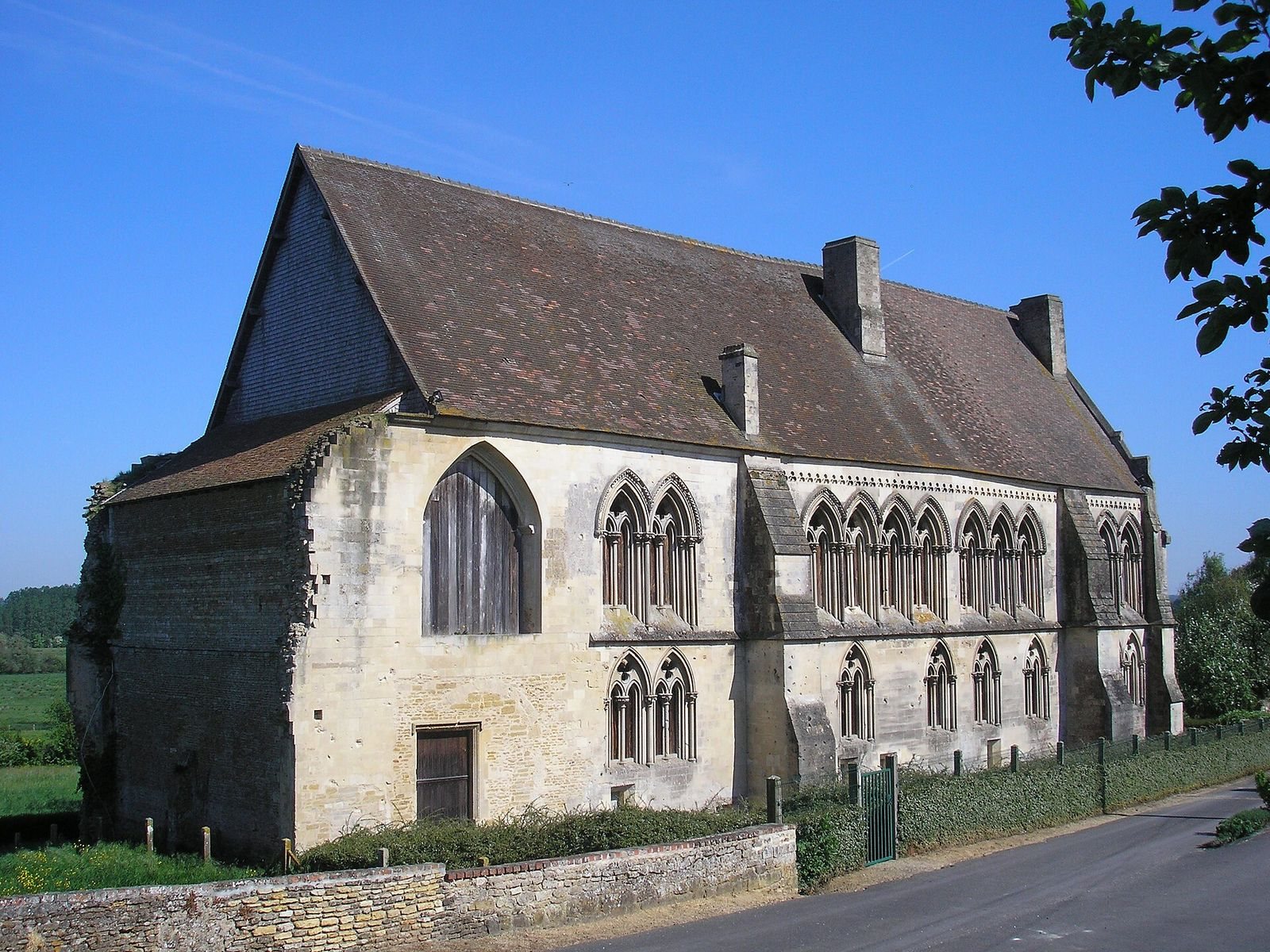
Only a small portion of the abbey survives, including a rectangular building dating to the thirteenth century. The former complex was laid out around a church and a square cloister, with residential and service buildings arranged along its sides and in adjoining courtyards. Its architecture was predominantly Gothic, the medieval style associated here with the thirteenth century.
The church and cloister
Abbey church
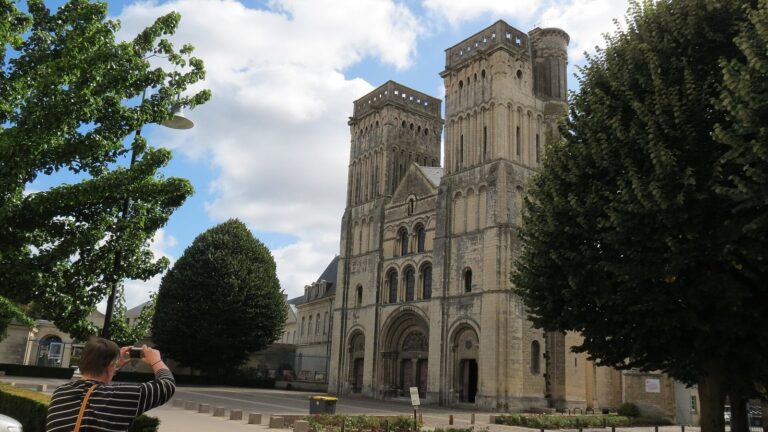
The former church had a Latin-cross plan, with a nave, two side aisles, a transept with four chapels, and a choir ending in a flat eastern wall. It measured 76 by 11 metres, not including the aisles, and had two towers, each 26 metres high. These dimensions and the plan describe the abbey’s principal worship building, although only a few remains of the wider complex survive.
Cloister and adjoining ranges
The cloister formed a square measuring 34 metres on each side, with covered galleries 3.40 metres wide. The church made up its northern side. The chapter house, where the monks met, and the dormitories stood to the east; the refectory was on the south, and cellars occupied the western range.
Courtyards and service buildings
Main entrance and Boar Gate courts
The abbey stood south of the main road between Caen and Pont-l’Évêque. A large square led to the principal entrance gate, beyond which a descent brought people to the church. Past the gate, a shared courtyard contained the porter’s lodging, stables, an almonry, a barn, a press, and houses for the prior and abbots. The Boar Gate opened into a smaller court containing the archive building and infirmary.
Almonry
The almonry, a building where alms were distributed, was dismantled and rebuilt outside Troarn. It belonged to the service buildings grouped around the entrance courtyard.
Relocated and commemorative features
Entrance portal
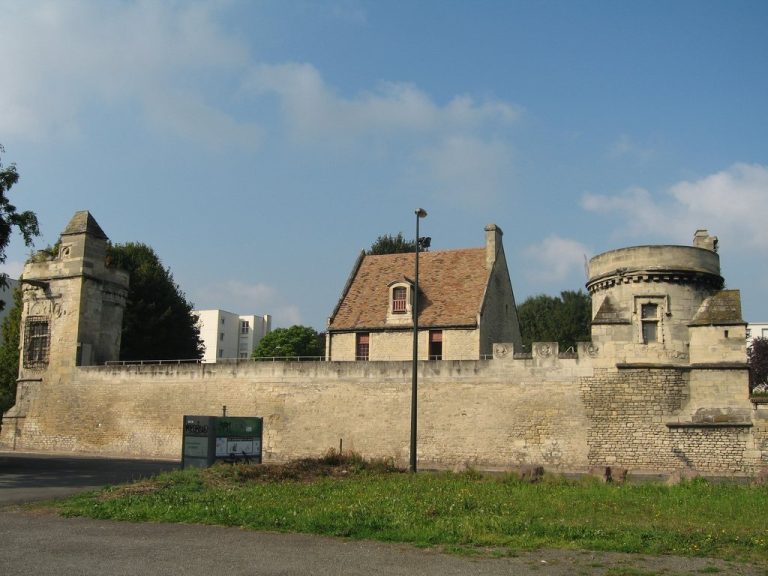
The abbey’s fourteenth-century entrance portal was moved to the entrance of Sannerville, within the municipality of Banneville-la-Campagne, beside National Route 175. Since the mid-nineteenth century, it has served as the entrance to Banneville Castle.
Tombs and memorials
The abbey contained the tomb of the knight Hugh, a companion of William the Conqueror. Its Romanesque sculptures were moved with the tomb to the parish church of Saint-Martin-de-Marais. Drawings identify another tomb as that of Mabille of Bellême, giving her death as 1082, while a separate date for her burial at the abbey is 5 December 1077. The drawings also show an abbot’s tombstone, the tomb of Guillaume de Silly, and a cenotaph, a memorial without the person’s remains, associated with abbots Mathurin de Harville and Anthoine de Brunfay.
Seals and heraldic emblems
The abbey seal of 1271 depicts Saint Martin in a bishop’s ceremonial clothing, blessing with one hand and holding a book of the Rule with the other. A seal belonging to Abbot Philippe de Touchet shows him standing with a pastoral staff and a book. The abbey’s earlier coat of arms is uncertain. An armorial from 1696 shows a blue shield with three irregularly arranged gold fleurs-de-lis, stylized lily emblems, and a red border bearing eight silver circles. Eighteenth-century seals arrange the lilies more regularly.