Tombs of Talpur Mirs: A Funerary Complex of Sindh’s Ruling Family
Site at a Glance
- Rating
- 3.9
- Popularity
- Very Low
- Country
- Pakistan
- Primary era
- Modern
- External website
- Open
- Eras represented
- Modern
- Civilizations
- Unclassified
- Site type
- Burial
- Remains
- Necropolis
On this page9 sections
History
The Tombs of the Talpur Mirs are a funerary complex in Hirabad, Hyderabad, Pakistan, built for the Talpur Mirs, the ruling family of Sindh from 1784 to 1843. Also known as the Cubbas, a Sindhi term meaning “domes,” the complex served as a burial ground for the rulers and their families.
The Talpur burial ground
Large mausoleums were assigned to the rulers, while smaller tomb buildings held the remains of wives, consorts, daughters, and children. The complex therefore preserves the burial arrangements of the Talpur household across several generations. Its mausoleums follow architectural specifications closely resembling the tomb of Mir Fateh Ali Khan at New Khudabad, a historic settlement in Sindh, and their patterns broadly recall other Talpur structures.
Changing management and preservation
Under the former management of the Department of Archaeology, Government of Pakistan, the mausoleums deteriorated. After government authority was devolved to the provinces, the Culture Department of the Government of Sindh assumed responsibility for the monuments on 30 March 2011.
The complex was enclosed within a walled area to limit encroachment by surrounding residential buildings. Some deteriorating tombs were used at night by drug users and vagrants, while open ground around the mausoleums was used for cricket during the day. Restoration work on tombs of former Talpur rulers elsewhere began in April 2012 under the leadership of Ishtiaq Ansari, but the Tombs of the Talpur Mirs themselves subsequently remained neglected. The Sindh government expressed a willingness to improve the monuments and address the problems associated with the previous 63 years of management.
Remains
Layout and principal mausoleums
The complex consists mainly of square or rectangular tomb buildings arranged in groups. The largest domed mausoleum contains the graves of Mir Karam Ali Khan, who died in 1828, and Mir Murad Ali Khan, who died in 1833. A smaller building behind it holds the graves of two wives of Mir Karam Ali Khan, the wife of Mir Abdullah Khan, and an infant. Two small tombs at the southwestern corner of Mir Karam Ali Khan’s mausoleum contain the remains of other Mirs.
Northern mausoleums
A mausoleum north of the principal domed building contains the graves of Mir Nur Muhammad Khan, Mir Nasir Khan, Mir Shahdad Khan, and Mir Husayn Ali Khan. The rulers are traditionally said to have designed their own burial places during their lifetimes. The building east of this northern mausoleum contains the remains of the wife and child of Mir Nur Muhammad Khan and the wife of Mir Husayn Ali Khan. A small mausoleum in the northwestern corner holds the remains of other wives of two rulers and three young children.
Southern burial group
In the southern group, the two principal mausoleums nearest the eastern entrance and immediately behind it contain the graves of four Mirs. The other southern mausoleums hold the remains of their wives and children. Additional buildings across the complex contain the bodies of wives, daughters, and children of several rulers, while unmarked graves also occur outside the mausoleums.
Female mausoleums
The female mausoleums are closed, vaulted structures with forms compared to covered wagons. One rectangular mausoleum is topped by two domes and has projecting elements at each corner. Its entrance façade is divided into three arched panels on each side. Rectangular panels above the arches carry tiles with floral patterns, and the other sides use broadly similar arched panels and decoration.
Lattice screens, or jaalis, fill the arched doorways of the female mausoleums. These screened forms continue in death the observance of purdah, the seclusion traditionally observed by women during life. Men are still forbidden to enter these mausoleums.
Tilework, graves, and inscriptions
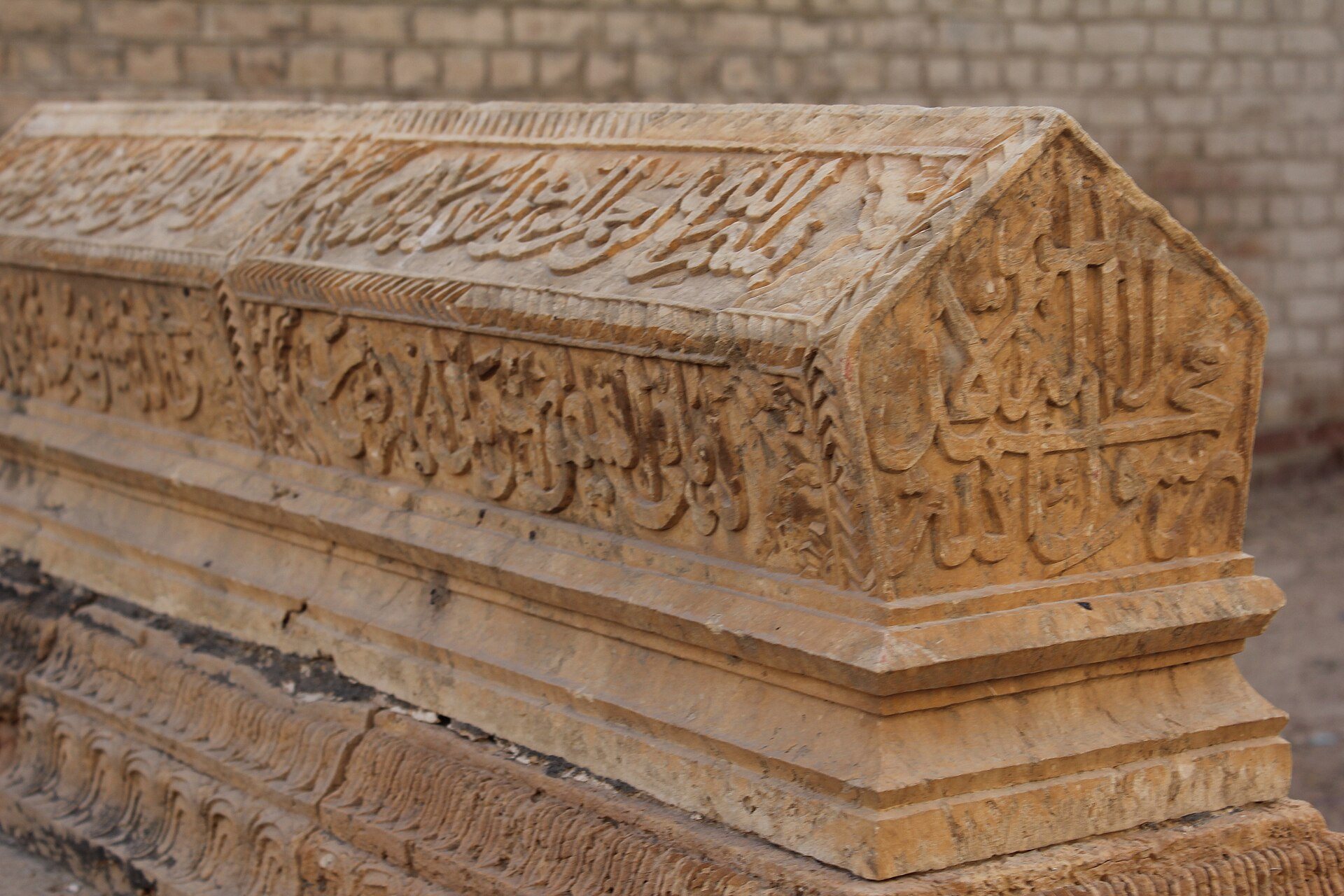
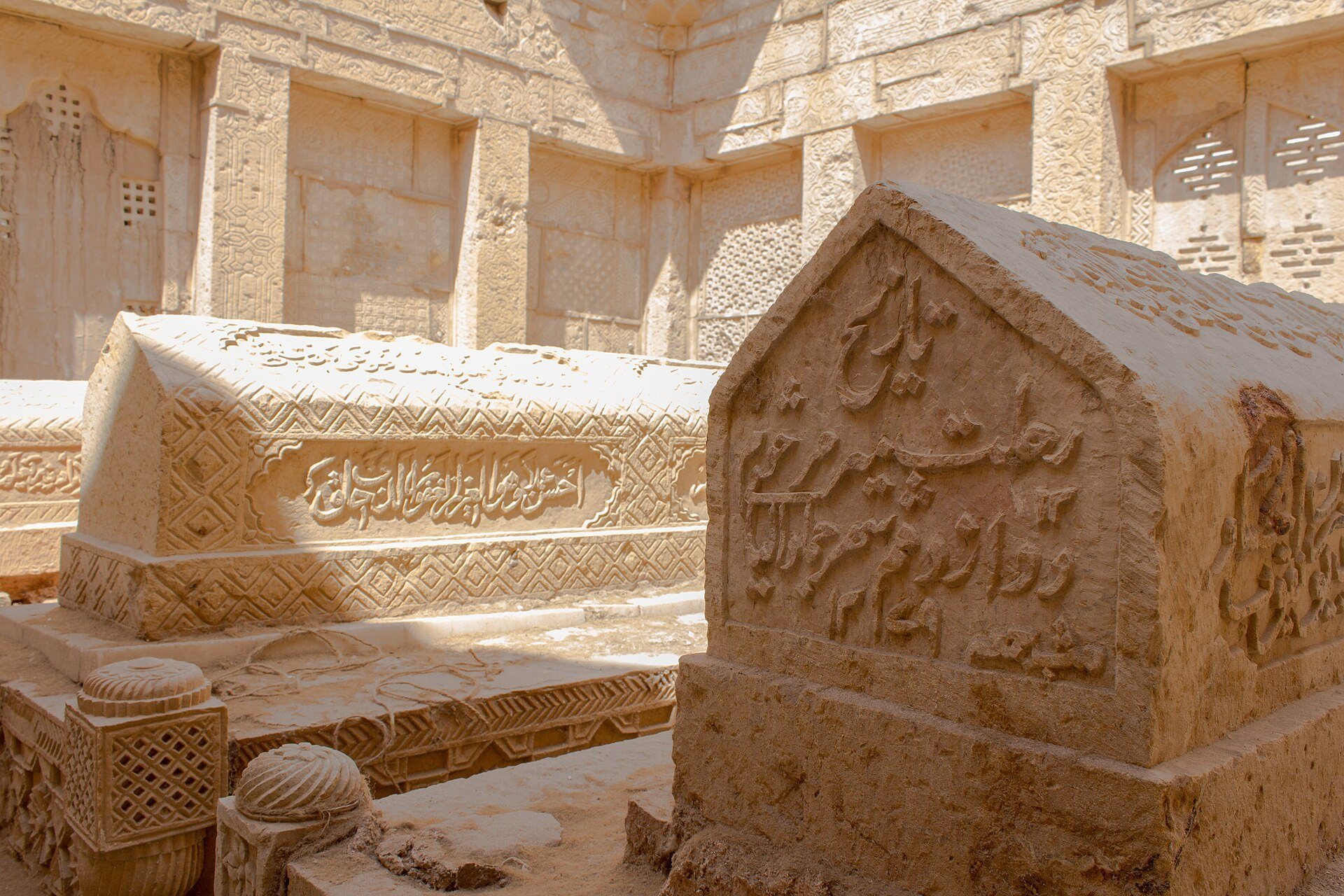
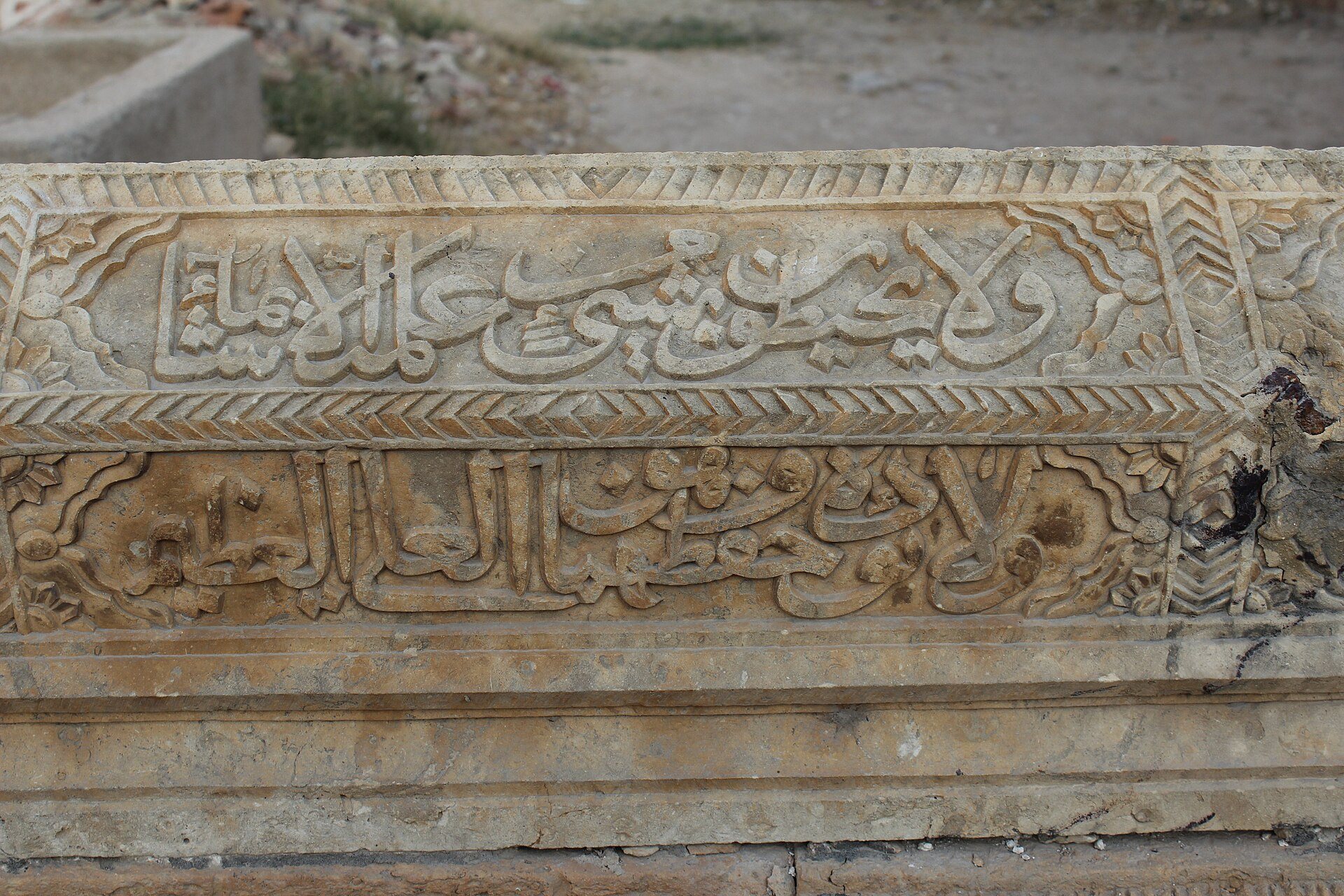
Multicoloured tilework distinguishes the exterior façades, particularly blue floral designs on white backgrounds, with green, yellow, and brown accents. The graves are generally covered with marble masonry, with some receiving more elaborate treatment than others. The marble graves of the rulers generally have their actual royal turbans placed on projections at the ends.
Many graves carry Quranic verses in Arabic, passages from Islam’s central scripture, while some interior walls bear Persian poetry. Most graves are unmarked and do not identify their occupants, although a few bear names. The combination of domed structures, marble burials, inscriptions, and vivid tilework preserves the funerary traditions of the Talpur ruling family.