Tomb of Ahi Evren: A Mosque-Tomb Complex in Kırşehir, Türkiye


Site at a Glance
- Rating
- 4.8
- Popularity
- Low
- Country
- Turkey
- Primary era
- Medieval
- Eras represented
- Medieval
- Civilizations
- Dulkadirid, Karamanid
- Site type
- Religious
- Remains
- Tomb
On this page10 sections
History
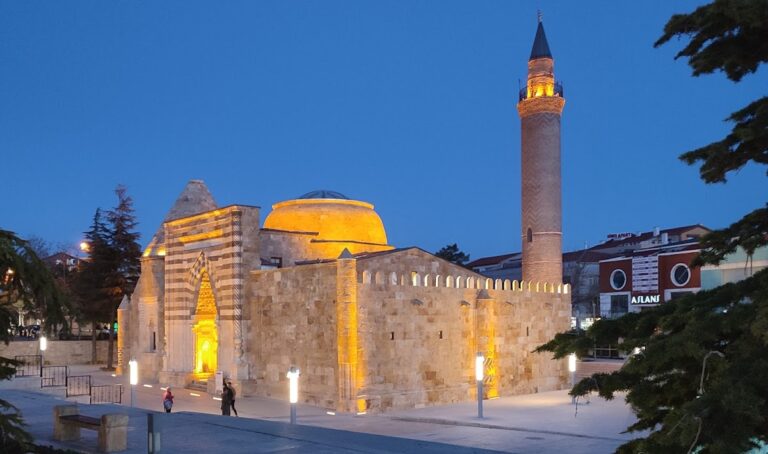
The Tomb of Ahi Evren is a mosque-tomb complex in Kırşehir, Türkiye, built around the tomb of the thirteenth-century Muslim preacher and leader of Anatolia’s Ahi Brotherhood. The tomb itself was built in 1450 by Hasan Bey, an Ahi craftsman. The complex represents the continuing religious and institutional importance of Ahi Evren, whose organization shaped the community of craftsmen in Anatolia.
Ahi Evren and the Ahi Brotherhood
Ahi Evren began as a leather dealer and organized Muslim craftsmen into a guild-based association of artisans and producers. The Ahi Brotherhood combined craft and commercial organization with mutual support and ethical-religious principles. Its system remained effective until the nineteenth century, and Ahi Evren is still regarded as an honorary leader of craftsmen. The organization is also regarded as the foundation of the modern system of craftsmen’s chambers in Türkiye.
Mongols killed Ahi Evren on 1 April 1261. The Ahi Brotherhood continued its resistance in Anatolia and later in Rumelia, contributing to the Turkification of both regions. The precise location of Ahi Evren’s grave was later inferred from the positions of other Ahi graves.
Fifteenth-century expansion
In 1481, Bozkurt of Dulkadir renovated and enlarged the complex by adding a zaviye, an Islamic religious lodge or retreat associated with teaching, worship, and accommodation. Bozkurt belonged to the Dulkadirid principality, a regional Anatolian dynasty that briefly controlled Kırşehir in the late fifteenth century. Inscriptions associated with both Hasan Bey and Bozkurt are preserved within the complex, which is also listed as completed in 1482.
The complex was originally established as a zaviye and was later used as a mosque. It includes the mosque, Ahi Evren’s tomb, and spaces associated with a zaviye and religious lodge. A branch office of Türkiye’s Ministry of Culture and Tourism is housed within the complex. The site was added to UNESCO’s World Heritage Tentative List in the Cultural category on 15 April 2014.
Remains
The complex stands in central Kırşehir and consists of a mosque, the tomb, and spaces used as a zaviye and religious lodge. It has one minaret. The tomb is reached by an internal staircase and is organized around an iwan, a vaulted or roofed space open on one side, with two chambers.
Tomb chambers
Northern chamber
The northern chamber contains Ahi Evren’s symbolic coffin. It formerly held a second decorated coffin belonging to a sheikh named Erzurimi. That coffin was transferred to Ankara for protection. The arrangement reflects the complex’s association with Ahi religious figures and the interpretation of Ahi Evren’s burial place.
Southern chamber
The southern chamber has recently been restored and arranged as a display room. Its present form therefore combines the surviving tomb setting with a later interior use focused on display.
Iwan and inscriptions
Coffins in the iwan
The iwan contains five simple coffins belonging to unidentified people. The room was decorated during the nineteenth century, giving this part of the tomb a later decorative phase within the fifteenth-century complex.
Inscriptions
Inscriptions associated with Hasan Bey and Bozkurt of Dulkadir are located within the complex. They connect the surviving buildings with the tomb’s construction in 1450 and its fifteenth-century enlargement.