Tamié Abbey: A Cistercian and Trappist Monastery in France
Site at a Glance
- Rating
- 4.5
- Popularity
- Low
- Country
- France
- Primary era
- Early Modern
- External website
- Open
- Eras represented
- Medieval, Early Modern, Modern
- Civilizations
- Duchy of Savoy, French, Holy Roman Empire, Italian, Kingdom of Sardinia
- Site type
- Religious
- Remains
- Monastery
On this page9 sections
History
Tamié Abbey is an active Cistercian monastery in France, near Plancherine in the Tamié valley, founded in 1133 by monks from Bonnevaux Abbey. Set near the Tamié Pass in the Bauges mountains, at about 900 metres above sea level, it became part of the Cistercian lineage of Cîteaux and belonged to the Archdiocese of Chambéry. The monks arrived on 16 February 1133 under Peter of Tarentaise, a Cistercian monk who later became Archbishop of Tarentaise and is also known as Saint Peter of Tarentaise.
Foundation and medieval endowment
The lords of Chevron ceded the Tamié valley for the foundation in 1132. Local lords and the Count of Geneva then endowed the new abbey with agricultural properties and alpine pastures. A papal bull, meaning a formal document issued by the pope, placed the community’s possessions under papal protection in 1171. These holdings included properties at Glières, Tournon, Menthonnex, Pitulle, Montmeillerat, Avalon, Le Marais, and Euresol, although the exact locations of some estates are uncertain.
Tamié was initially a daughter house of Bonnevaux. Its agricultural estate expanded and changed through purchases, sales, donations, exchanges, and legacies. A land register from 1730 listed six consolidated farms, while isolated parcels were leased to private individuals. The monastery’s buildings and finances were repeatedly tested by fires, famine, plague, and damage caused by passing troops. The original thatched roofs made the buildings especially vulnerable to fire, and part of the abbey archive was lost.
Commendam and monastic decline
The commendam system allowed an abbot to be appointed from outside the monastic community and to receive the abbey’s revenues without directing its daily religious life. At Tamié, this arrangement contributed to periods of decline because income was diverted from the monks and from the upkeep of the buildings. Guillaume Guinard de Narbonne was appointed by Antipope Clement VII in 1381. In 1454, Georges Jocerand de Cons was appointed by the Duke of Savoy and confirmed by Pope Nicholas V.
Pierre de Beaufort, commendatory abbot from 1537 to 1581, became associated with extravagant spending. He built a large residence below the Tamié Pass overlooking the Isère valley. Only a tower above the church of Plancherine remains from that residence. After his death, the Duke of Savoy placed the abbey’s property under sequestration, and an official report described the monastic complex as seriously deteriorated.
Reform and economic rebuilding
Jean-Antoine de La Forest de Somont was appointed abbot in 1659 by Duke Charles Emmanuel II. In 1677 he promoted a stricter observance at Tamié, following the reform associated with Armand-Jean de Rancé at La Trappe. Supported by Jean-François Cornuty, he restored regular monastic life that year. The reform was accompanied by a major rebuilding campaign, since the original buildings had fallen into poor condition. A new building was begun farther south, and the abbey’s agricultural property was gradually restored.
The restored estate supported the surrounding population through loans, aid to the poor, medical care, and employment for about forty young people. From 1677, cheesemakers from Gruyère in Switzerland helped local producers and the abbey’s farms process milk according to the Gruyère method. Cheese production continued until the community was suppressed in 1792 and later became one of its principal sources of income.
Ironworking also formed part of the abbey’s economy. The Audé family of Annecy established a small ironworks near the abbey on the Bard stream around 1650. The monks took over the abandoned installation on 23 March 1749 and restarted production, especially of iron bars and also of fireplace plates. Villagers worked the bars at home during the winter, making nails and small tools. During the eighteenth century, the monks operated blast furnaces and forges, using charcoal from the forests of the Bauges massif and iron ore brought from the Hurtières deposit in the Maurienne valley.
Revolution, restoration, and twentieth-century history
In autumn 1792, the abbey’s ecclesiastical property was declared national property and inventoried. French soldiers occupied the complex in April 1793 to control the Tamié Pass against a possible return of Sardinian troops. Dom Antoine, the abbot, decided that the community should leave, and the monks fled during the night. The authorities later ordered the bell tower demolished under the decree directed against the bell towers of Savoie. After the French Revolution, the interior had been devastated, while many books from the library had been burned or stolen.
The monastic community was suppressed in 1792. After a period under non-monastic ownership, restoration began in 1827 under Ernesto Melano, an engineer of the Sardinian court in Turin. Trappist monks from La Grâce-Dieu Abbey returned to the restored buildings in October 1861. The Trappists were expelled under the anti-congregation decrees in 1880 but returned in 1881. The bell tower was restored and received a new spire, while a cheese dairy helped the community overcome financial difficulties.
During the Second World War, Tamié served as a transit point and refuge for members of the French Resistance and for people pursued by the militia and German forces. Two monks of Tibhirine had come from Tamié and were killed in Algeria in 1996. Their story was later portrayed in the 2010 film Of Gods and Men, whose Divine Office singing was provided by monks of Tamié.
The living community
Tamié remains a Trappist community within the Order of Cistercians of the Strict Observance. In 2023 it had 27 monks, and Dom Marco Bassignana became abbot that year. The community continues to emphasize the liturgy, Divine Office, manual work, and hospitality under the Rule of Saint Benedict. The Divine Office, the cycle of scheduled Christian prayers sung or recited by monastic communities, brings the monks together seven times each day along with the Eucharist.
The abbey dairy processes nearly four tonnes of refrigerated raw milk each day, purchased from farmers in the Tamié valley. Its cheese, marketed as Abbaye de Tamié, is the community’s principal economic resource and helps sustain mountain agriculture. Since 2003, about 3,000 to 4,000 litres of whey produced daily by the dairy have been converted into biogas for hot-water production, providing energy equivalent to about 80 litres of fuel per day. A small amount is also used in Imperial Milk Stout made by Brasserie du Mont Blanc.
Tamié is also associated with the origins of the Petits Chanteurs à la Croix de Bois choir school, although the monks did not take part in its foundation. Pierre Martin and Paul Berthier conceived the project in 1906 while staying at the Tamié inn, and it was established in Paris the following year. The abbey’s heraldic arms are blue with a silver chevron surmounted by an abbatial crozier. The chevron refers to the arms of the Chevron family.
Remains
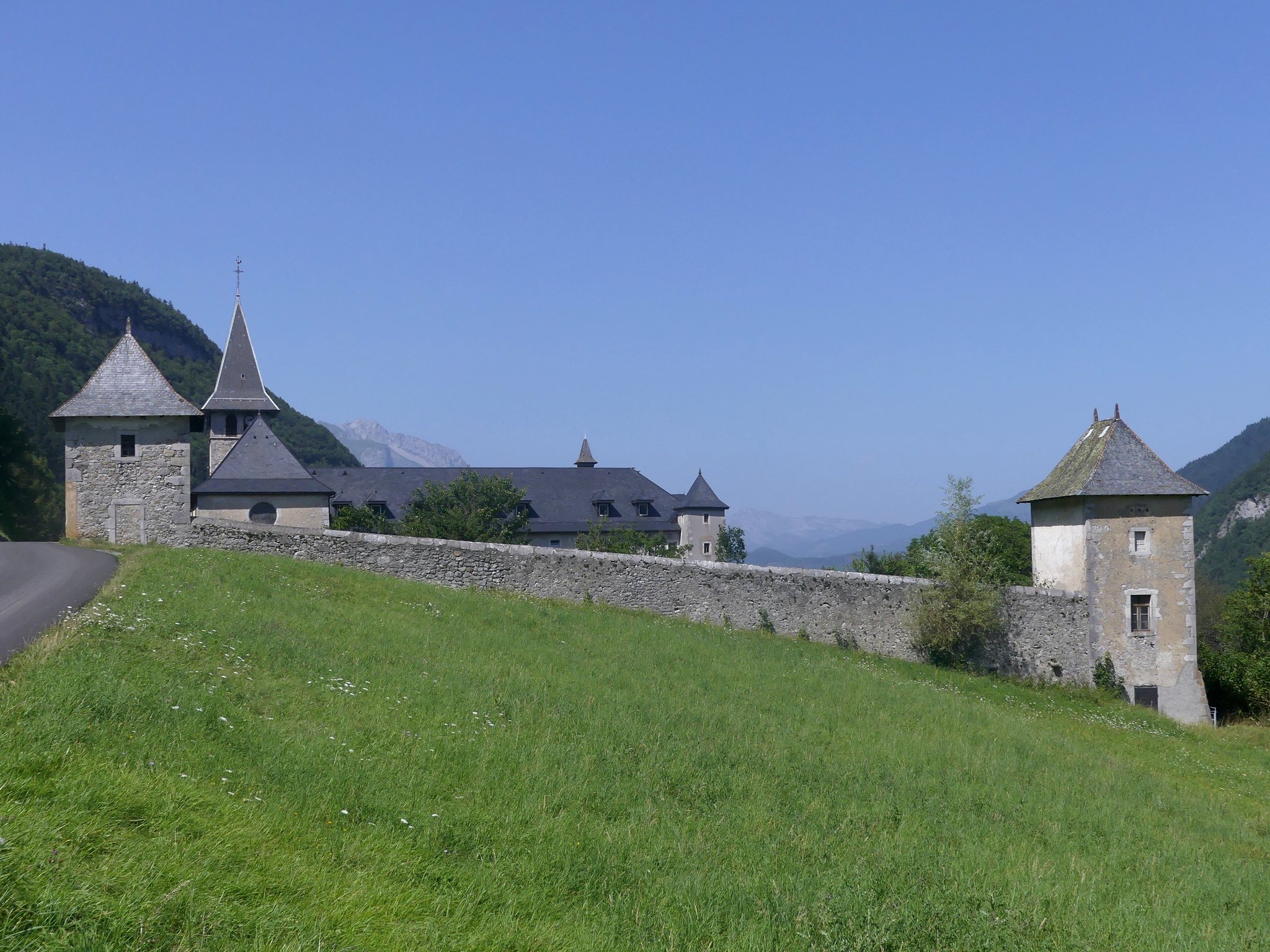
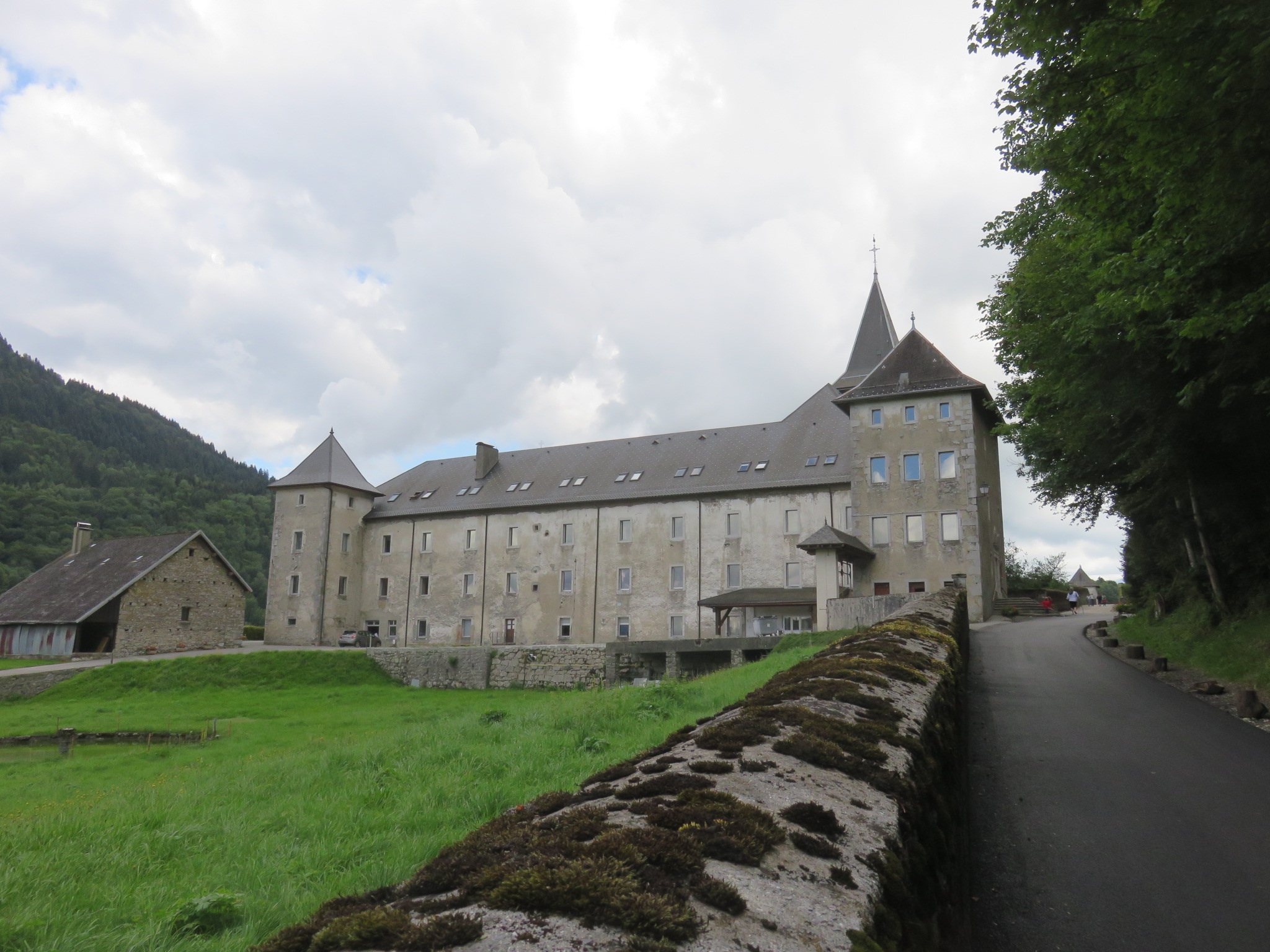
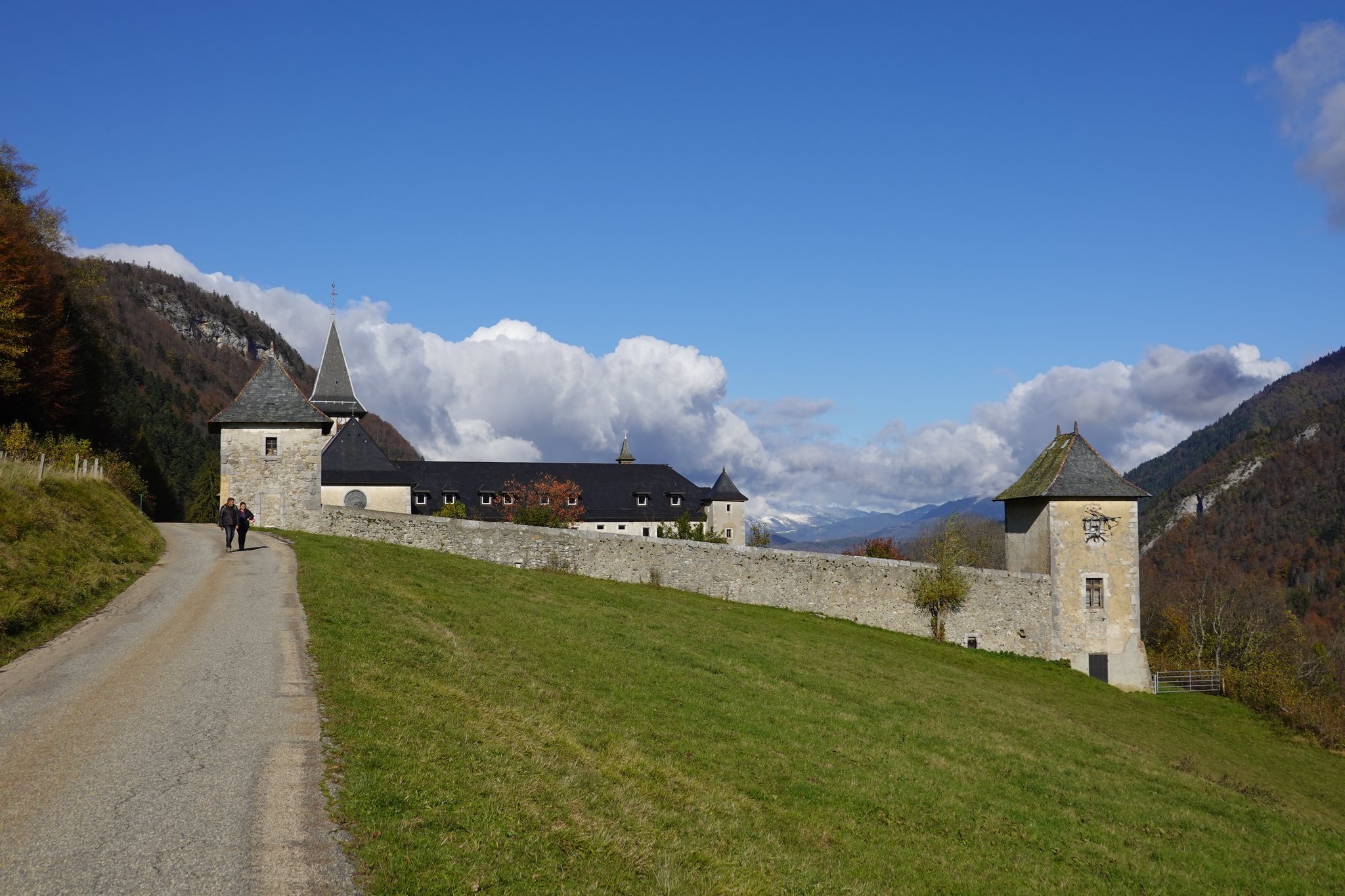
Tamié occupies a mountain site in the Tamié valley near the pass and forms a regular quadrilateral. The complex has a fortress-like appearance. The guest wing occupies the northern side, while the church is oriented south. The original church was consecrated in 1150 and had semicircular apses at the choir. Substantial deterioration led to the post-1677 rebuilding, including a new building farther south of the original complex.
Church and monastic complex
The abbey church and its surrounding buildings preserve the principal arrangement of the monastery. The bell tower was rebuilt during the restoration begun in 1827 by Ernesto Melano, at first without a spire. After the Trappists returned in the nineteenth century, a new spire was added. The church itself was restored in 1964. The former residence built by Pierre de Beaufort below the Tamié Pass is represented by a surviving tower above the church of Plancherine.
Waterworks and mills
A pond, a fish-rearing pond, and a mill appear on the Sardinian cadastral map of 1728. In the early nineteenth century, the site included a one-wheel mill combined with a sawmill and a separate two-wheel mill. On 2 July 1867, the superior received authorization to build a downstream mill and sawmill. A turbine supplied electricity to the abbey. The mill was powered by a pond fed by the Martignon and Varrey streams. In 1869, an older intake on the Bar stream was restored, sending water through a 100-metre paved channel to a reservoir. From there, it could flow either to a sawmill or through a 750-metre underground masonry channel beneath the forest to the mill pond.
The downstream mill survives as a five-level stone building with a slate roof, architecturally inspired by the mill of La Grâce-Dieu Abbey at Chaux-lès-Passavant in the Doubs. An extension was added in the 1950s. In 1925, Abbot Bernard Ferrand converted the building into accommodation for groups, and it became known as the Saint Bernard Mill. The upstream mill was demolished in the 1970s and replaced by a chalet-style building.