Takaidayama Kofun: An Early Horizontal-Entry Burial Mound in Japan

Site at a Glance
- Rating
- 3.6
- Popularity
- Very Low
- Country
- Japan
- Primary era
- Classical
- Eras represented
- Classical
- Civilizations
- Yamato
- Site type
- Burial
- Remains
- Burial Mound
On this page12 sections
History
Takaidayama Kofun is a burial mound in Japan, located in Kashiwara, Osaka, and built during the mid-Kofun period, the era of large Japanese burial mounds conventionally dated from about the third to the sixth century. Excavated Sue ware dates its construction to approximately AD 480–490. The tomb is historically important for its early horizontal-entry stone chamber, a burial structure reached through a side passage, and for evidence linking its construction and grave goods with Baekje, one of the ancient Korean kingdoms.
Before the Hirao-yama group
The mound was identified during a 1974 distribution survey as Burial Mound 56 in the second Takai-da branch of the Hirao-yama Kofun Group. That group is a representative late-Kofun clustered-burial group. Later investigation showed that Takaidayama Kofun was nearly half a century older than both the Hirao-yama Kofun Group and the Takaida Tunnel-Tomb Group, placing it at an earlier stage in the development of the local funerary landscape.
The tomb’s design has been compared with early Baekje horizontal-entry chambers and with Fujinomori Kofun, an early Kinki example of this type. Taichiro Shiraishi regarded Takaidayama Kofun as the earliest form of the Kinki-type horizontal-entry chamber. Kazuo Ichinose placed it one stage after the Fujinomori example, using the chronology of Sue ware, and proposed that its broader burial chamber may represent the beginning of the later lineage of large horizontal-entry chambers in the Kinki region, the historical central-Japanese area that includes present-day Osaka and neighboring districts.
Preservation and interpretation
A planned land-readjustment and development project near the Takaida Tunnel-Tomb Group raised concern that changes in groundwater and vegetation would speed the weathering of the tombs. The protected area was expanded by 3,000 square meters, bringing Takaidayama Kofun into the preservation zone.
The Kashiwara Municipal Board of Education excavated the mound in 1990 so that it could be preserved and developed with the tunnel-tomb group as part of a historic-site park. The work clarified the mound’s general form and revealed the early stone chamber. The tomb is included in the national Historic Site designation for the Takaida Tunnel-Tomb Group. Its excavated materials were collectively designated Kashiwara municipal tangible cultural properties in 2008 and are kept by the Kashiwara Municipal History Museum.
Looting had heavily disturbed the burial chamber, but the positions of iron coffin clamps and the associated grave goods indicate that two wooden coffins originally lay inside it. The chamber’s design and contents have led to a theory that the buried person was the leader of a group that came from Baekje with immigrant technical specialists and held status comparable to royalty. One hypothesis identifies the occupant as King Konji, a member of the Baekje royal house, but this remains an identification proposed for discussion rather than an established fact.
Remains
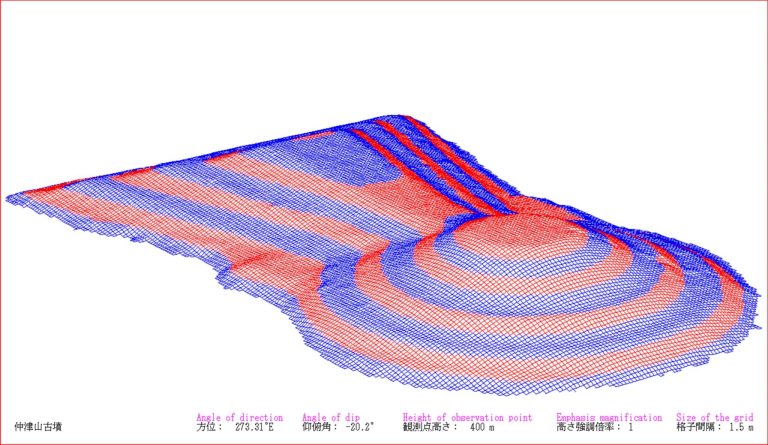
Takaidayama Kofun is generally understood as a circular mound about 22 meters in diameter. Much of its fill had washed away, however, so the possibility of an originally keyhole-shaped mound could not be excluded. Residential development cut the northern side into a cliff, while the western side was cut back for a road and became a steep slope. The southern and western sides retained their natural ground, although in most excavated areas that ground lay only several tens of centimeters below the topsoil.
The mound and stone chamber
Burial mound
The chamber was set within a roughly oval burial pit made by flattening and cutting into the natural ground. The pit measured about 8 meters from east to west and 9 meters from north to south. Nine cylindrical, morning-glory-shaped, and umbrella-shaped haniwa were recovered from soil inside the chamber. Haniwa were clay funerary objects placed on or around burial mounds. These specimens are thought to have fallen from the mound’s upper surface when the chamber roof collapsed, probably after the tomb had been damaged and looted.
Horizontal-entry chamber
The horizontal-entry stone chamber was built by stacking flat stone slabs and followed a one-sided-corridor plan, meaning that the passage was attached to one side of the chamber entrance. The upper part had collapsed, leaving many stones fallen within the burial chamber. The chamber formed a slightly expanding rectangle, measuring 3.73 meters in length, 2.34 meters across at the rear wall, and 2.26 meters across at the entrance. The surviving rear wall indicates a height of about 1.3 meters.
The entrance passage was approximately 2.0 meters long and 1.18 meters wide where it met the chamber. Its precise dimensions remain uncertain because the blocking stones were preserved in place. The surviving arrangement provides physical evidence for an early Kinki form of a side-entered burial chamber.
Coffins and grave goods
Central coffin
One wooden coffin stood at the center of the chamber. Its associated objects included a single pure-gold earring and an iron sword.
Eastern coffin
A second coffin stood along the eastern wall. It was made from koyamaki wood and was accompanied by a Chinese mirror 20.6 centimeters in diameter, decorated with divine figures, dragons, and tigers. Other objects included a bronze smoothing iron, two pure-gold earrings, an iron sword, two small knives, and glass beads recovered in five groups.
The bronze smoothing iron has the form of a traditional charcoal-heated iron. Comparable examples are known from Chinese tombs from the Han period onward and from tombs on the Korean Peninsula from the fifth century onward. Only four examples, including the one from Takaidayama Kofun, were known from Japanese kofun. A closely comparable object came from the tomb of King Muryeong of Baekje.
Weapons, armor, and other objects
Objects distributed around the two coffins included seven iron spears or spear fragments, nine halberds, and at least 18 stone butt-end fittings for spears or halberds. Numerous iron arrowheads were found with a riveted horizontal-plate helmet bearing a projecting brow, a neck guard, shoulder guards, and lamellar armor plates. Fragments of stirrups and buckles represented horse equipment. The assemblage also contained sickles, iron adzes, small knives, gilt-bronze fragments, many Sue-ware vessels, and Haji-ware pottery.
The Sue ware consisted of jars, stands, footed jars, covered and uncovered high-footed cups, and spouted vessels. Their forms belong to the TK23–TK47 sequence of the Suemura kiln chronology. Sue ware was high-fired, wheel-made pottery produced in Japan from the Kofun period onward, and this sequence supports the date of approximately AD 480–490 for the tomb.
Rare glass bead
Among the glass beads was a gold-decorated bead 12 millimeters in diameter. Gold leaf was enclosed between an inner and an outer glass tube to create its ornament. This type is exceptionally rare in Japanese kofun, with five known examples including one from Tomb 126 of the Shinzawa Senzuka Kofun Group. Large quantities of the same type were recovered from the tomb of King Muryeong of Baekje, adding to the evidence for the wide connections considered in interpretations of Takaidayama Kofun.