St Spas Church, Leskoec: A Fifteenth-Century Orthodox Village Church

Site at a Glance
- Rating
- 5
- Popularity
- Very Low
- Country
- North Macedonia
- Primary era
- Medieval
- Eras represented
- Medieval, Modern
- Civilizations
- Ottoman
- Site type
- Religious
- Remains
- Church
On this page6 sections
History
St Spas Church, also known as the Church of the Ascension of Christ, is an Orthodox church in Leskoec, North Macedonia, built around 1461–1462. It is the principal village church and remains an active place of worship. The year 1462 appears in the donor inscription in the main worship space, while an inscription from the 1898 renovation also gives 1461–1462 as the construction date.
Foundation and Religious Affiliation
The church was founded and endowed by Tode, a spahi, and his wife, Bulka. A spahi was an Ottoman cavalryman supported through revenue-producing land or tax rights. Tode and Bulka belonged to the Christian nobility. The church is part of the Macedonian Orthodox Church–Ohrid Archbishopric and is associated with the Debar–Kicevo Diocese and the Ohrid deanery. A gallery caption dates a fresco portraying Tode and Bulka to 1426, a date earlier than the construction date given by the church’s inscriptions.
Renovation and Later Additions
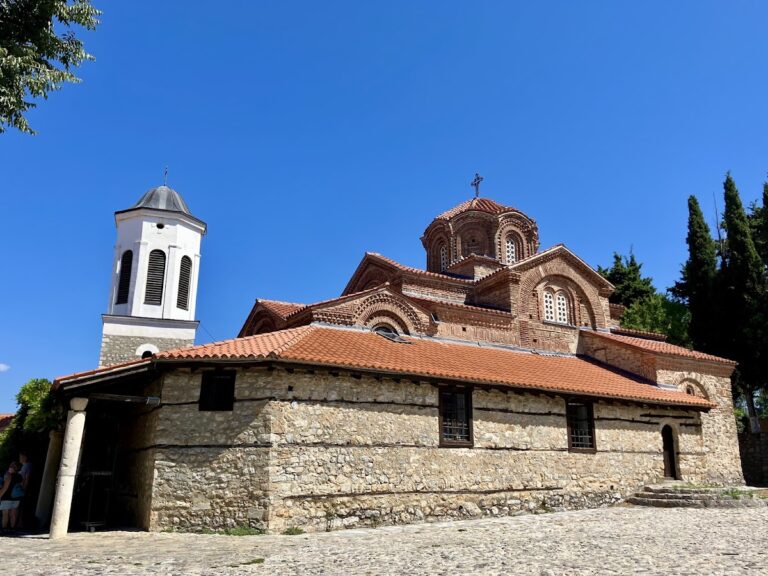
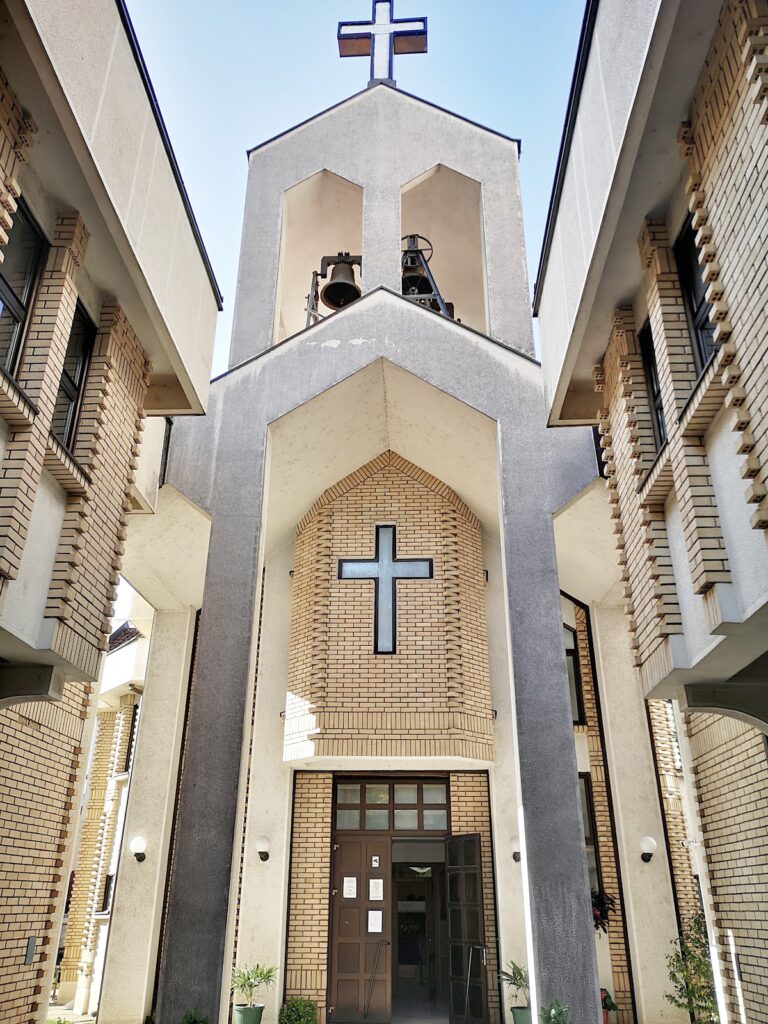
In 1898, St Spas was renovated and enlarged with a porch along its western and southern sides. Another porch was built on those sides in 1989. During the 1990s, the church received a replacement roof, a new narthex, or entrance vestibule, and a bell tower. It is protected as a cultural monument.
Remains
Church Building and Setting
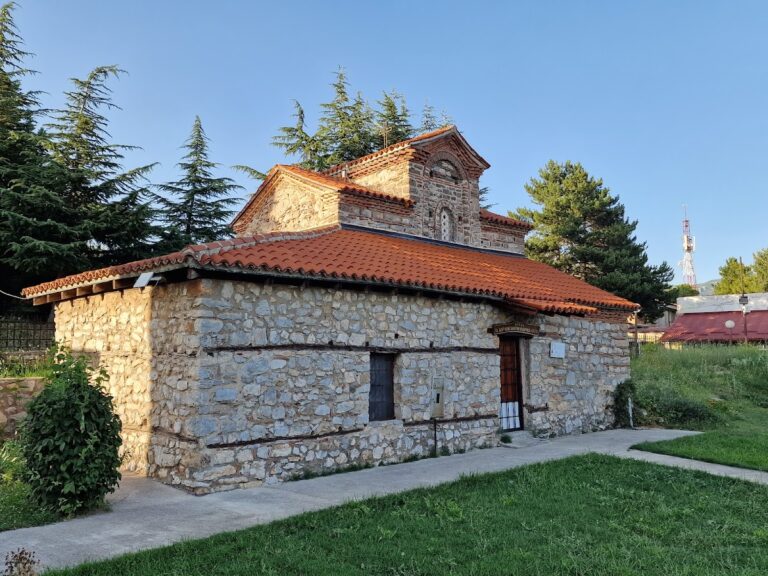
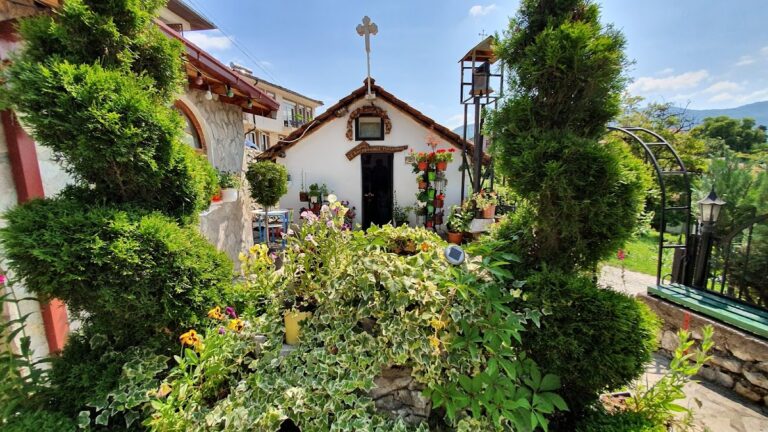
St Spas stands in the old part of Leskoec, surrounded by the village cemetery, which remains in use. The church is a single-nave building with one main worship space, covered by a semi-cylindrical vault formed from a semicircular arch extended along the building’s length. Its sanctuary ends in a three-sided apse. A porch runs along the western and southern sides, while the later narthex, bell tower, and replacement roof form part of the building’s present appearance.
Fresco Painting
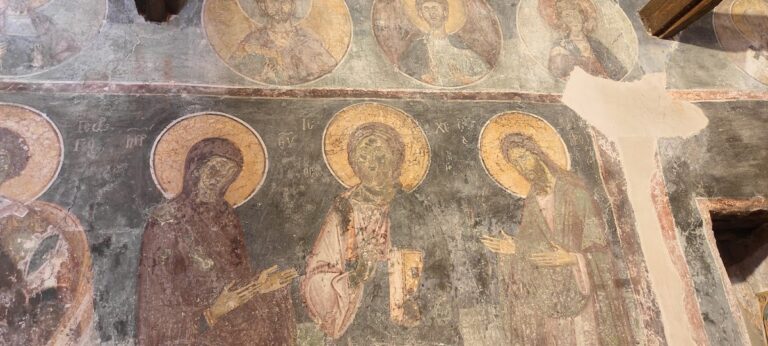
The interior preserves extensive fresco painting. The main compositions include the Last Supper, the Washing of the Feet, the Communion of the Apostles, and scenes from the Passion of Christ. The southern wall carries a full-length image of Saint Clement of Ohrid holding a model of Ohrid. Clement was a medieval Christian missionary and scholar closely associated with the religious and literary culture of the Ohrid region. The church also contains a Great Deesis, an Orthodox devotional composition showing Christ enthroned with the Virgin Mary and Saint John the Baptist in intercession.