St Jude’s Church, Hampstead Garden Suburb: An Anglican Parish Church
Site at a Glance
- Rating
- 4.8
- Popularity
- Medium
- Country
- United Kingdom
- Primary era
- Modern
- Eras represented
- Early Modern, Modern
- Civilizations
- British
- Site type
- Religious
- Remains
- Church
On this page21 sections
History
St Jude’s Church, Hampstead Garden Suburb, is an Anglican parish church in the United Kingdom, established in 1908 for a planned community founded the previous year by social reformer Henrietta Barnett. Also known as the Parish Church of St Jude-on-the-Hill, it belongs to the Church of England. Barnett intended Hampstead Garden Suburb to bring people of different social classes together in an attractive setting and a spirit of social harmony.
Foundation and building
British architect Edwin Lutyens designed the church, combining Queen Anne Revival forms with traditional church planning. Construction began in 1909, and the church was consecrated on 7 May 1911. The west end was completed in 1935. The Lady Chapel, the earliest part of the building, opened for worship in 1910. The apse was completed in 1923, the same year the Harmsworth family gave St John’s Chapel.
Worship and public life
St Jude’s first vicar, Basil Bourchier, became known for dramatic sermons on topical subjects. The novelist Evelyn Waugh, confirmed at the church in 1916, later recalled that Bourchier’s preaching drew devoted listeners from across London.
The writer and Christian thinker C.S. Lewis preached at St Jude’s twice. His sermons were titled “Miracles,” delivered on 27 September 1942, and “The Grand Miracle,” delivered on 15 April 1945.
Art, music, and later history
British painter and illustrator Walter P. Starmer began the Lady Chapel murals in 1920 and completed the paintings in the apse in 1929. A commemoration at the church records the Prince of Wales’s unveiling of murals in 1924.
The church’s Father Willis organ came from St Jude’s Church in Whitechapel, where Canon Samuel Barnett, Henrietta Barnett’s husband, was vicar. Father Willis was the name used by British organ maker Henry Willis. After spending ten years at the west end of St Jude’s, the organ was restored and moved to the chancel in 1934. It was rededicated in October 2002 following extensive rebuilding and renovation, including the installation of a new console.
Charles Proctor was organist and choirmaster from 1943 to 1973. In 1945 he married painter and sculptor Rosemary Rennie, daughter of Father Maxwell Rennie, who served as vicar from 1936 to 1954. The church’s resonant acoustic has also led to occasional recording use. Since 1992, it has hosted the annual Proms at St Jude’s music festival.
St Jude’s is Grade I listed, the highest category for listed buildings in England. In 2022 it was on Historic England’s Heritage at Risk Register, with its condition assessed as poor.
Remains
Exterior and interior layout
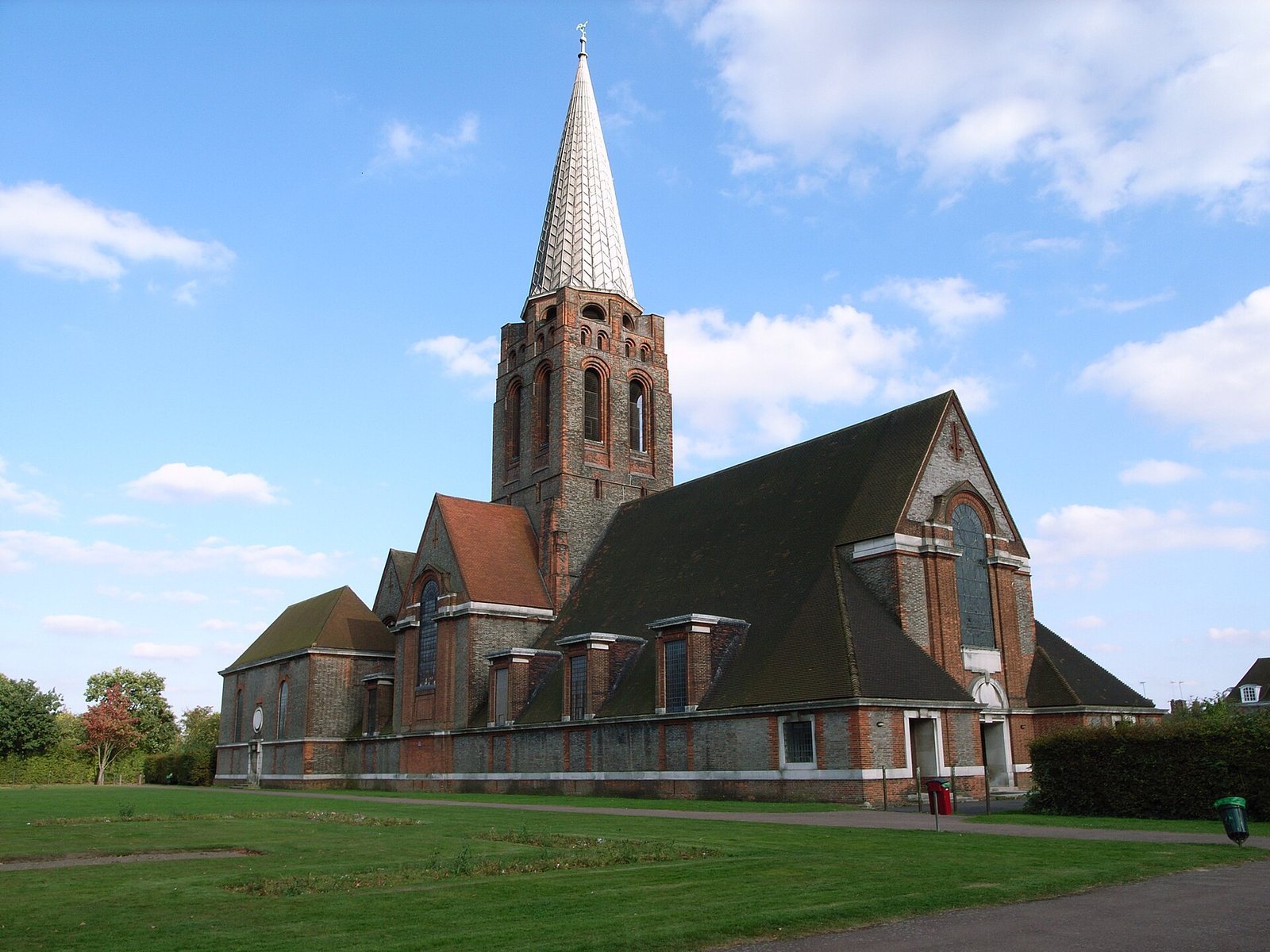
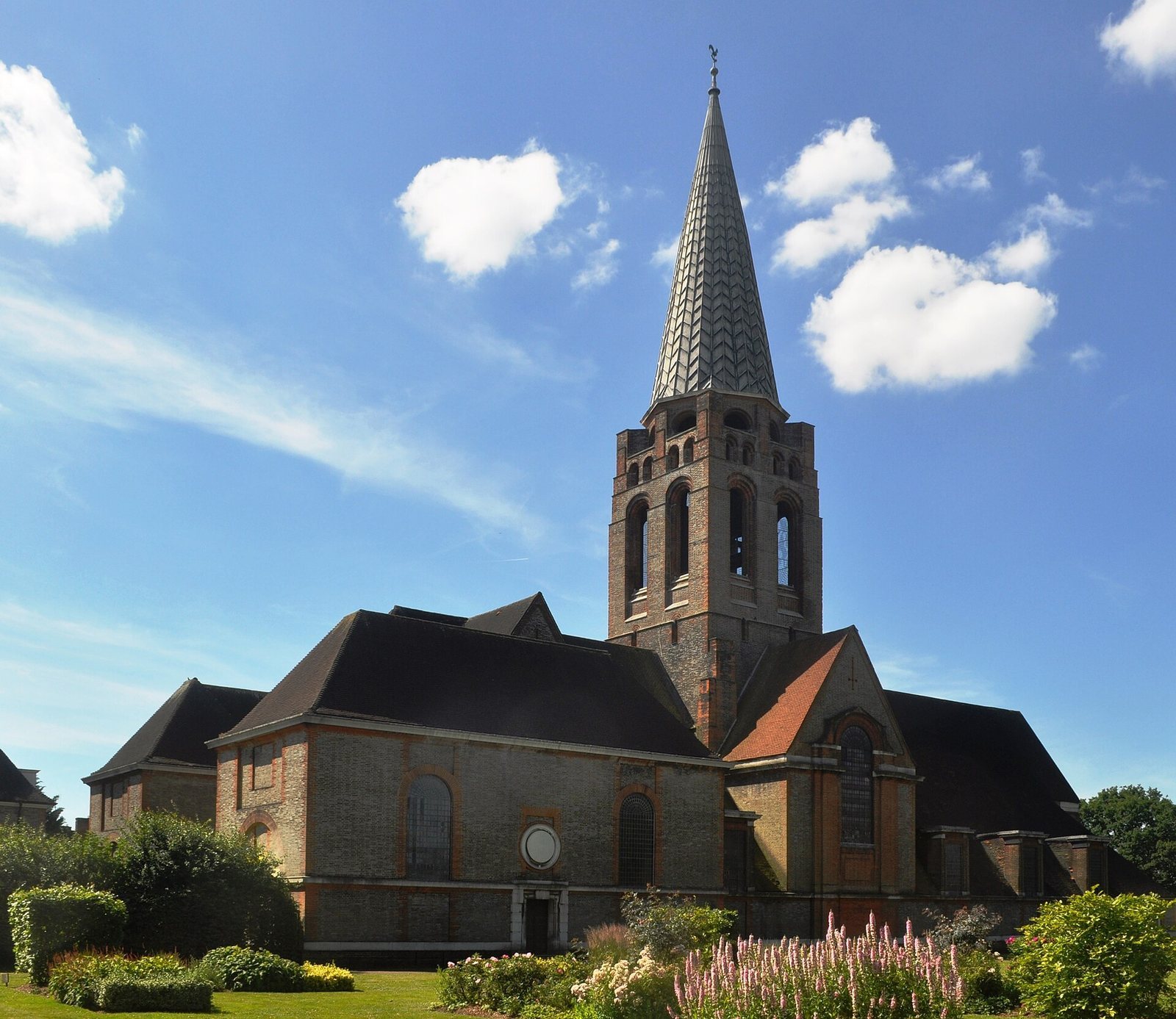
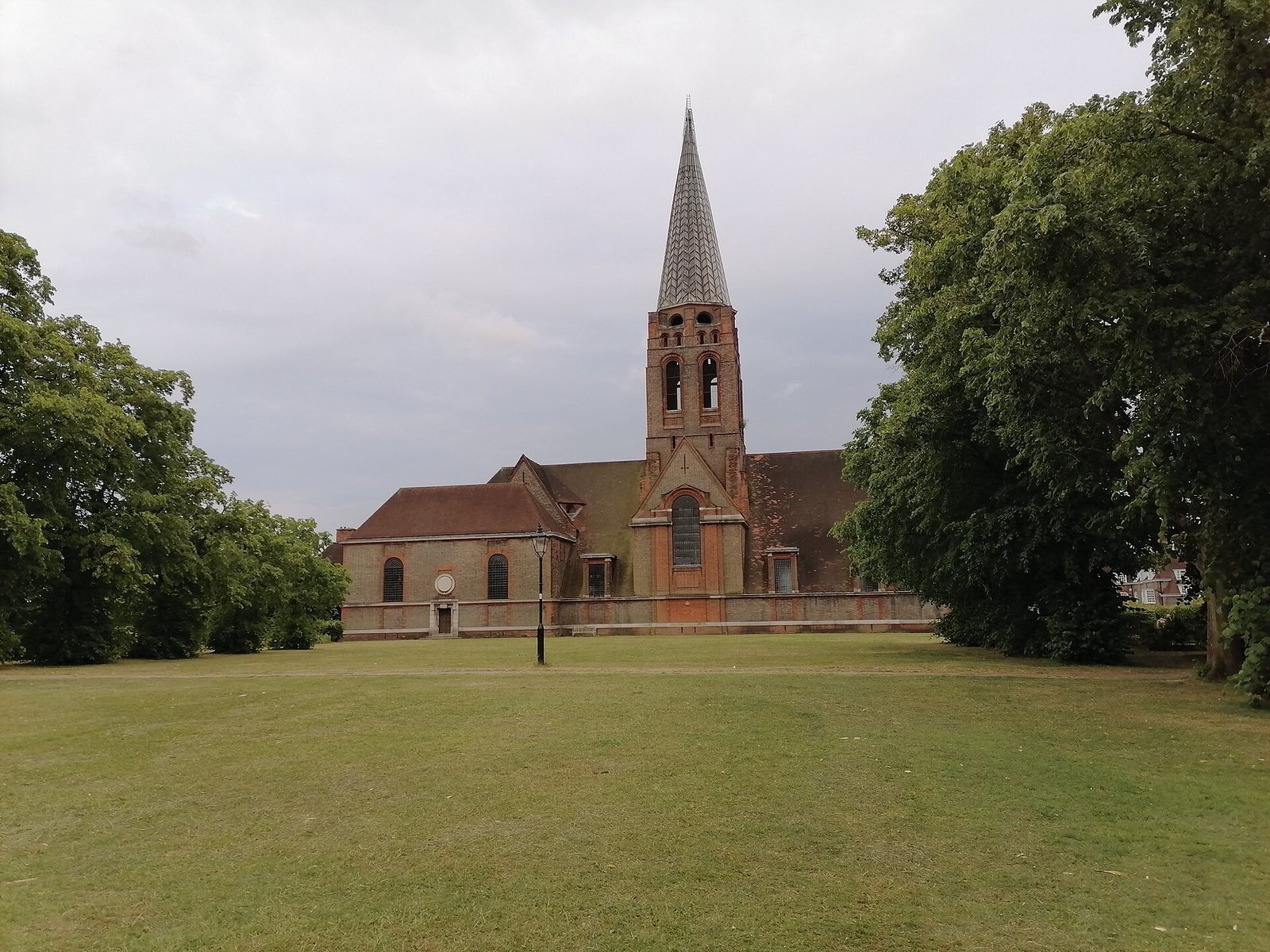
The church measures 200 feet along its exterior, and its spire rises 178 feet above the ground. A central tower stands over the crossing, where the main axes of the church meet, and carries the spire. The building’s design avoids pointed arches and has been described as rejecting Gothic forms. Inside, it has been described as a modern Western interpretation of Byzantine style, drawing on traditions of the Byzantine Empire.
From the west door to the steps of the chancel, the area around the choir and altar, the interior measures 122 feet. The ceiling reaches 40 feet at its highest point. Three barrel vaults, continuous curved ceilings, extend from the west end to the crossing, where a shallow saucer dome rises above them. Beyond it is another vault, followed by a second saucer dome over the sanctuary, the area around the altar. The church ends in an apse, a recessed space at the eastern end.
Paintings, murals, and window
Ceiling and chancel paintings
Painted panels over the central aisle show the wise men and shepherds, Christ feeding a multitude and stilling a storm, and Christ healing blind people and lepers. The dome depicts the Crucifixion. In the chancel, a panel shows Christ entering Jerusalem while carrying the cross.
Murals and devotional scenes
Starmer’s murals on the north side and in the south aisle depict Jesus’s teaching through the parables of the kingdom. His Stations of the Cross, a sequence of scenes recalling Christ’s Passion, begin on the north side and continue into the south aisle.
West window
The west window, dedicated in 1937 and designed by Starmer, depicts St Jude holding a cross in his right hand and an image of the church in his left. Below him is a ship, St Jude’s symbol. Above, Christ appears in glory among the traditional symbols of the four evangelists.
Memorials and commemorative art
West entrance
A brass plaque north of the west door commemorates horses killed in the First World War. Its associated warhorse relief, made by Rosemary Proctor, replaced a bronze horse model by Lutyens’s father; both works were later stolen. Nearby are a memorial to first vicar Basil Bourchier and a south-pillar commemoration of the west end’s completion. Portraits of former vicars are displayed in the north-west porch.
North wall and St George’s altar
Memorials on the north wall honour John Raphael, a sportsman killed in the First World War, and Father Maxwell Rennie. The memorial to Rennie is a bust by his daughter Rosemary Proctor. In the semicircular space above St George’s altar, a painting by Starmer depicts the final moments of Michael Rennie, the vicar’s son. He died of exhaustion after rescuing evacuee children from the SS City of Benares, which was torpedoed on its way to Canada in 1940.
South door and wall
A commemoration above the south door marks the Prince of Wales’s unveiling of the murals in 1924. Above the door is a figure of Christ by Rosemary Proctor, made in memory of her brother. A memorial to Edward VII, king of the United Kingdom from 1901 to 1910, is on the south wall.
Sanctuary and furnishings
Altar and sanctuary fittings
Iron screens flank the sanctuary. They predate the church and bear the name Matthias Heit and the date 1710. The sanctuary floor has a pattern of brick and marble. The high altar incorporates two stones from Canada: a small, dark stone from the former French royal chapel at Annapolis Royal, Nova Scotia, and a larger, lighter one from the altar steps of Montreal Cathedral. The pulpit was also given by Canada.
Organ
The Father Willis organ is now positioned in the chancel. Its restored form includes a new console added during the rebuilding and renovation completed before its rededication in 2002.
Foundation stone and vicarage
On the north side of the chancel, a foundation stone by British artist and sculptor Eric Gill marks the laying of the stone on St Mark’s Day in 1910. The vicarage beside the church was also designed by Lutyens.
Chapels
Lady Chapel
To the left of the chancel, the Lady Chapel has a ceiling painting of heroic women associated with the First World War, women’s suffrage, and other causes. A key to the figures is on the pillar to the right of the entrance, and a memorial above the arch recalls the unveiling of the frescoes, murals painted on wet plaster.
A wooden statue of Our Lady, a title for Mary, reproduces an early-sixteenth-century Mourning Virgin, also known as the Nuremberg Madonna. The original type of statue would have formed part of a Crucifixion scene. Its proportions suggest it was made to be placed high and viewed from below. A modern reproduction of Bernini’s Madonna and Child fills the central panel of the altar. The Eucharist is reserved in a tabernacle, a container for it, behind the altar.
St John’s Chapel
St John’s Chapel lies to the right of the sanctuary, with vestries behind its altar. Its murals draw on the Gospel of John and the Book of Revelation. A memorial window honours Robert Lovel St John Harmsworth (1898–1920), son of Sir Robert Leicester Harmsworth, 1st Baronet. Designed by Robert Anning Bell, the window uses features associated with seventeenth-century English Baroque tomb memorials.
Lutyens designed the chapel’s green-and-white marble altar. Its central panel by Maurice Greiffenhagen shows St John holding a chalice from which a serpent emerges. The image refers to a legend in which John survived poison given to test his faith and restored two men who had already died from it.