St Conan’s Kirk: A Church of Scotland Place of Worship on Loch Awe
Site at a Glance
- Rating
- 4.8
- Popularity
- Very High
- Country
- United Kingdom
- Primary era
- Modern
- Eras represented
- Modern
- Civilizations
- British
- Site type
- Religious
- Remains
- Church
On this page12 sections
History
St Conan’s Kirk is a Church of Scotland church on Loch Awe in Argyll and Bute, United Kingdom. Begun in 1881, its architecture combines ancient Roman and Norman influences with modernist elements. The Campbells of Innis Chonan established it as a chapel of ease, a church serving worshippers who would otherwise travel to a more distant parish church.
Foundation and first design
A popular tradition links the project to Walter Douglas Campbell’s elderly mother, who disliked travelling to Dalmally for worship. The family is said to have responded by building a small chapel on their land. Walter, a self-taught architect, presented a simple rectangular design in 1886 and dedicated the chapel to St Conan, a Christian saint venerated in Scotland. He also designed a nearby family mansion on Innis Chonain in a similar style for himself, his sister Helen, and their mother.
Expansion and completion
Walter later developed a more elaborate design. The kirk was substantially enlarged between 1906 and 1914, and work on the complex plan began in 1907. News of the Sagrada Família in Barcelona, the major church project of Catalan architect Antoni Gaudí, may have influenced his ideas. The project was intended to rely on donations and use local materials and craftspeople.
Walter died in 1914, and work paused during the First World War, a major international conflict. Helen continued his plans. Work was under way by 1927, the year she died, and the building was completed and consecrated in 1930.
Worship and heritage status
St Conan’s remains a place of worship for the local Church of Scotland parish. The Church of Scotland is a Presbyterian church whose congregations are organized through presbyteries rather than dioceses. The kirk was bequeathed to the independent St Conan’s Church Trust. Since 1971 it has held Category A listed status, Scotland’s highest listing category for buildings of special architectural or historic interest.
Remains
Building plan and exterior
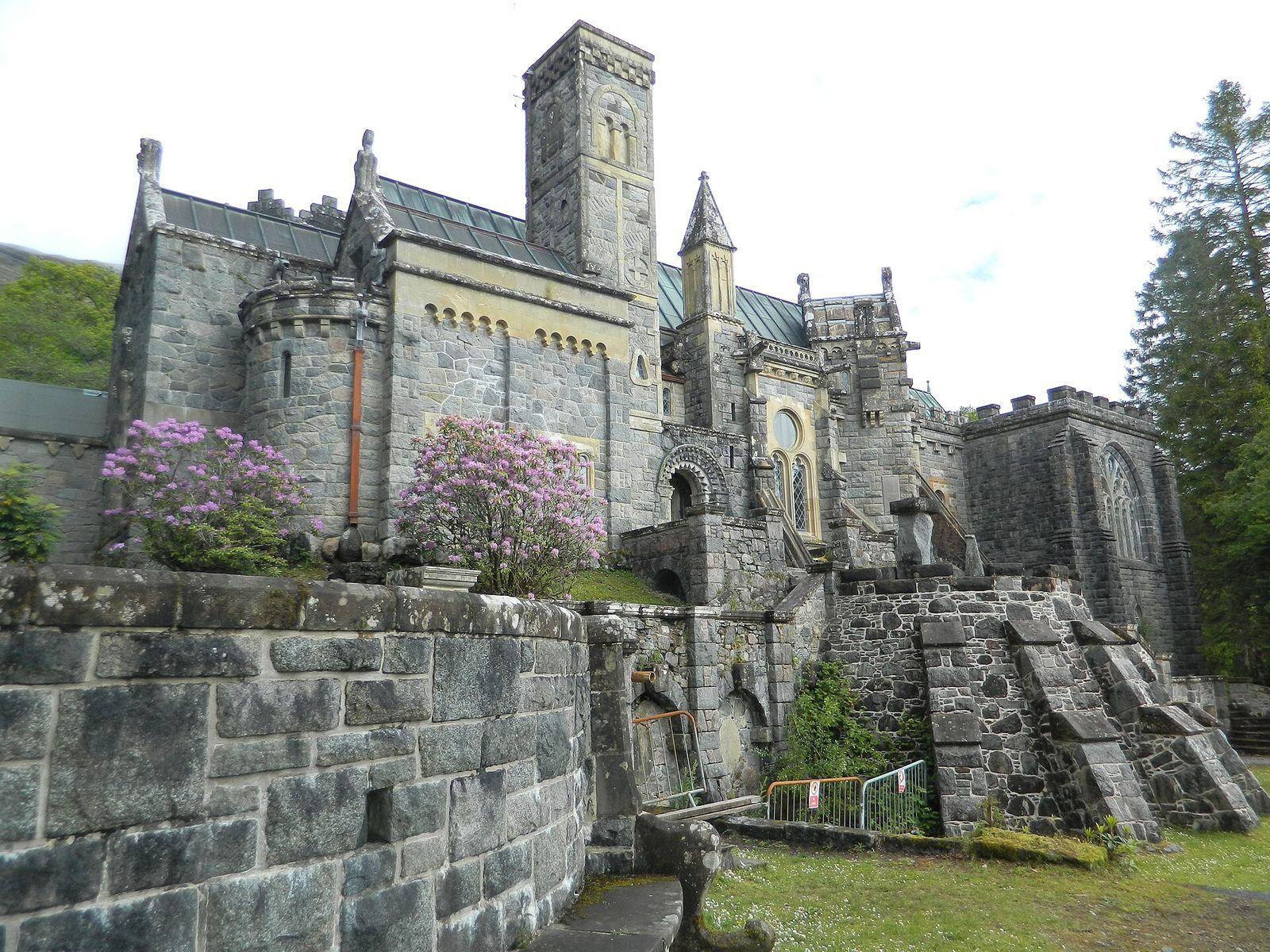
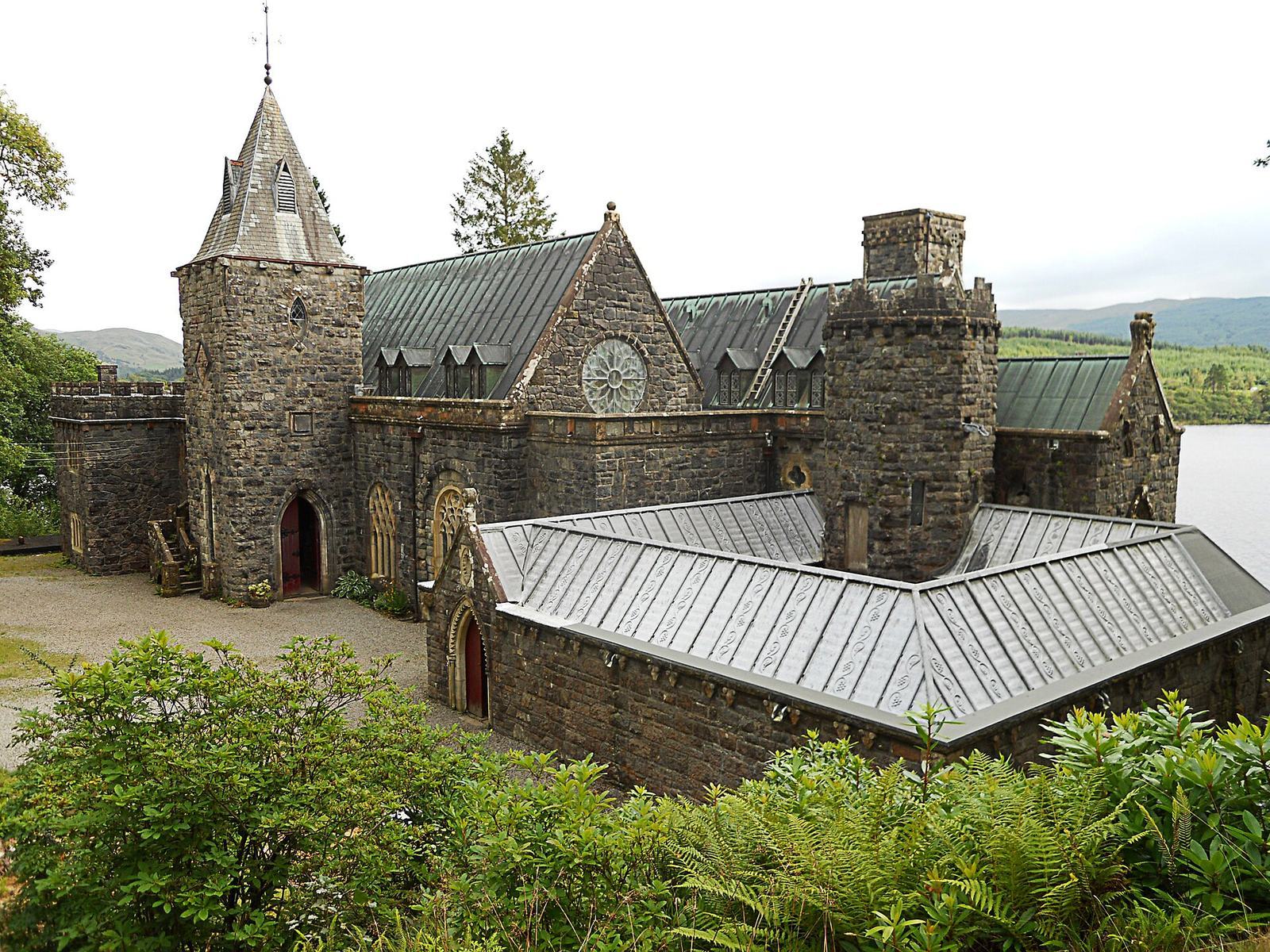
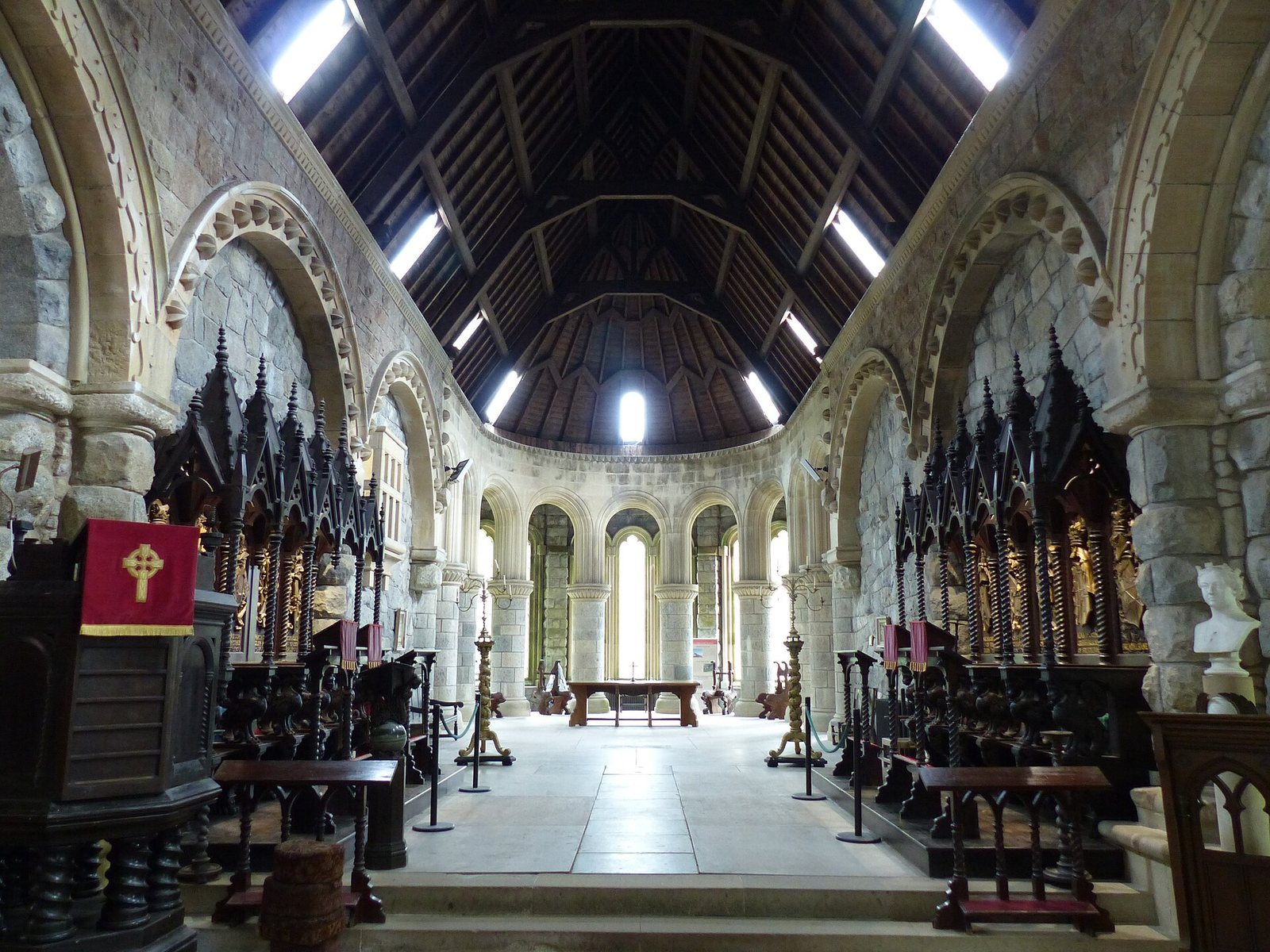
Built of local stone, the kirk is arranged around a nave, the main central area, and a chancel, the part around the altar. Crosswise arms called transepts give the plan the shape of a cross. A tower and spire rise above the building, while large, unsmoothed granite boulders from nearby Ben Cruachan form the supports for the chancel arch. The north façade, which contains the principal entrance, is comparatively plain. The more elaborate south façade faces the shore of Loch Awe. A terrace on this side has a sundial, and a Norman-style doorway opens onto a terrace overlooking the loch.
Chapels and memorials
Bruce Chapel
The Bruce Chapel contains a carved effigy of Robert the Bruce, the medieval king of Scots and a leading figure in the Wars of Scottish Independence. The figure is made of wood and alabaster, with its face and hands in white marble, and a lion lies at its feet. A relic attributed to Bruce is kept in the chapel; the kirk also houses a bone fragment said to have come from him.
St Brides Chapel
St Brides Chapel contains a life-size wooden effigy of Walter Douglas Campbell. Sunlight entering through a window illuminates the figure’s face. Its metalwork gates, like those at St Conval’s Chapel, were made by Thomas Hadden.
St Conval’s Chapel
St Conval’s Chapel is dedicated to the 4th Lord Blythswood, the fourth holder of the hereditary title. Its metalwork gates were made by Thomas Hadden.
Fittings and decoration
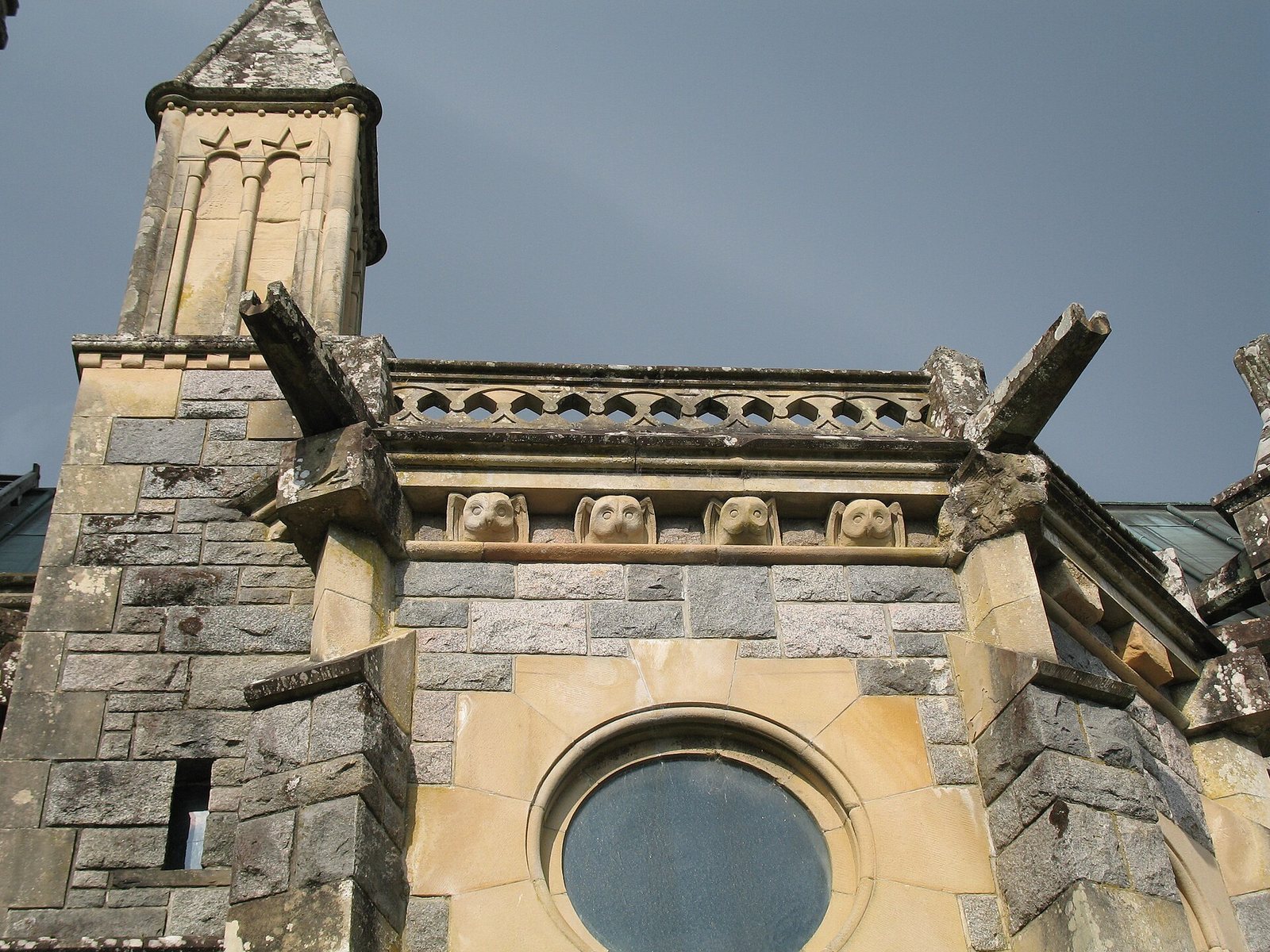
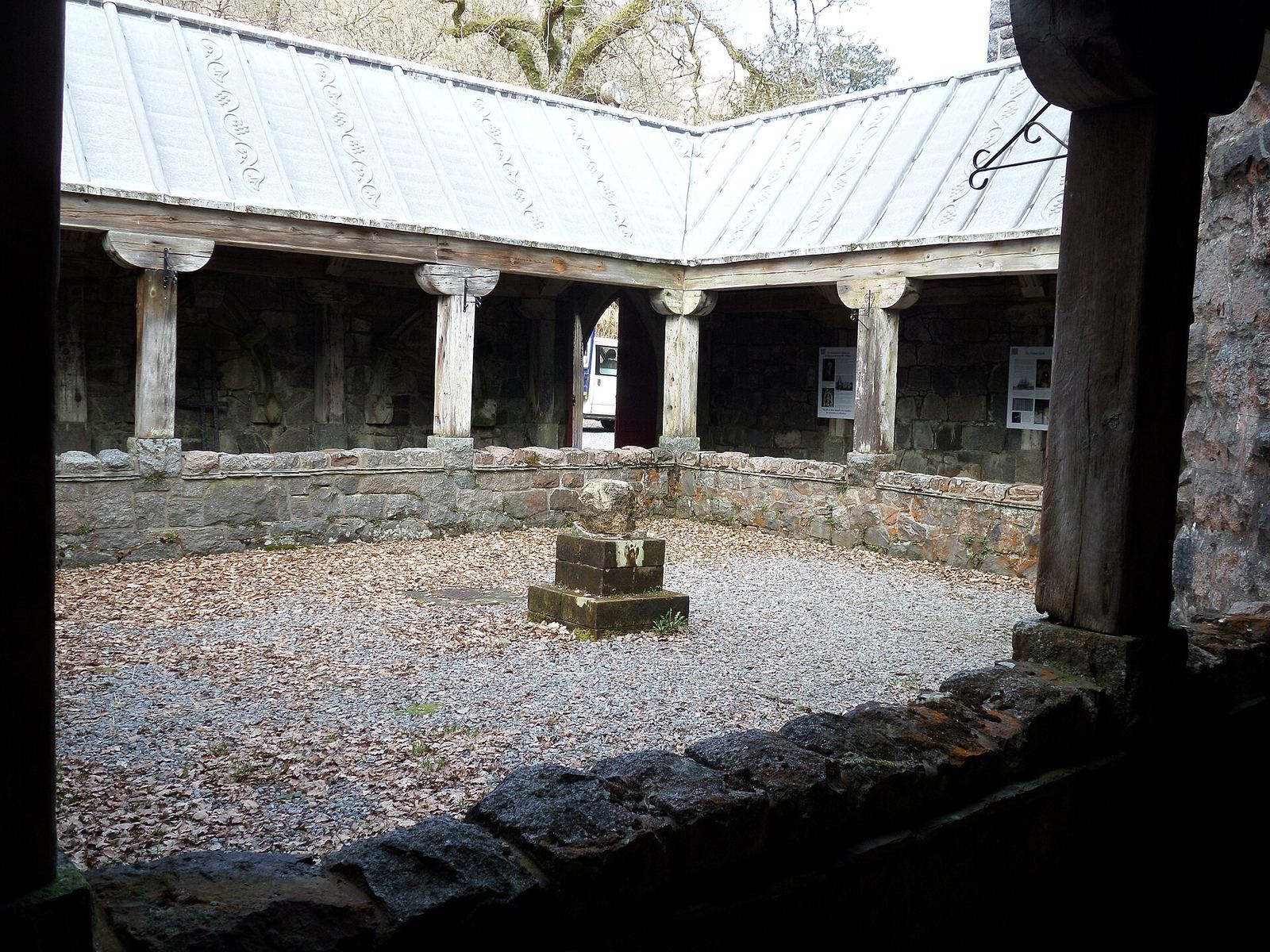
The fittings include a small organ, an older window reused from South Leith, and the window known as the Iona window. The cloister, a covered walkway enclosing an open space, has a roof of embossed lead sheets decorated with grapevine reliefs. Its heavy oak beams are believed to have come from the wooden warships HMS Caledonia and HMS Duke of Wellington; the latter is associated with the date 1852. Other details include carved projections shaped as hunting dogs and rabbits, dolphin-shaped chairs, owl-shaped carved stones, and handmade ironwork with plant forms.
Grounds and commemorative features
A circle of standing stones near the entrance has a form associated with prehistoric settlements in northern Scotland. A Celtic cross erected in 1897 commemorates Walter’s mother, Caroline Agnes Douglas of Blythswood.