Sri Surya Pahar: A Hindu, Buddhist, and Jain Religious Center in Assam
Site at a Glance
- Popularity
- High
- Country
- India
- Primary era
- Medieval
- Eras represented
- Iron Age, Classical, Medieval
- Civilizations
- Unclassified
- Site type
- Religious
- Remains
- Sanctuary
On this page21 sections
History
Sri Surya Pahar is an archaeological and religious site in Assam, India. Its built phases are broadly dated from the 1st to the 12th centuries CE, and its remains are interpreted as evidence of Hindu, Buddhist, and Jain traditions at the same site. It was a major center of religious activity in ancient Kamarupa.
Settlement and religious traditions
A popular tradition says that the sage Vyasa carved 99,999 Shiva lingas, aniconic representations of the Hindu god Shiva, to create a second Kashi. The sacred city now known as Varanasi was said to have held 100,000 lingas. The traditional total is not verified. Archaeological discoveries of houses and lingas point to a prosperous settlement around Sri Surya Pahar centuries ago.
Some scholars have proposed that the site, rather than Guwahati, was Pragjyotishpur, an ancient name associated with Kamarupa’s capital. They connect this possibility with the account of Xuanzang, a Chinese Buddhist monk and traveler of the 7th century, and discoveries at nearby Paglatek. The proposed identification relates to the kingdom of Kumar Bhaskara Varman, a 7th-century ruler whose reign is dated to around 600-650. Given the site’s proximity to the Brahmaputra, it may also have functioned as a trading center or administrative seat.
The site was likely associated with sun worship. The Kalika-Purana, a Hindu religious text dated to around the 10th century, refers to two centers of sun worship in ancient Assam; Sri Surya Pahar has been identified as one of them.
Buddhist and later religious activity
Evidence from excavations indicates that Buddhism flourished around Sri Surya Pahar and across the lower Brahmaputra valley from the early Common Era through the 10th century. The Pala dynasty’s expansion into Assam in the 9th century, and its support for Mahayana and Vajrayana Buddhist traditions, are linked to the wider spread of Buddhism in the valley. Buddhist remains at Pancharatna, Barbhita village, and Bhaitbari, on the lower Brahmaputra’s southern bank, also reflect this regional activity.
Hindu worshippers were active in the area during the 9th and 10th centuries, when some Shiva lingas were carved on fallen boulders within the stupa complex. Jain worship also took place at the site. A water basin at the southern foothills probably served devotees and monks preparing to worship Jain deities in a natural cavern.
Archaeological investigations
The Archaeological Survey of India excavated Sri Surya Pahar during the 1990s and continued work through 2001. Excavations in 1996 and 1997 uncovered a Buddhist stupa and monastery, estimated to date to the 8th-9th centuries. G. C. Chauley and K. K. Muhammed excavated a brick temple in 1999-2000, and Syed Jamal Hasan led work on a panchayatana temple complex in 2000-2001.
Remains
Site layout and settlement
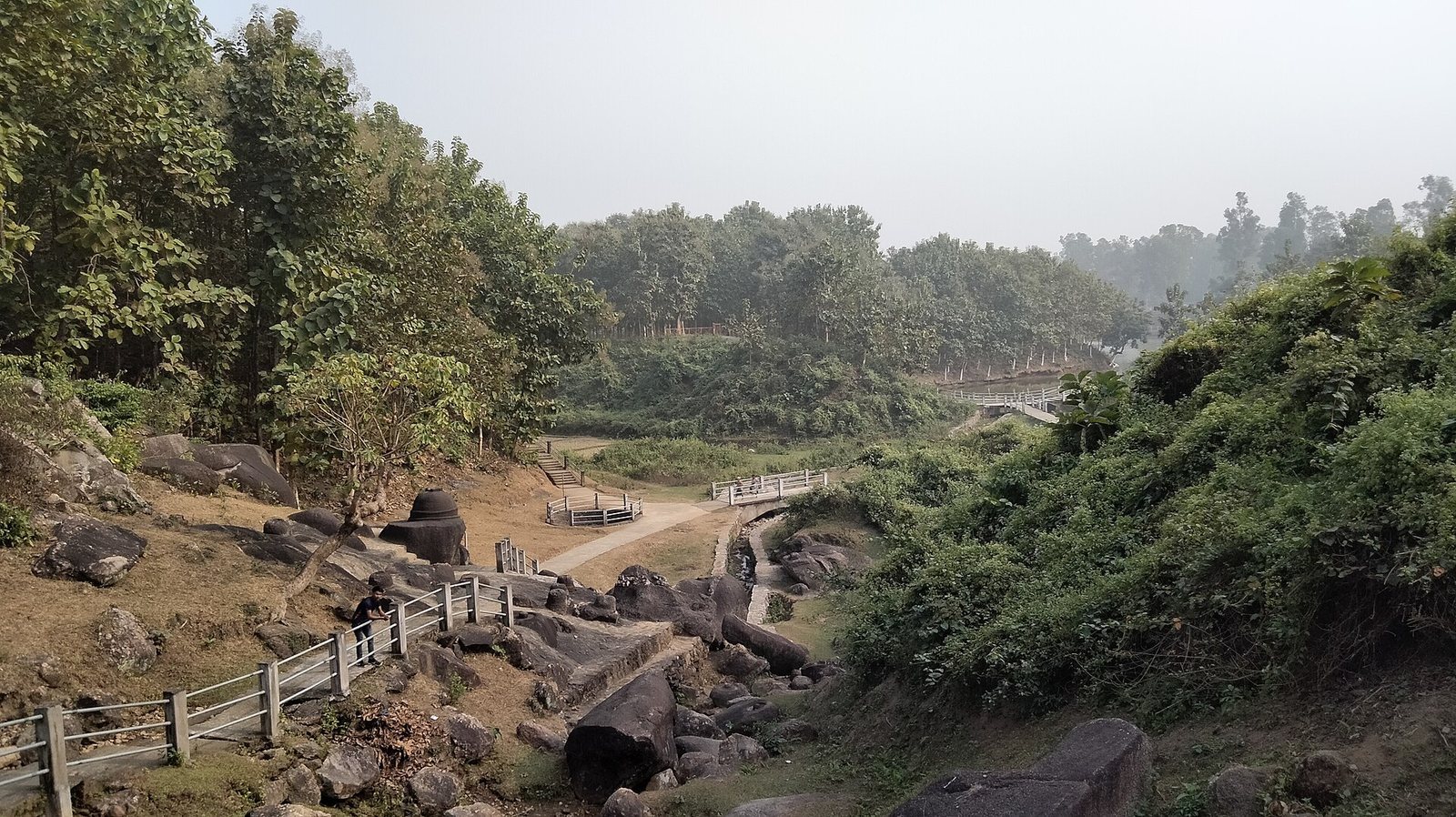
The archaeological site covers about 1,400 acres (570 hectares) of hilly terrain and is centered on seven hills. Its remains extend across roughly one kilometre, and an entrance gateway is identified within the site. Excavated houses have intricate plans and carefully designed bricks. Hundreds of Shiva lingas, ranging from small to large, are scattered around the foothills; their total remains uncertain after centuries of neglect and pilferage.
Temples and water features
Brick temple complex
One excavated temple complex is aligned north to south. Its rectangular brick enclosure measures 26.80 by 17.80 metres and contains a sanctuary and several structures with verandas, built in three phases. The principal temple has a shrine chamber and porch and covers 477.04 square metres. Its date is placed either in the Later Gupta period, a post-imperial Gupta era, or in the early medieval period.
Panchayatana temple complex
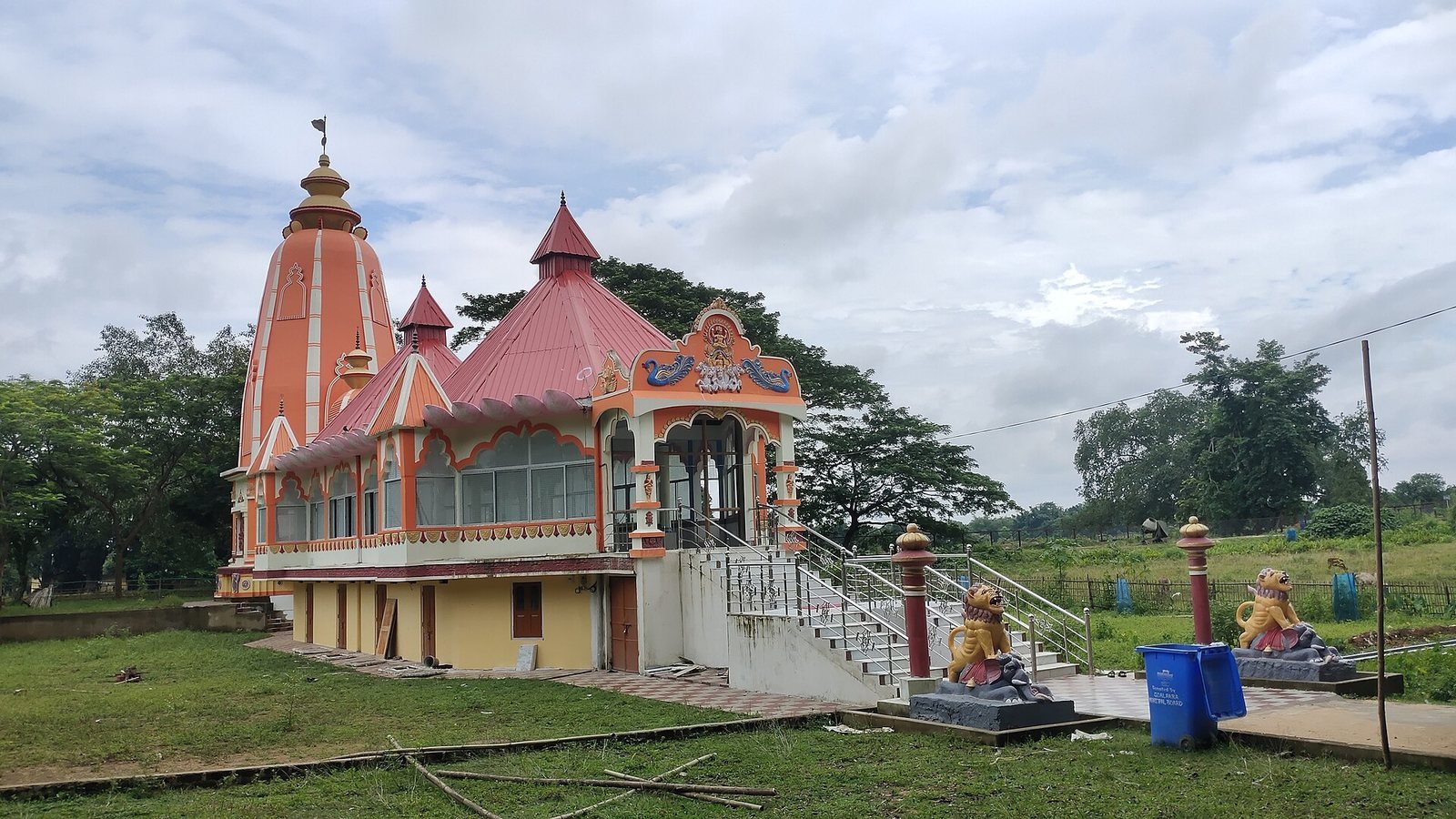
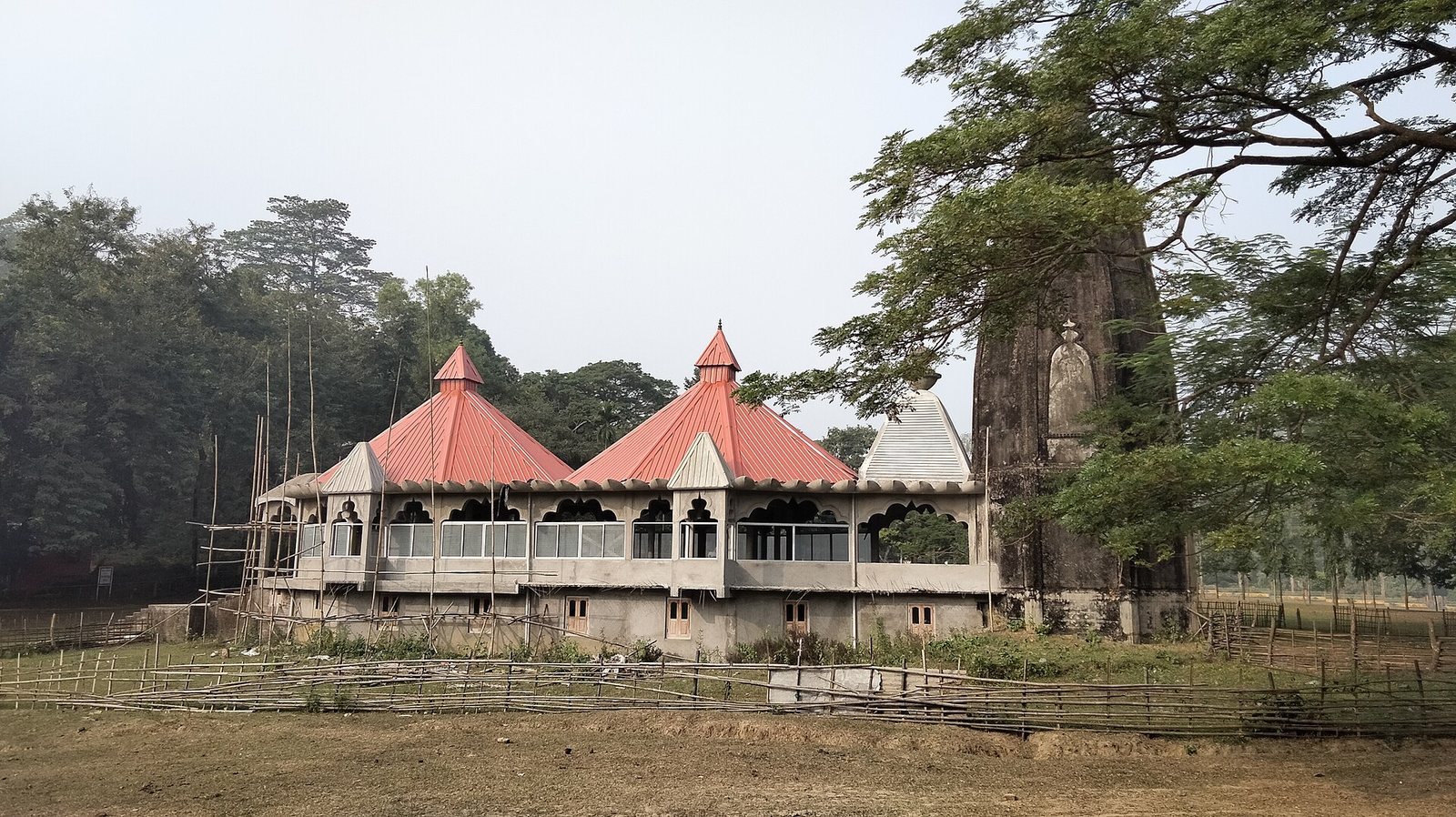
A second brick complex follows the panchayatana plan, with one main shrine and four smaller shrines within a quadrangular wall. The four reported wall-side measurements are 23.45, 41.80, 30.90, and 49.20 metres. The complex is probably dated to the 9th-12th centuries, and its tower follows the Nagara style, a North Indian temple style with a tower above the sanctuary. Images of the twelve Adityas, a group of solar deities, and other Hindu figures were found there. The central temple’s Vishnu image is now in the Assam State Museum in Guwahati.
Water basin and nearby sculptures
A stone-paved basin lies at the southern foothills, where retaining walls help control the natural flow of water. It probably served devotees and monks for bathing and other ablutions before worship at the Jain cavern. Sculptures of Ganesha and Mahishasuramardini, a form of the goddess Durga, were found at a temple complex near an ancient tank.
Buddhist remains
Rock-cut stupas
About 25 votive stupas, Buddhist monuments made as devotional offerings, are carved into granite boulders. They extend from the far northwestern slope to a point about one kilometre to the south. A group of three large stupas faces east on a fallen boulder at higher elevation in the northeastern part of the site. Each has a base, drum, dome, and harmika, the square structure above the dome. Three narrowing rings encircle each base, with the upper ring nearly semicircular and flattened across the top. A central groove in each surviving harmika held a parasol shaft. The forms of the rock-cut stupas have been tentatively dated to the 1st century BC or AD. The three-stupa group may represent the Buddha, his teaching (Dharma), and the monastic community (Sangha), or may be commemorative stupas associated with the Buddha.
Elliptical stupa, monastery, and plaques
A separate elliptical stupa is carved on a smaller boulder between two larger ones. This rare form in eastern India has a parallel at Langudi in Odisha. The excavated Buddhist monastery and stupa are estimated to date to the 8th-9th centuries. Terracotta plaques found at or near the site date to the 8th century and show the Buddha seated in the lotus posture, Avalokiteshvara, a bodhisattva associated with compassion, and a chaitya, a Buddhist shrine or place of worship.
Hindu images and carvings
Carved solar slab
A carved stone slab now housed in the Sri Surya Temple is worshipped as Surya, the Hindu sun deity. It may have broken away from the temple ceiling. Its circular design places a figure identified as Prajapati, a creator deity, within an inner ring. Twelve lotus petals surround the ring, each containing a seated Aditya. The twelve are Dhatri, Mitra, Aryaman, Rudra, Varuna, Surya, Bhaga, Vivasvan, Pushan, Savitr, Tvastr, and Vishnu.
Foothill carvings
Rock carvings of Hindu deities occur at the foothills and nearby. Panels showing Shiva and Vishnu follow the Eastern School of Art and are associated with the early 9th century and the reigns of the Pala rulers Dharmapala and Devapala. A prominent figure standing on a lotus has twelve arms and a seven-hooded canopy, with necklaces, earrings, armlets, and garlands. It is worshipped as Dasabhuja Durga, though its identity is disputed. Some scholars identify it as the snake goddess Manasha; the Archaeological Survey of India considers it a male deity whose appearance was later altered with thick plaster to look female. Other carvings include Ganesha, Harihara, who combines Shiva and Vishnu, and Vishnupadas, or footprints associated with Vishnu. Most are dated to around the 9th century. A carved Chandra Chakra, or moon-wheel motif, is badly eroded by natural processes.
Lingas within the stupa complex
About half a dozen Shiva lingas were carved on fallen boulders within the stupa complex. Their associated stone bases include channel spouts.
Jain carvings
Cavern and hilltop figures
A natural cavern among piled stones on the southern slope contains Jain carvings and inscriptions dated to the 9th century. Two figures are carved shallowly into a large granite boulder. They stand with their hands lowered to their knees, with identifying marks below them. Another 9th-century figure, identified as Adinath, sits on a rocky outcrop at the hilltop, with two bulls marked at its base. Adinath, also called Rishabhanatha, is regarded in Jainism as the first Tirthankara, or spiritual teacher.
Rock-shelter figures and footprints
Standing figures of Rishabhanatha occur in both the first and second rock shelters, while a similar figure of Neminatha, another Tirthankara, was found in the first. The figures are unclothed, and their hand positions differ slightly. Footprints at the site have been tentatively associated with followers of Rishabhanatha.
Site museum
The site museum displays 96 excavated antiquities. Its collection includes stone sculptures of Gajasimha, an elephant-lion figure, Vidyadharas, celestial beings, and Salabhanjikas, women associated with trees. Other objects include a decorated lion head, moulded fish, human-figure plaques, mythical animals, a Kirtimukha or decorative face motif, an Amalaka or ribbed disk-shaped temple element, and tiles with floral and geometric patterns. The collection also holds deity heads with Karanda Mukuta crown forms, stupa remains, terracotta mortar-and-pestle implements, ritual vessels, Apsaras or celestial female figures, and Purnaghata imagery, an auspicious full-pot motif.