South Leith Parish Church: A Historic Parish Church in Edinburgh
Site at a Glance
- Rating
- 4.3
- Popularity
- Medium
- Country
- United Kingdom
- Primary era
- Medieval
- Eras represented
- Medieval, Modern
- Civilizations
- British, Kingdom of Scotland
- Site type
- Religious
- Remains
- Church
On this page13 sections
History
Origins and religious change
South Leith Parish Church is a church in Leith, Edinburgh, United Kingdom, on a site used for worship since 1430. In that year, Scottish landowner Sir Robert Logan of Restalrig built a monastery dedicated to St Anthony. South Leith had belonged to Restalrig parish since the twelfth century and had no church of its own. A Roman Catholic chapel dedicated to St Mary was erected in 1483 and consecrated in 1487. It was also called the Kirk of Our Lady or St Mary’s. At the dedication, King James III gave the church 18 shillings.
The church became a refuge during the Rough Wooing, Henry VIII’s campaign to force the marriage of his son Edward to the infant Mary, Queen of Scots. In 1544, it sheltered people driven from their homes when English forces attacked Leith. The Protestant preacher George Wishart preached there in 1545, and John Knox may have been among those listening. English troops used the church as a makeshift prison for Scottish nobles in 1547.
Mary of Guise worshipped there in 1559. The following year, English troops besieged Leith at the invitation of the Lords of the Congregation, Protestant Scottish leaders. Artillery damaged the church, and its eastern parts were probably destroyed. The Treaty of Edinburgh provided for French and English forces to leave, although the agreement was never formally ratified.
A parish church after the Reformation
During the Scottish Reformation, when worship in Scotland shifted from Roman Catholic practice to Protestant forms, the church became Presbyterian. After the General Assembly, the national governing body of the Church of Scotland, ordered the destruction of Restalrig Church, the damaged church at South Leith became Leith’s parish church. People from Restalrig parish also worshipped there from 1560 until 1839. The church came under the ministry of David Lindsay, who later became Bishop of Ross.
Church appointments prompted disputes in 1571, including objections to noblemen becoming bishops without further qualification and to posts going to people who were not yet legally adults. In 1572, regent the Earl of Mar, acting as ruler while James VI was a minor, called an extraordinary meeting of the General Assembly at the church. The meeting’s decisions were not fully put into effect during the king’s minority. On 1 May 1590, James VI and his queen, Anne of Denmark, arrived at the Port of Leith. After Anne stayed at the King’s Wark, James went alone to hear Patrick Galloway preach at the parish church.
An Act of Parliament confirmed the church as South Leith’s parish church in 1609, and parish records survive from May 1597. Its roughly triangular parish covered about 2,200 acres (8.9 square kilometres). The Firth of Forth marked its northeastern boundary; to the west it adjoined the historic parishes of North Leith, Edinburgh and St Cuthbert’s, while Duddingston and Canongate lay to the south. As the surrounding population grew and boundaries changed, new parishes formed within the original area.
Plague, occupation and denominational change
During the plague of 1645, which killed more than 2,700 people, about half the population, the church helped organize sanitary measures and aid for those affected. Parliamentarian forces used the building as an ammunition magazine from 1650 to 1657, so services had to be held wherever space could be found. From 1687 to 1692, the congregation expelled Episcopalians, members of a church tradition governed by bishops, affirming its Presbyterian identity.
Reconstruction and recent history
The 1843 Disruption, a major split within the Church of Scotland, cost the congregation members. It later recovered, and architect Thomas Hamilton led reconstruction and restoration work in 1847–48. The rebuilding was criticized for replacing substantial parts of the church’s fabric. In 1925, one criticism argued that delaying the work might have allowed a more historically informed approach. The church was recorded as a Category A listed building in 1970.
In 1820, a new manse, or minister’s house, was built at Hermitage Place facing Leith Links; the building is now used as a hotel. The present manse is on Claremont Road. The 1915 Quintinshill rail disaster killed more than 200 soldiers and seriously injured a similar number from the 1st/7th Battalion of the Royal Scots. Most had been recruited in Leith, with others from nearby Musselburgh and Portobello. The battalion’s Colours are kept at the church in memory of the losses; the soldiers are buried at Rosebank Cemetery in Pilrig.
In 2024, North Leith Parish Church joined with South Leith Parish Church to form North & South Leith Parish Church, which uses the historic South Leith building. The congregation belongs to the Church of Scotland, a Presbyterian church, and the Presbytery of Edinburgh, a regional church court.
Remains
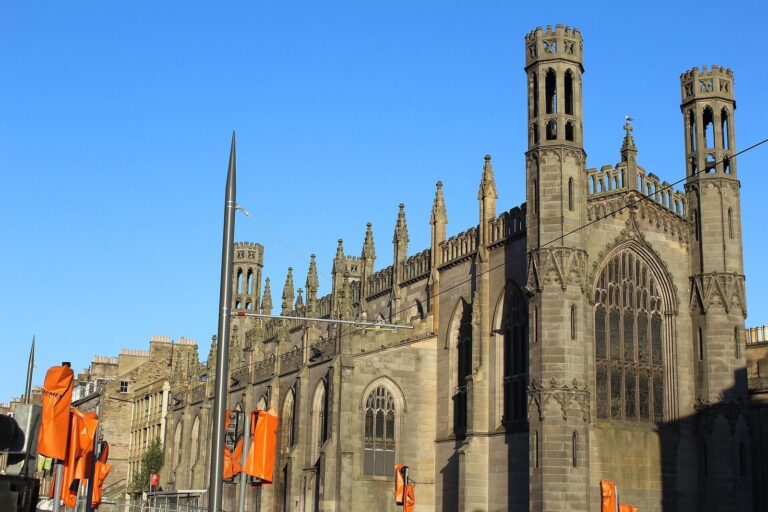
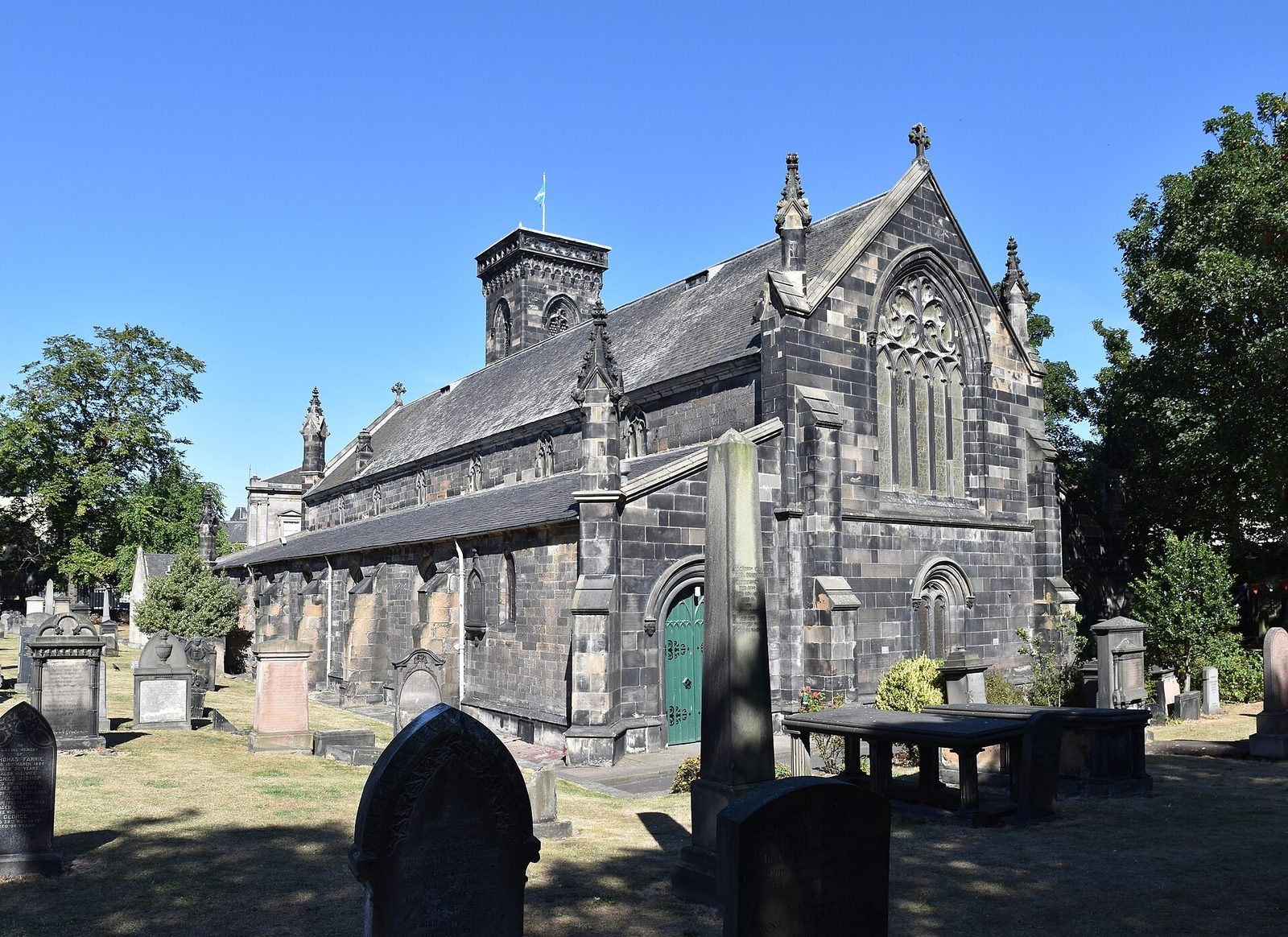
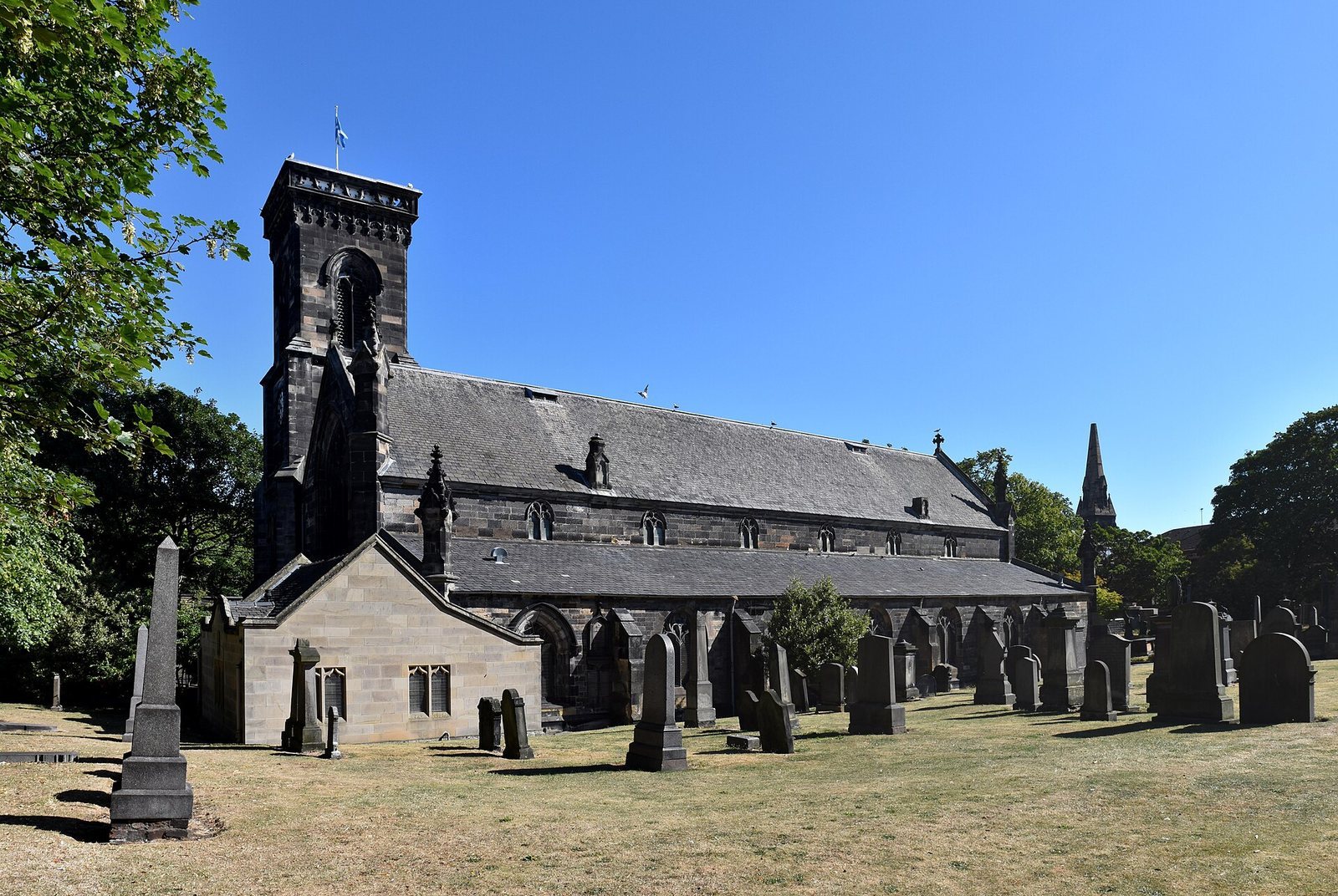
The stone church stands between Constitution Street and Kirkgate, near the foot of Leith Walk, and has a stated capacity of about 1,400. Its original plan included a nave, the main worship space, a chancel at the east end, a central crossing and transepts projecting from the crossing. The rebuilt church retains the basic layout of its old nave.
Church building
Plan and surviving fabric
The reconstruction preserved the nave arcade, the row of arches within the church, and the lower sections of the aisle walls. A seal on a 1608 charter granted to James Hall depicts a church in a form described as resembling the building today. Mary of Guise’s coat of arms appears at the entrance.
Tower and reconstruction
A central steeple was added in 1615. Later, cracks developed at the west end as newer walls sank around the original west wall, and the tower leaned. The steeple, also described as the west tower and spire, was removed in 1836. Hamilton’s 1847–48 work added a new square tower at the northwest corner of the church.
Roof, windows and interior memorials
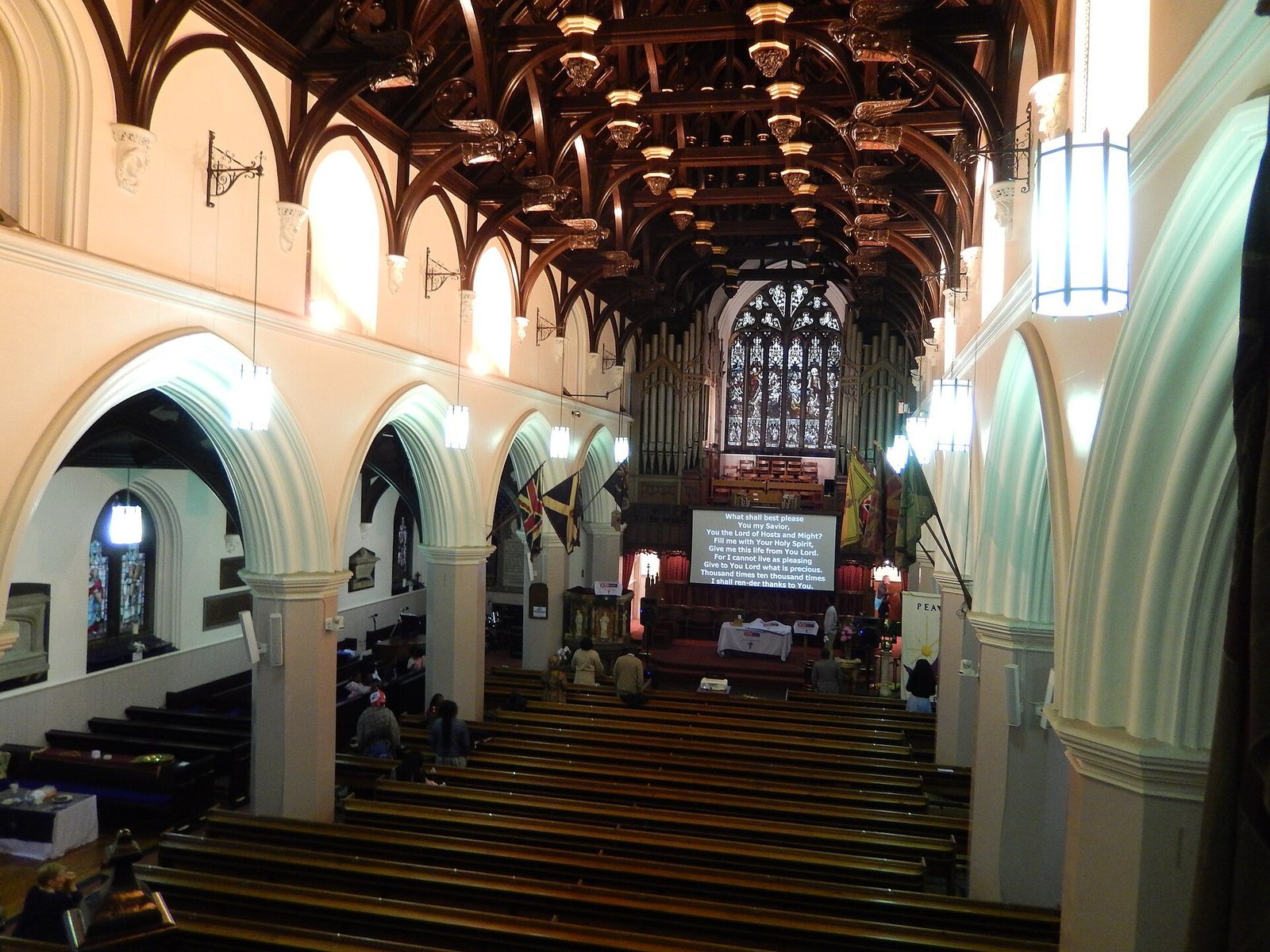
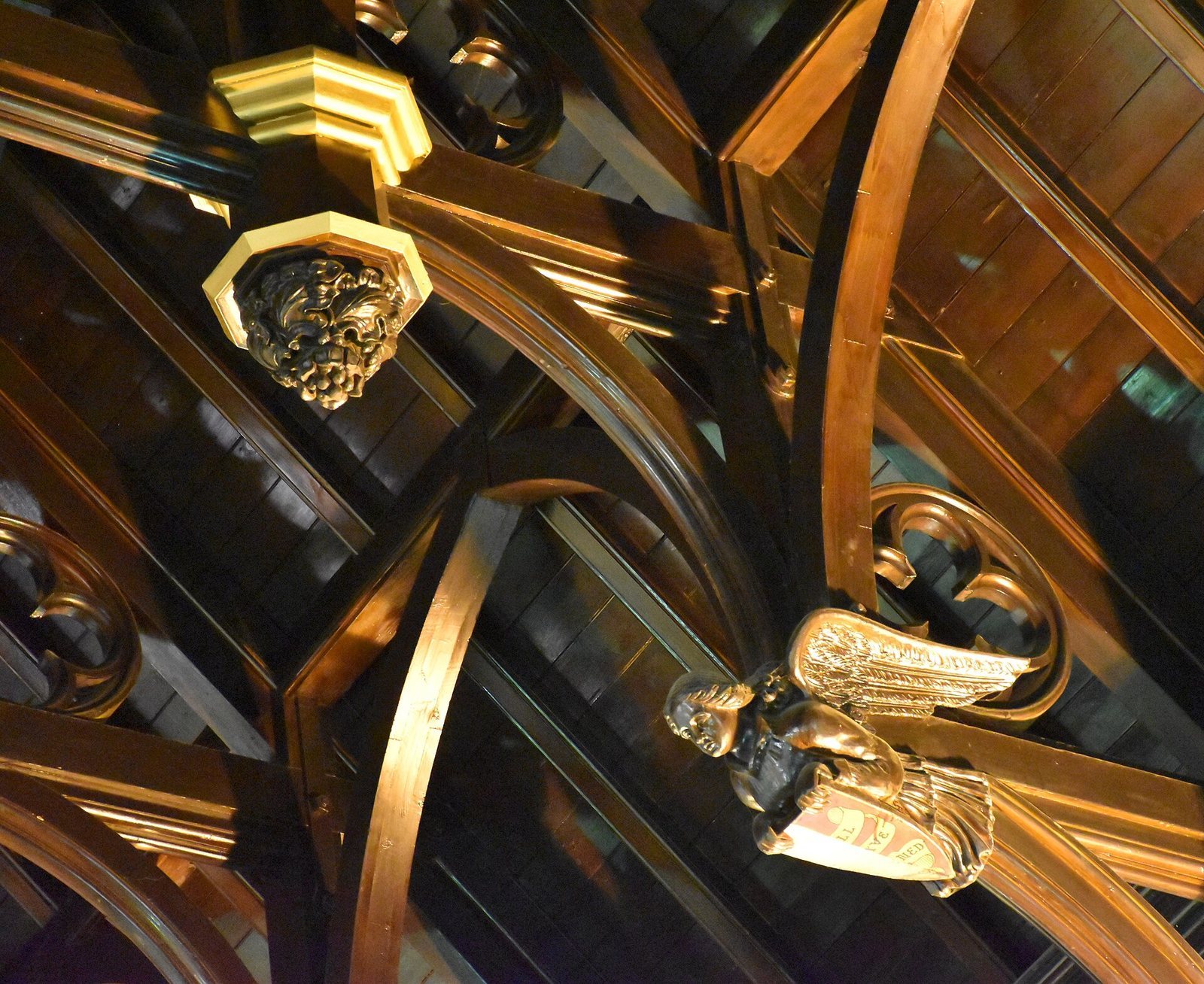
The aisle roofs were lowered during the reconstruction, exposing high clerestory windows that had been concealed for more than two centuries. These square-headed windows were later replaced by Gothic windows with patterned stonework. The east window dates from 1847–48. The nave has a hammerbeam roof, shaped and supported by projecting beams, said to be based on the roof of St Isaac’s in St Petersburg. The former west window was salvaged and reused at St Conan’s Kirk.
Inside the church are memorials to Very Rev Dr James Mitchell, Very Rev Dr John White, Sir Malcolm Smith, shipowner William Lindsay and James Reoch, Provost of Leith. James Pittendrigh Macgillivray made Reoch’s monument. Robert Forbes, an eighteenth-century Scottish Episcopal bishop and historian, is buried beneath the church floor. The Colours of the 1st/7th Battalion of the Royal Scots are kept here in memory of the soldiers killed and injured in the 1915 rail disaster.
Kirkyard
Burials and commemorated people
The kirkyard is the burial place of John Home, the Scottish playwright who wrote Douglas, and John Pew, a maltman reputed to have fathered 25 children. A tradition links Pew to Blind Pew in Robert Louis Stevenson’s Treasure Island. Stevenson, whose family was associated with the church, may have seen Pew’s grave during a visit. Other people buried in the kirkyard include Adam White, Leith’s first provost; historian Hugo Arnot; and John Hadaway, a lieutenant aboard the Bellerophon at the Battle of the Nile. Poet and songwriter Robert Gilfillan is buried just southeast of the church.
Family memorial structures
Structures in the kirkyard once housed family memorials. They appear to have been roofed and divided by walls, with a separate gate for each family’s memorial.