Søndersø Church: A Medieval Church in Denmark
Site at a Glance
- Popularity
- Very Low
- Country
- Denmark
- Primary era
- Medieval
- Eras represented
- Medieval, Early Modern, Modern
- Civilizations
- Danish
- Site type
- Religious
- Remains
- Church
On this page17 sections
History
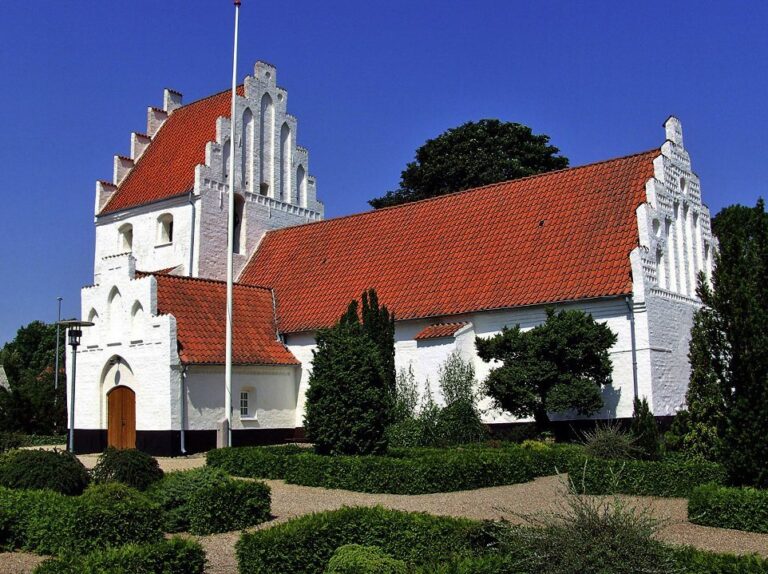
Søndersø Church is a medieval church in western Søndersø, Denmark, with a Romanesque, or medieval, core dating to around 1200. Its growth over the following centuries added chapels and changed the church’s plan and interior.
Medieval foundation and expansion
In the Middle Ages, the church was dedicated to Saints Peter and Paul. Its north chapel was originally dedicated to Mary. A south chapel was added around 1400, and the church was enlarged with large medieval bricks during the fifteenth century. Around 1500, the altar end was extended eastward and a north chapel added. Arched ceilings were installed during the early-sixteenth-century expansion.
Devotion and wall paintings
The north-chapel paintings date to 1500–1520 and are attributed to the Brarup Master, a conventional name for an unidentified medieval painter. Eigil Rothe uncovered and restored them in 1899; Egmont Otto Lind restored them again in 1933. The church’s Mass of Saint Gregory and Apocalyptic Madonna imagery is associated with medieval devotion to indulgences. In Catholic teaching, an indulgence concerns the remission of temporal punishment associated with sin. Alanus de Rupe (1428–1475), a Dominican friar and founder of the Rosary confraternity, a lay religious association, believed that three Rosaries, a form of devotional prayer, said before a Mass of Saint Gregory image connected with a Rosary altar could bring 60,000 years of indulgence. Images associated with indulgence practices were destroyed after the Reformation, the movement that ended Roman Catholic authority in Denmark and established Lutheran church structures.
Queen Christine has been proposed as a possible patron of the paintings. She often stayed at the royal manor in Næsbyhoved Forest and commissioned altarpieces at Bregninge and St Canute’s Church, both dated around 1520; a crucifix at Skamby was also thought to be her commission. The figures in the Søndersø paintings, however, do not resemble those on the two altarpieces. The frontal depiction of Melchior has also prompted the tentative suggestion that Melchior and Balthazar represent a donor and his son.
Later changes and parish
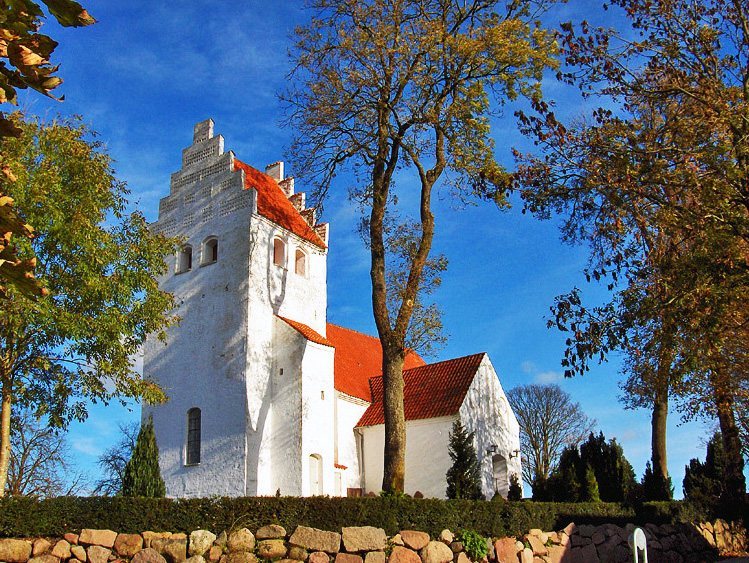
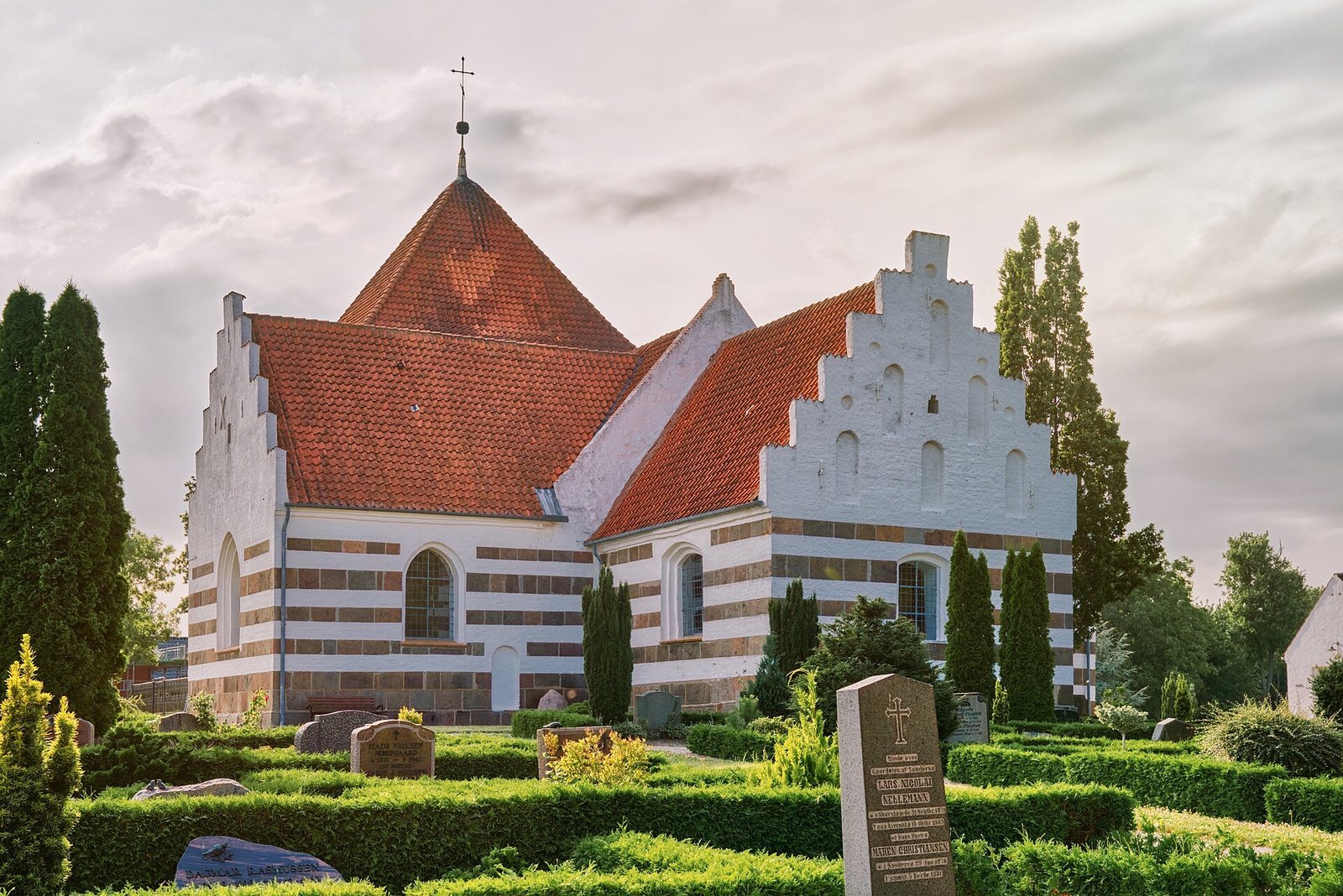
The tower was built in the late Middle Ages, probably after the Reformation. In 1753, its original north–south gables were replaced with a pyramidal spire. Søndersø Church belongs to Søndersø Parish, the Søndersø–Skamby Pastorate, Bogense Deanery and the Diocese of Funen.
Remains
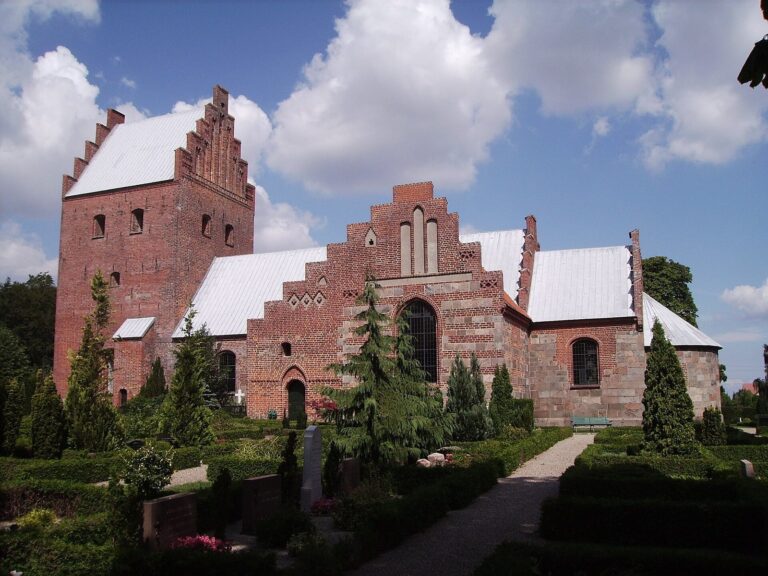
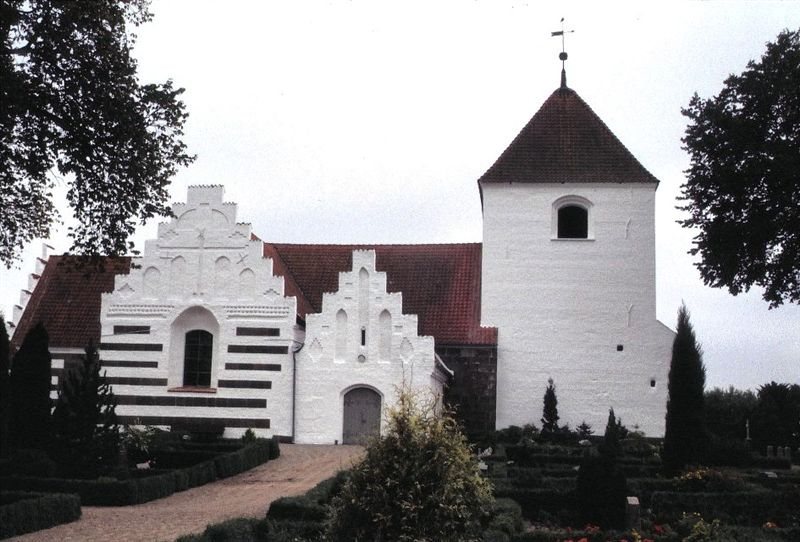
The church has a cross-shaped plan, with north and south chapels extending from its main body. Its Romanesque core is built of regular-cut granite blocks on a two-tier base. Later additions reuse stone from demolished openings, and the wall at the altar end combines bands of stonework with whitewashed brick.
Church fabric and plan
Nave and chancel
The nave, the church’s main interior space, and the chancel, the area at the altar end, form the central body of the building. A Romanesque window with a lintel made from a single stone survives in the chancel’s north wall.
Chapels, entrances and tower
The south chapel opens into the nave through a rounded arch. A porch, probably built at the same time as the north chapel, contains a door leaf dated 1483. It bears an extended inscription in lowercase script formed from imitation letters, along with the arms of Cecilia Bernikesdatter Skinkel. The south doorway is blocked, while the square-headed north doorway remains in use. The tower carries a pyramidal spire.
North-chapel paintings
North vault
The Annunciation, Gabriel’s announcement to Mary that she will bear Jesus, is presented as Gabriel’s hunt. Gabriel blows a horn and appears with his dogs; the associated unicorn story says the animal can be captured only when it meets a virgin, rests its head in her lap and submits. God the Father appears above, and the dove of the Holy Spirit descends toward Mary.
North wall
The western scene shows Pope Gregory’s vision, known as the Mass of Saint Gregory. During a mass, Christ on the crucifix begins to bleed, and the blood flows into the chalice. Two altar boys kneel with Gregory, while cardinals and bishops flank the scene. To the east, Mary is crowned while enthroned between Christ and God, who holds the crown above her.
East wall and vault
On the north part of the east wall, Mary stands on a crescent moon, holding the child and surrounded by a sunburst, a Rosary and symbols of the four Evangelists, the writers of the Gospels. This Apocalyptic Madonna draws on imagery associated with the Book of Revelation. A Visitation scene in the eastern vault was uncovered and later whitewashed again.
South vault
The Nativity fills this vault with a detailed landscape. Its distant city is rendered as a realistic townscape of around 1500, including a church with two towers. The child lies at the center in a halo of rays, recalling a vision of Saint Bridget, a fourteenth-century mystic. A donkey and an ox stand beside the manger, while Joseph is awake and active. Small ships below him may represent the Magi, the biblical visitors bringing gifts to Jesus, arriving by sea. The landscape has been compared with Dutch realism.
West vault
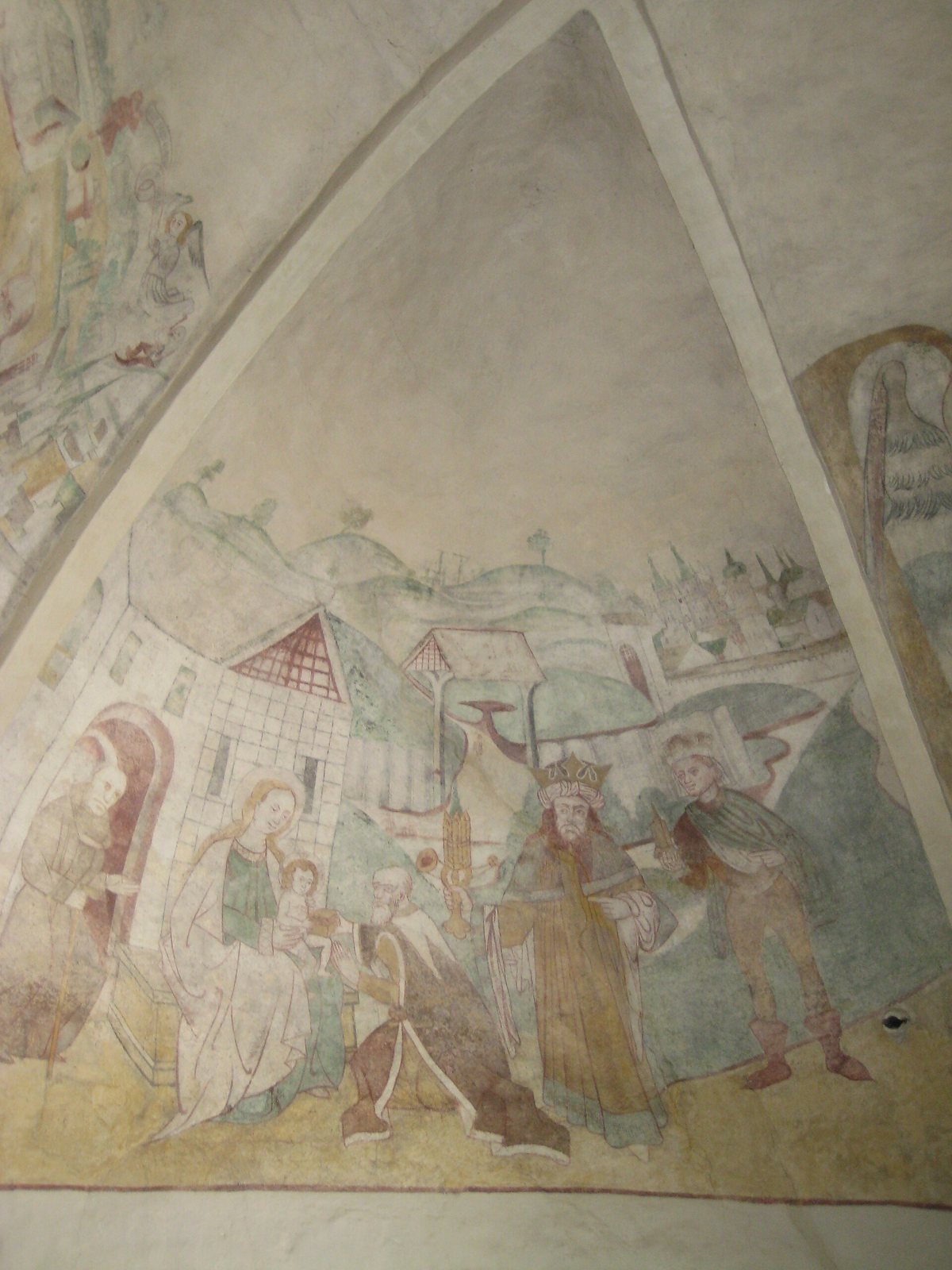
The Adoration of the Magi shows Joseph active rather than asleep. The background city represents Jerusalem, with a hill of Golgotha, associated with the Crucifixion, and gallows-like forms that may refer to the raising of the crosses. Its architecture has a more German than Danish character. Caspar kneels before Mary and the child; Melchior and Balthazar stand behind him with gifts, and Melchior points toward the child rather than the star. The composition has been compared with large Netherlandish depictions of the Adoration.
Furnishings and memorials
Altars and pulpit
Stefan Viggo Pedersen painted the altar painting in 1949, the same year Hans Georg Skovgaard made the altar-table paneling and altarpiece frame. The south chapel contains a former altarpiece painting from the eighteenth century. The late-Renaissance pulpit dates to around 1635 and bears the arms of Eiler Høeg and Else Krabbe. Some pew ends date to around 1575 and display the arms of Viffert and Bryske.
Font and grave slabs
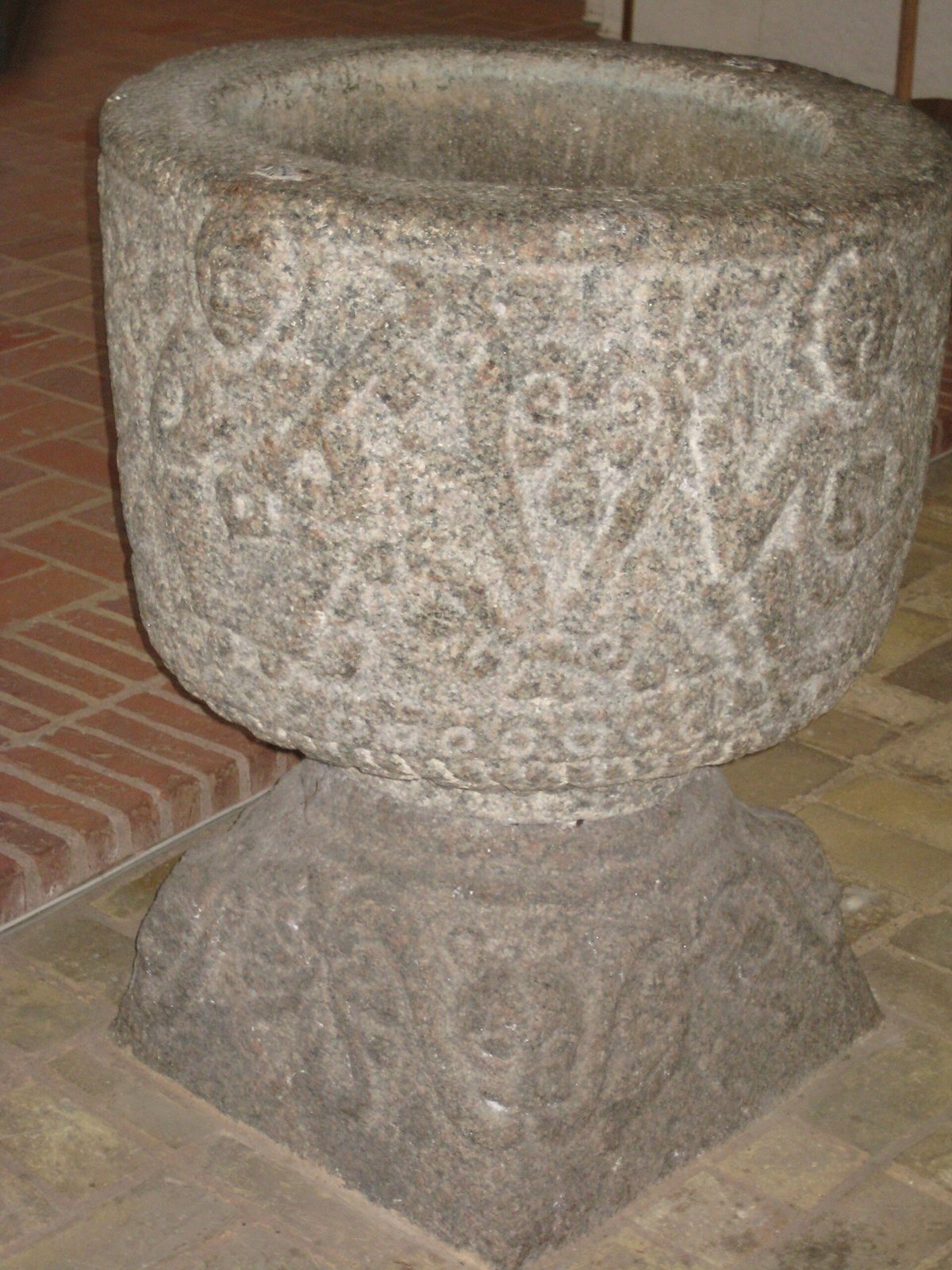
The Romanesque granite font has Christ in Majesty, an image of Christ as ruler, alongside Peter and Paul and two lions carved on its basin. Devil-like heads decorate the corners of its square base. Figural grave slabs in the chancel bear armorial bearings for Gert Bryske, who died in 1552, Elisabeth Bryske, who died in 1582, and Anne Viffert, who died in 1586.